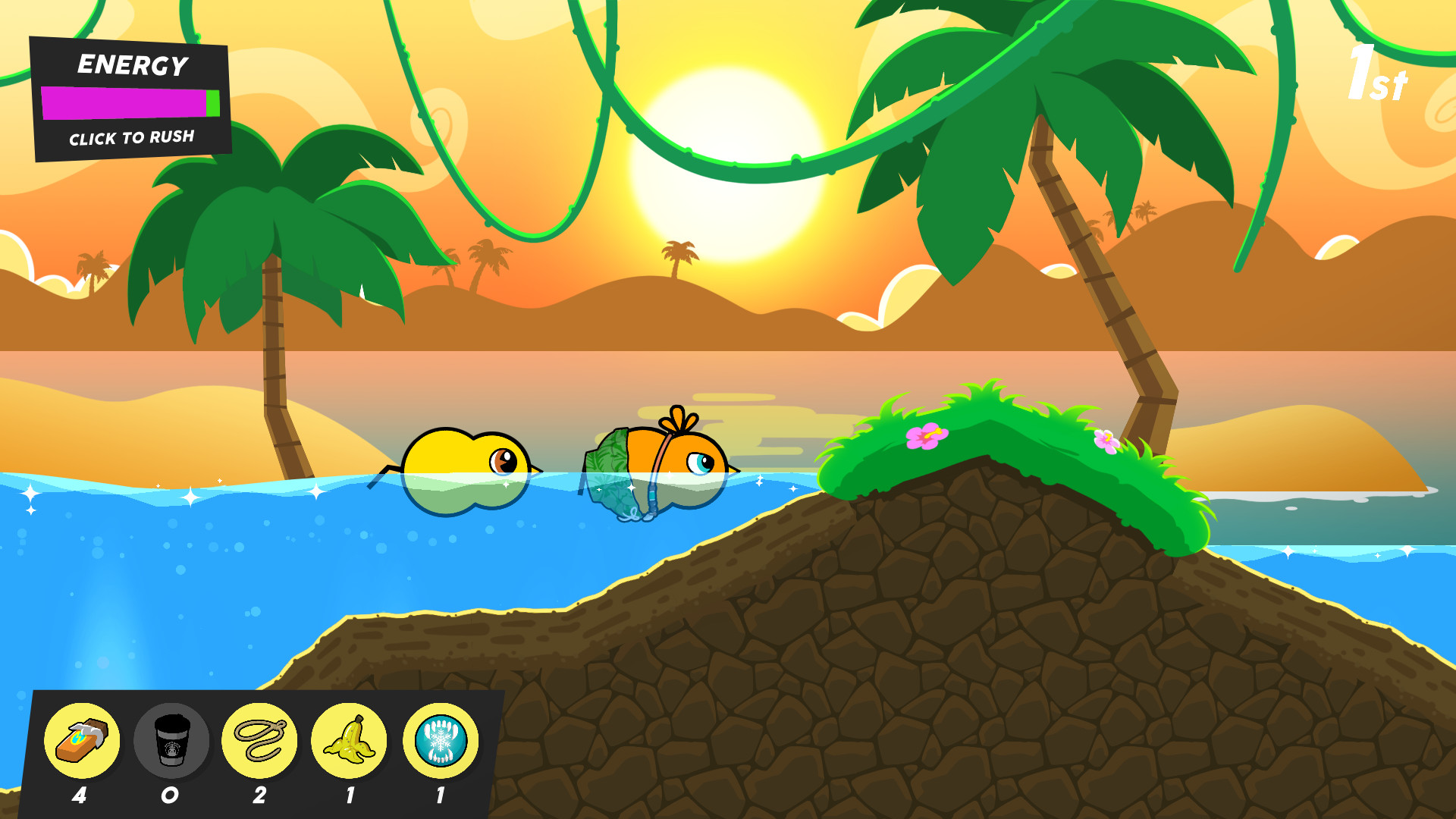
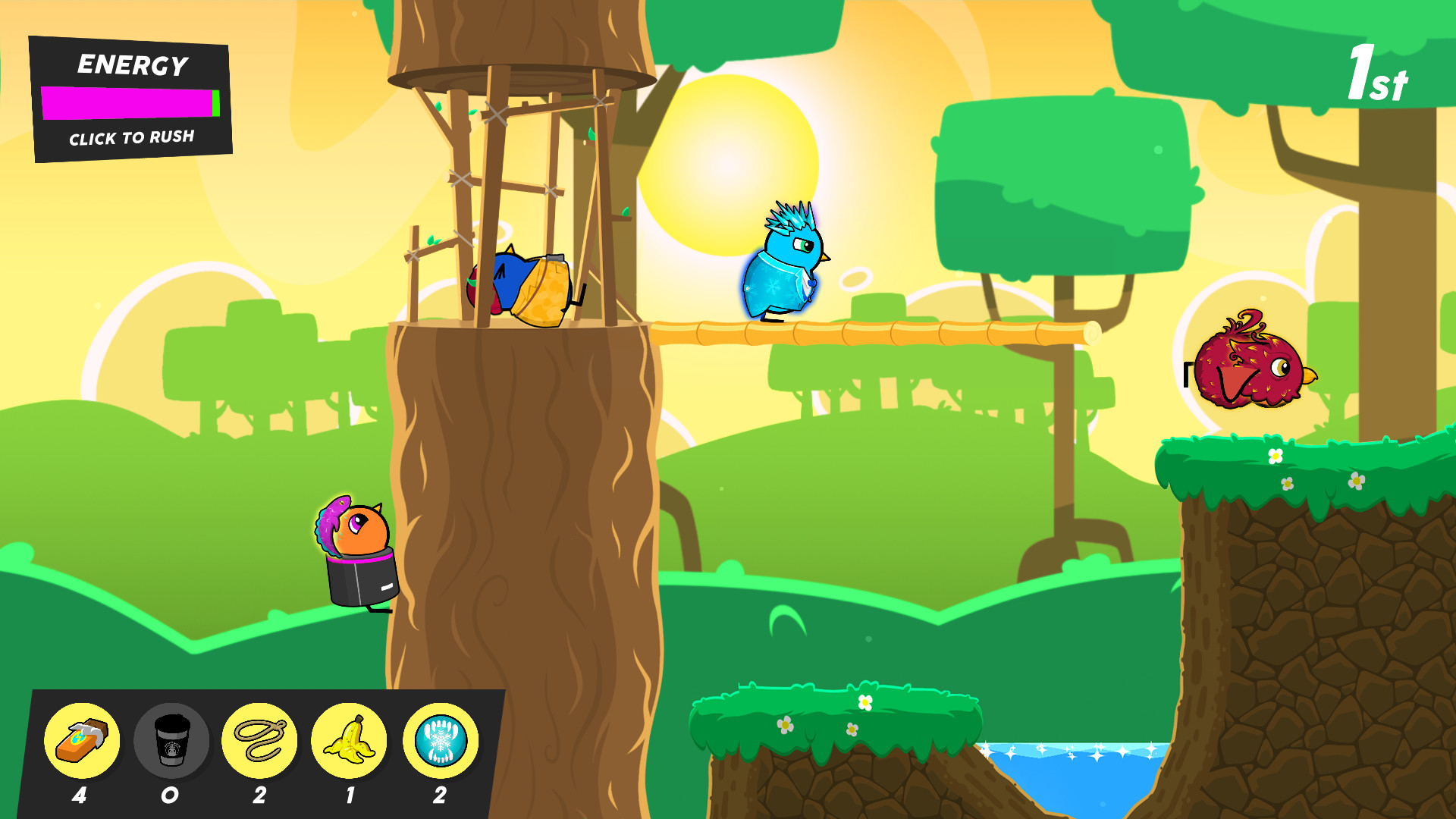
Duck Life 8: Adventure takes the familiar concept of raising and training a duck and turns it into a surprisingly broad casual adventure. Developed by Wix Games and published by MoFunZone Inc., it retains the simple charm of the Duck Life series while greatly expanding the player's freedom. Instead of being built almost entirely around a sequence of training exercises followed by races, the game introduces a large explorable world filled with training locations, shops, competitors, side activities, races, battles, and tournaments. The result is a lighthearted mixture of adventure, racing, sports, and RPG progression that remains accessible while providing considerably more to do than its straightforward premise might suggest. Character creation immediately establishes the game's playful personality. Players can customize their duck using different visual features, including hair and eye colors, before gradually collecting additional clothing and equipment. More than 75 hats, costumes, and weapons can be acquired with winnings earned through competition. Equipment can influence statistics as well as appearance, creating a simple choice between optimizing performance and creating the funniest or most stylish duck possible. It is not an especially complicated equipment system, but that simplicity suits a game designed around quick progression and approachable mechanics. Exploration is one of the biggest improvements to the traditional Duck Life formula. The overworld connects the various activities together and gives players a reason to travel rather than simply selecting everything from menus. New areas contain shops, training opportunities, characters, quests, races, and battles. The environments are mechanically uncomplicated, yet having a world to move through gives progression a stronger sense of adventure. Improving the duck consequently feels connected to an ongoing journey toward becoming a champion rather than existing solely as a sequence of increasingly difficult mini-games. Training remains the heart of the experience. There are 16 training mini-games covering eight skills, with each training activity offering five modes for a total of 80 variations. This provides considerable variety considering how frequently training is required. Rather than improving statistics through passive experience accumulation, players actively participate in short challenges that gradually strengthen their duck. This interactive progression is satisfying because better performance in training eventually translates into noticeable improvements during competitions. Repetition inevitably appears after extended play, especially when raising several statistics, but the number of training variations helps keep the grind reasonably entertaining. Racing provides the main opportunity to see that training pay off. There are 60 tracks where ducks can be required to run, climb, jump, swim, and fly. Because races can incorporate different abilities, developing several skills becomes important rather than simply maximizing one attribute. Power-ups can also provide an advantage when natural performance is not enough. The racing mechanics are deliberately easy to understand, making preparation and character development just as important as what happens during the race itself. This creates a satisfying loop where losing encourages additional training rather than making failure feel completely arbitrary. Battles broaden progression further by introducing opponents who would rather fight than race. Players can obtain 25 weapons and make use of different abilities and power-ups while improving combat-related attributes. Strength increases offensive capability, health improves durability, and jumping eventually allows attacks to be dodged. Combat does not transform Duck Life into a complex tactical RPG, but it provides a useful alternative to racing and gives additional purpose to equipment and character statistics. Switching between athletic competition and combat prevents the adventure from depending too heavily on a single activity. Side quests further diversify the journey. Ducks encountered throughout the world can ask for assistance with unusual objectives, ranging from relatively ordinary collecting tasks to deliberately silly missions such as stealing diamonds. These quests reinforce the humorous atmosphere while encouraging exploration beyond the direct route toward the next tournament. Ultimately, tournaments provide the primary milestones. Finding them, defeating their competitors, and overcoming their champions creates a clear long-term objective and gives all the training, shopping, exploration, racing, and fighting a common purpose. The presentation works particularly well because it never takes the premise too seriously. Colorful environments, expressive ducks, amusing costumes, and absurd situations create an inviting atmosphere. The game is most successful when treated as a relaxed progression adventure rather than a demanding racing game or deep RPG. Players expecting complicated combat strategies or sophisticated character builds may find its mechanics shallow, while anyone who dislikes repeating mini-games may eventually become tired of training. However, accessibility is also one of its strengths. Most systems are immediately understandable, allowing the satisfaction to come from watching a customized duck steadily transform from an inexperienced competitor into an increasingly capable adventurer. Steam Deck compatibility is another positive aspect. Duck Life 8: Adventure is rated Playable for Steam Deck rather than fully Verified. Its default controller configuration provides access to the game's functionality, appropriate controller icons are displayed, interface text is considered readable, and the default graphical configuration performs appropriately on the handheld. It also runs successfully under SteamOS. The notable inconvenience is text entry, which can require manually bringing up the Steam Deck's on-screen keyboard. Consequently, it is not a completely seamless handheld experience, but the actual gameplay is well suited to portable sessions. Duck Life 8: Adventure ultimately succeeds by taking a wonderfully simple idea and surrounding it with enough progression systems and activities to sustain a much larger adventure. The combination of 80 training variations, numerous customization items, 60 race tracks, battles, 25 weapons, side quests, exploration, power-ups, and tournaments gives the player a constant stream of objectives. Some repetition and mechanical simplicity prevent it from becoming an exceptional RPG or racing experience on its own, but those genres are supporting pieces of a charming progression game rather than its sole focus. For players who enjoy steadily improving a character through accessible mini-games and then testing those improvements in competitions, this is an entertaining and surprisingly substantial entry in the series. Rating: 8/10