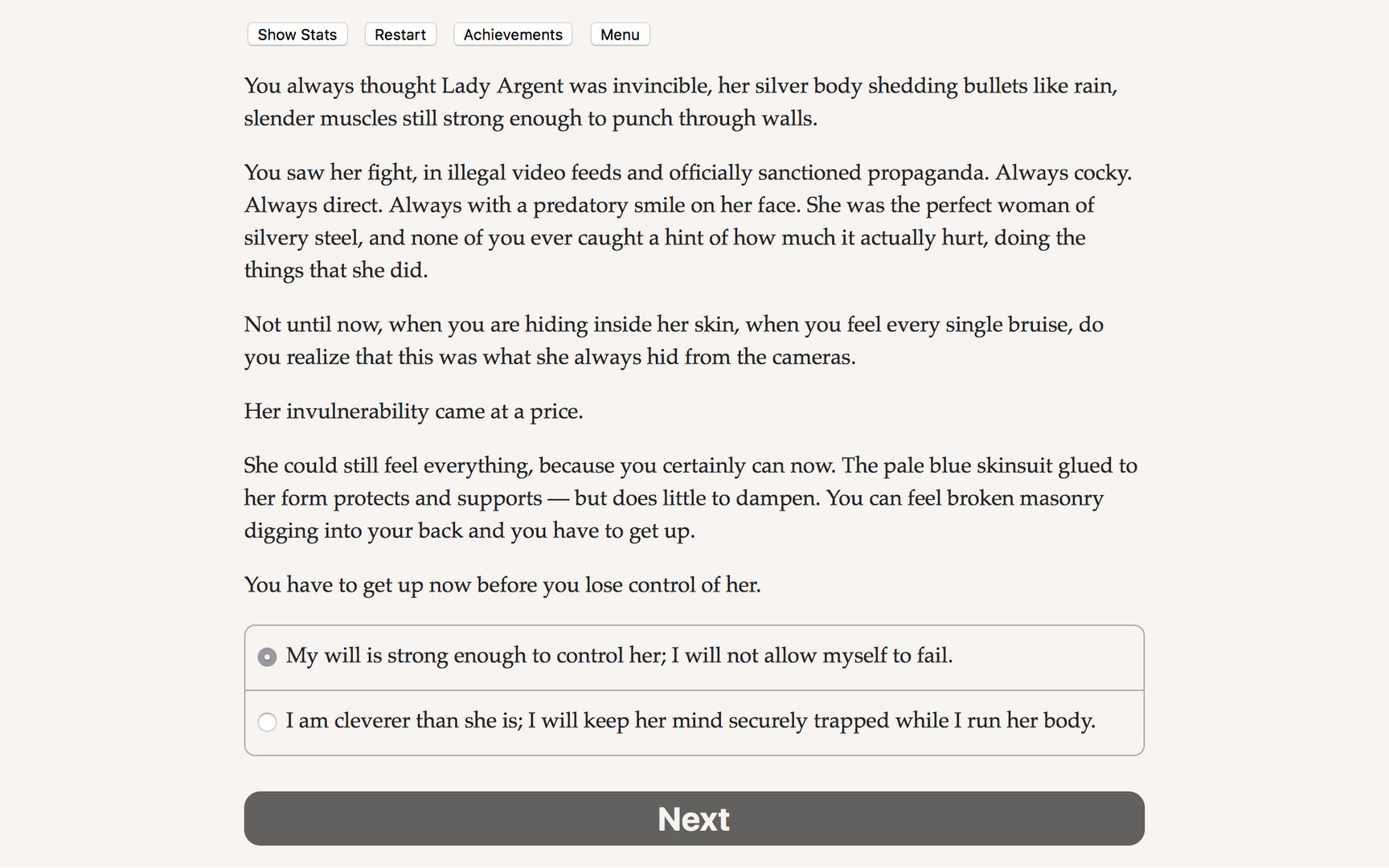
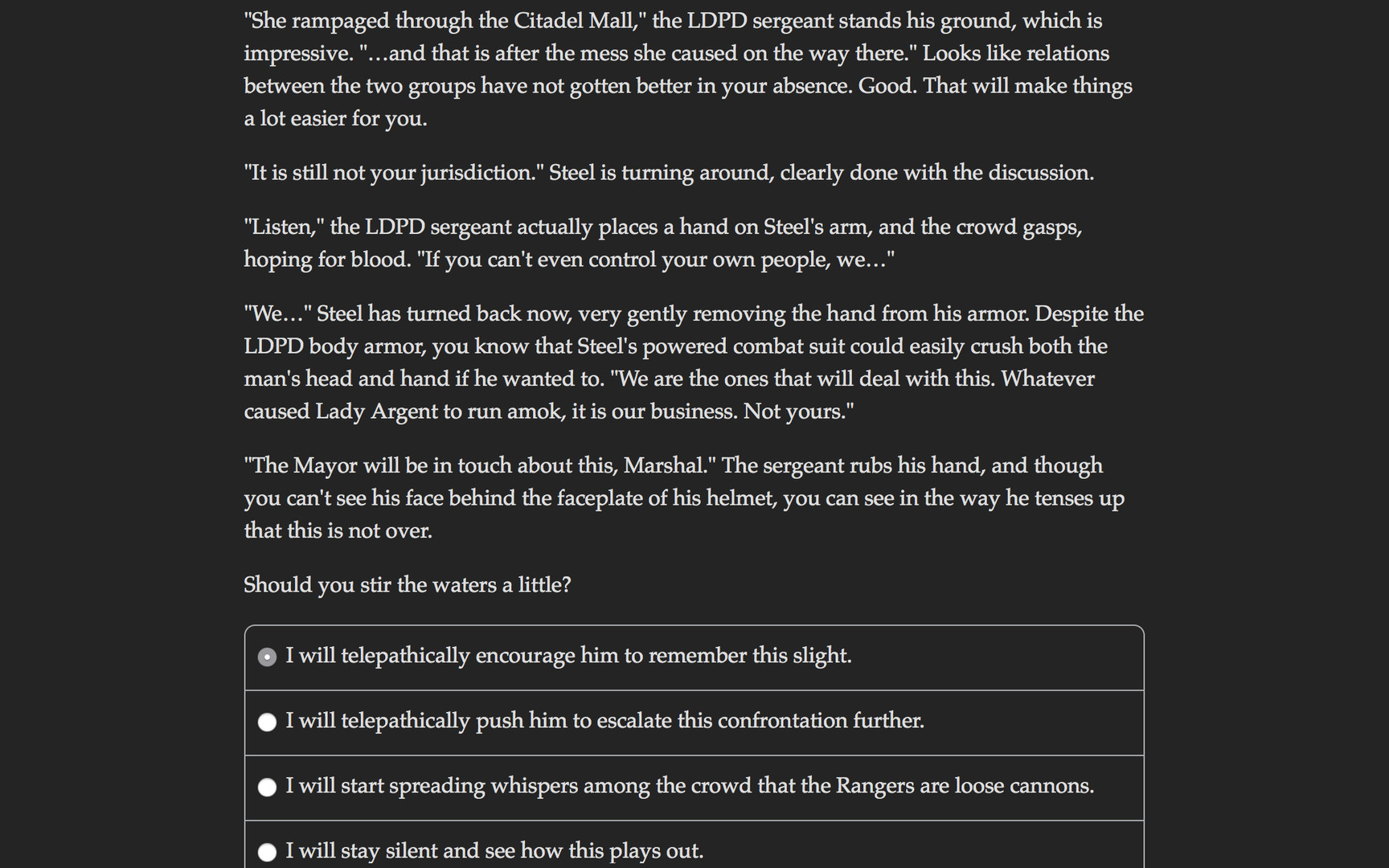
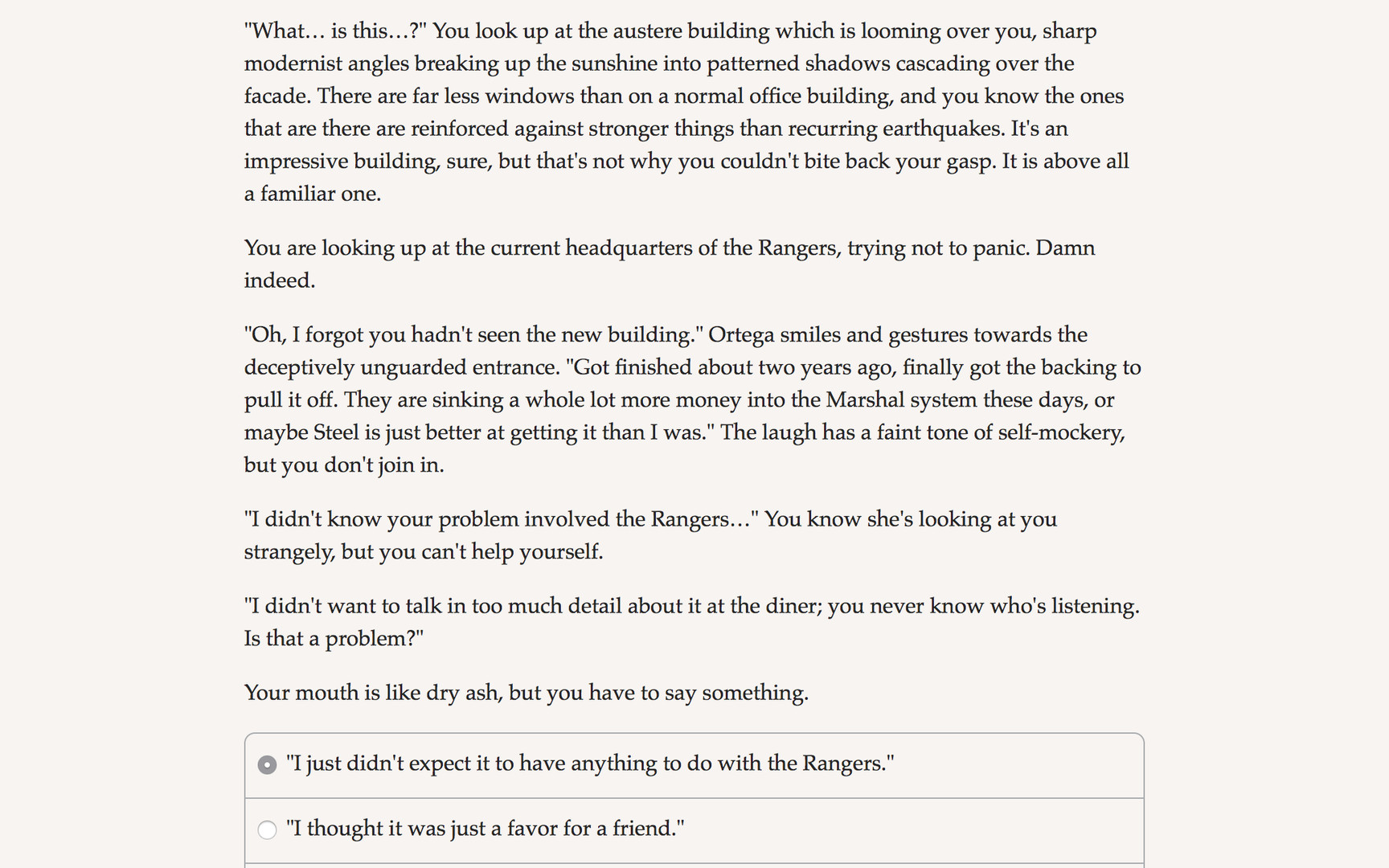
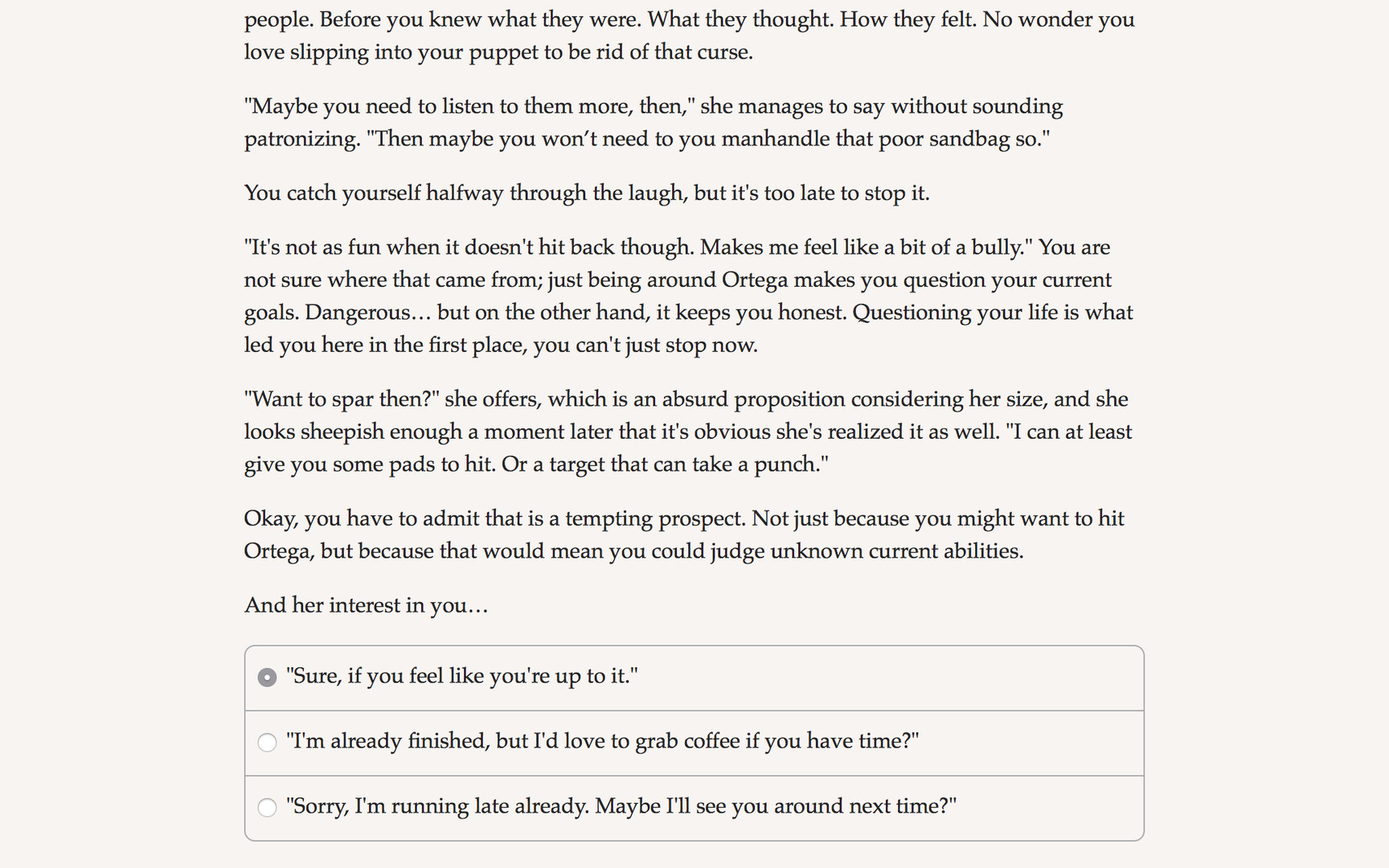
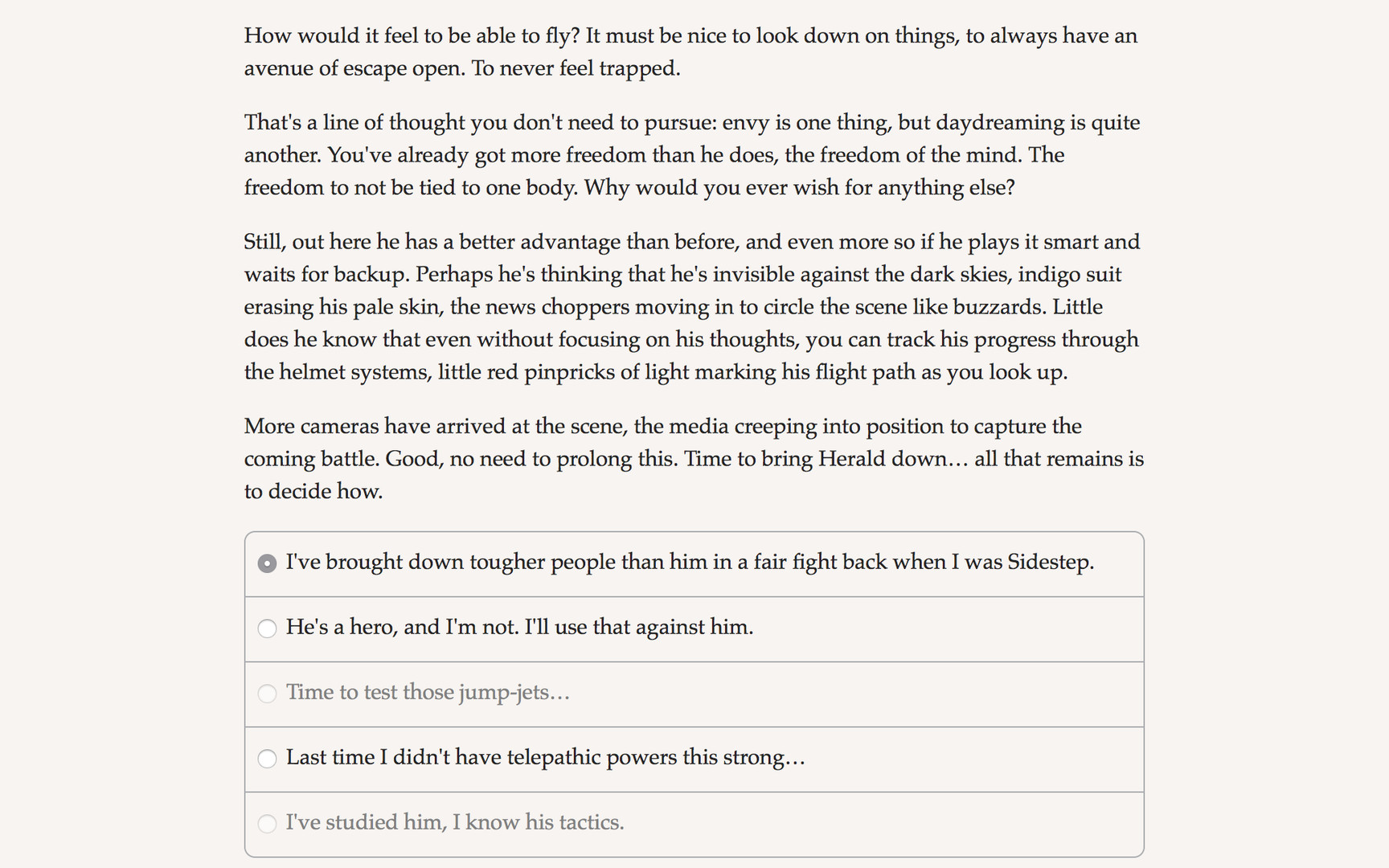
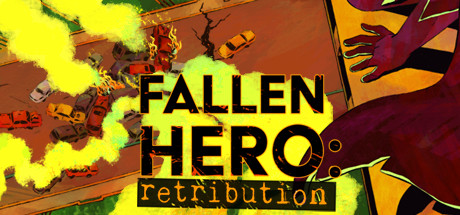
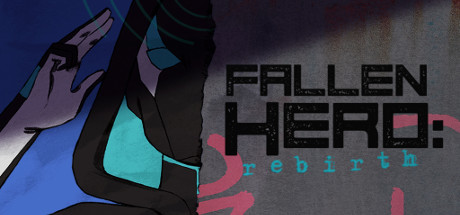
Reviewing (mostly) every game (or DLC) in my library, part 566: ⭐️⭐️⭐️⭐️⭐️⭐️⭐️⭐️☆☆ (8/10) It's a common joke amongst the fandom that every time someone asks for recommendations, Fallen Hero: Rebirth ("FH") meets at least one of their recommendations. Want to play as a villain? FH. Want to play as a trans character and explore gender? FH. Want a slowburn, friends-to-enemies-to-friends-to-lovers? Play FH. Want great writing? Play FH! Needless to say, my expectations were sky high—which, sadly, backfired. Don't get me wrong, FH is an objectively good work: nicely written, a small yet appealing cast, a fascinating take on the superhero genre, and some clever social commentary. I quite liked it! However, with that kind of reputation, my expectations were … extremely high. I went in braced for something transcendent, but I don't think it cracks my top 3 series, personally. A large portion of that is, admittedly, my very personal and picky cons. You play Sidestep, a hero turned villain with telepathy. You can control people or mentally manipulate them, and eventually you gain a “puppet,” a comatose patient used as a second body to carry out your deeds. Why commit evil? The narrative doesn’t fully tell you. Sidestep is unpleasant—full of trauma, angst, and stubbornness—which makes it hard to trust or empathize with their perspective. Pros: ✅ Good worldbuilding. The game begins with two pages of exposition. I got a bit nervous—is this well-acclaimed game going to start with a lore dump? Thankfully, not. All the most important bits are mentioned in the beginning, then threaded carefully throughout the plot. I found it believable how superpowers came to exist in this world. Heroes and villains are not born; they're made. Long story short, it involves federalism, capitalism, drugs, and government control (or the lack of it). Again, realistic and believable. There's also a timeline of important events, as well. I particularly appreciated how telepathic powers worked. They're not a deus ex machina at all. There are rules to the power system: the more targets you have, or the farther your targets are, the more difficult it will be for Sidestep. Hop into someone's head for too long, and you'll get physically ill. Superheroes are mentally strong enough to fight you off; some villains are so consumed with hate that you can't mind-control them. This design choice is a good way to put restraints on the MC without making them a doormat. ✅ Complex cast. The case is small, but even in one book, I can see how they're not what they appear. Your ex-associates, The Rangers, are the pinnacle of heroism. (Well, more than you at any rate.) Herald is the pure golden boy who worships the person you once were; Lady Argent is rather cool and stand-offish; Marshel Steel is the war veteran who doesn't quite trust you; and, of course, much has been said about Oretga, your past ... something. There's also Doctor Mortum, the mad yet charismatic scientist. I liked them more than I liked Sidestep, honestly! ✅ Central ideas. FH is at its most interesting when it leans into themes of duplicity and performance. Sidestep is never just one person: they’re a body, a mind, a puppet, a mask, a role someone else expects them to play. The puppet mechanic is a literalization of dissociation, control, and self-fragmentation. The fact that you can inhabit another body, present a different gender, choose a new name, and move through the world more comfortably as someone who isn’t you is telling. Is it an allegory for being gay? For being trans? For feeling different? YES. Thoughts bleed into actions, masks slip, and the line between who Sidestep “really is” and who they pretend to be gets increasingly blurry. ✅ Pacing. The pacing is surprisingly tight for a book 1. The story moves forward with a clear sense of momentum, rarely lingering too long on any one scene. However, there are big emotional beats, action sequences, and quieter introspective moments that are interwoven in the game. A chapter on villainy or suit building follows relationship building. Even when the game slows down to sit in Sidestep’s head (which it does, a lot), it usually feels intentional rather than indulgent. There’s a steady push toward the inevitable confrontation, and that forward motion helped me stay engaged even when I wasn’t fully sold on the MC. ✅ State page. I love how the game's thematic ideas are also reflected in the stat page. Imagine my surprise when I open the stat page and am greeted with not only Sidestep's relationship bar with the cast, but also my puppet's relationship bar. Sidestep and Ortega's relationship is "it's complicated"; my puppet and Ortega's relationship is "flirting." That was rather unsettling and a bit of a mindf*ck. Also, the stat bars are not the usual red and blue—they're a beautiful light blue and orange?! Come on, authors, add some color to your stats! A sweet lavender, perhaps, or a forest green? Cons: 🟥 Unlikable MC. I wasn't expecting this. Sidestep reminds me of the ronin in Samurai of Hyuga , where the protagonist isn't you/a self-insert, but a defined character going through their own arc. Sidestep becomes a villain due to their ~traumatic backstory~ and frankly, they're hard to like. I don't think the author intended this, actually, but a lot of their internal narration veers into prolonged “woe is me” territory where life sucks, and they want vengeance. While their trauma is mechanically well-written, I, sadly, don't have time for self-pity. And before anyone gets up in arms—I say this as someone who used to have depression! For ME, a part of my recovery was realizing that, yeah, it actually was "all in my head" and being a depressed teenager was actually "not that deep." This is probably a me issue, but Sidestep reads more as frustratingly passive. 🟥 Unclear past/motives. This is more of an objective continuation to the above con. Sidestep frequently fixates on revenge—how they were wronged, betrayed, and irreparably damaged—yet the narrative withholds the full picture for a long time. Sidestep's past comes in flashbacks, and they're a bit of an unreliable narrator (more on this later). The result is a disconnect: you’re asked to emotionally buy into Sidestep’s motivation before you’re given all the context needed to judge it. I'm supposed to root for blowing up a museum for ... what? 🟥 Unreliable narrator. Again, I don't know if Rydén intended this, but I found Sidestep's actions not exactly matching up with their memories. Or that there was a disconnect for me as the reader. They frame themselves as deeply wronged and emotionally abandoned, yet the timeline doesn’t always support that self-image. Mild story spoilers, but seven years pass without a single word to Ortega, and somehow Sidestep still positions themselves as the injured party. From Ortega’s perspective, that silence would be brutal—and honestly, completely unforgivable. If I were Oretga, I would kick their ass tbh. Ortega practically begs for Sidestep to open up to them, but they’re just “no, you wouldn’t understand 💔🥀.” Similarly, the narrative is full of paranoia when it comes to Steel, but I actually liked and understood him! So he’s not jumping for joy when he sees you. So what? Haven’t you proven his suspicions right? Like, babe, I know you’re depressed, but have you tried making an appointment with your PCP? Have you perhaps tried picking up a new hobby? I hear pickleball is all the rage. If you enjoyed this review, please check out my curator page to find more: [url=https://store.steampowered.com/curator/45814768-Verdict-Play-or-Pass/]Verdict: Play or Pass. Also, please leave a like and visit [url=https://steamcommunity.com/groups/Indie_Gems]IndieGems and our YouTube channel for more reviews like this one.
Expand the review