Sync your Steam wishlist to find the lowest game prices instantly. No login required, just paste your Steam profile URL! ⚡ Try Wishlist Radar!
Sync your Steam wishlist to find the lowest game prices instantly. No login required! ⚡ Try Wishlist Radar! Close

PRINCIPIA: Master of Science on Steam

Quick menu

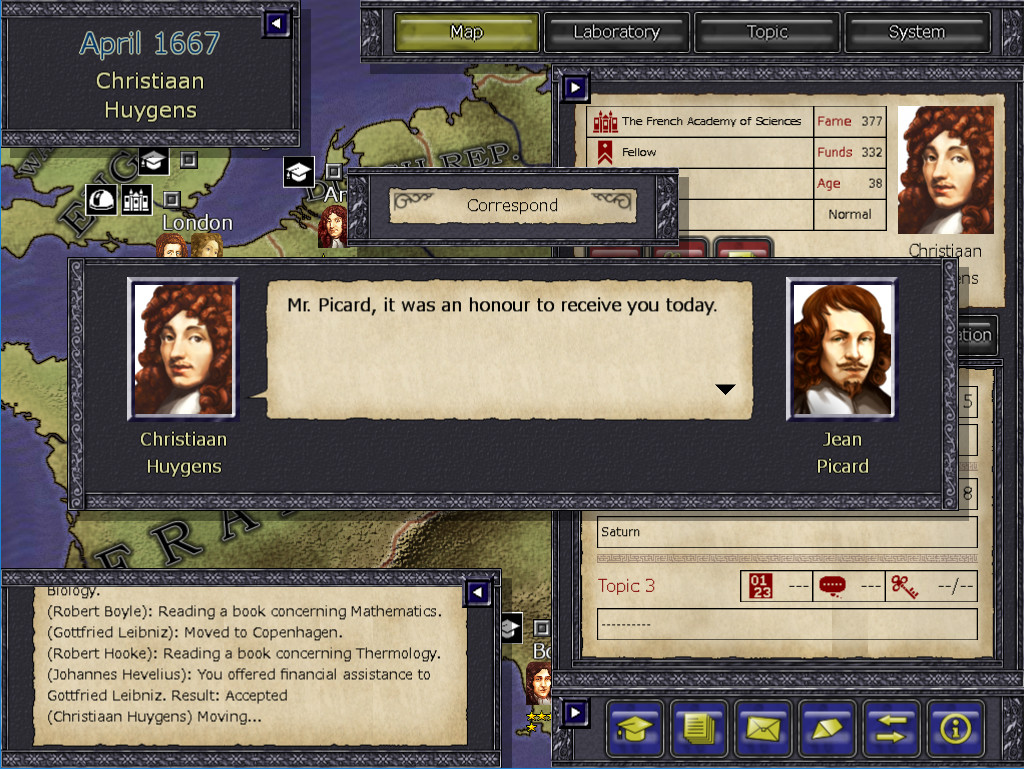
Principia: Master of Science is a simulation game with the theme of European science in 17th century. Choose one of 12 real scientists from the era of Isaac Newton and proceed with your research. It is a time when even the term "Science" did not exist. Who can be the master of science?

PRINCIPIA: Master of Science is a early access, turn-based tactics and political sim game developed by tomeapp and published by PLAYISM.
Released on September 09th 2016 is available on Windows and MacOS.

It has received 311 reviews of which 219 were positive and 92 were negative resulting in a rating of 6.7 out of 10. 😐

The game is currently priced at 9.99€ on Steam.


The Steam community has classified PRINCIPIA: Master of Science into these genres:

Media & Screenshots

Get an in-depth look at PRINCIPIA: Master of Science through various videos and screenshots.
System requirements

These are the minimum specifications needed to play the game. For the best experience, we recommend that you verify them.

Windows
  • OS *: Windows 7/8/8.1/10 32/64bit
  • Processor: Intel Core 2 Duo or greater
  • Memory: 256 MB RAM
  • Graphics: Intel HD Graphics 4000 or greater
  • DirectX: Version 9.0
  • Storage: 100 MB available space
MacOS
  • OS: Mac OS X 10.8
  • Processor: Intel Core2 Quad Q8200 (4 * 2330) or equivalent
  • Memory: 2 GB RAM
  • Storage: 100 MB available space

Steam Price & Best Deals

User reviews & Ratings

Explore reviews from Steam users sharing their experiences and what they love about the game.

12 hours played
Oct. 2025
PRINCIPIA: Master of Science, developed by tomeapp and published by PLAYISM, is a deeply unconventional simulation game that attempts to capture the birth of modern scientific inquiry through strategy, philosophy, and historical nuance. Set during the intellectual upheaval of the seventeenth century, it places the player among the pioneering figures of early science, from the likes of Isaac Newton to Gottfried Leibniz, and tasks them with building reputations, conducting experiments, and publishing revolutionary discoveries. The game is not about conquest or destruction but about thought and perseverance—the gradual, uncertain process through which knowledge emerges. It provides an opportunity to explore a world where reason is the weapon, where ideas compete for recognition, and where the player’s greatest adversary is the shifting balance between curiosity and credibility. The core gameplay unfolds in a turn-based structure that revolves around six major fields of research: Astronomy, Physics, Optics, Thermodynamics, Biology, and Mathematics. Each field represents a branch of discovery that can yield insight, prestige, or practical applications depending on how the player approaches it. You begin by choosing one of several historical scientists, each with distinct traits that influence research potential and social standing. As you progress, you allocate time toward experiments, theoretical studies, and scholarly correspondence, balancing the need to innovate with the imperative to maintain reputation within academic circles. Discoveries are presented to learned societies, and rival scientists can challenge your findings, resulting in debates that determine who becomes the era’s intellectual authority. Rather than relying on flashy mechanics, PRINCIPIA thrives on systems that evoke the competitive yet fragile nature of the scientific revolution. What makes the experience particularly fascinating is its focus on the politics of knowledge. Each decision carries both intellectual and social consequences. Publishing too early may result in ridicule or rejection, while withholding results for too long might allow rivals to claim your discovery first. You are not merely a thinker but also a diplomat, navigating the volatile dynamics of reputation and influence. The game’s representation of the Royal Society and similar institutions is one of its most compelling features, illustrating how the acceptance of new ideas depends as much on timing and prestige as on truth itself. There is an underlying tension throughout: science here is both pure pursuit and political theater. Visually, PRINCIPIA adopts a restrained style that suits its cerebral nature. The interface resembles an academic parchment—a space filled with charts, diagrams, and clean, minimalistic illustrations. It is not visually rich in the conventional sense, but its simplicity channels focus onto the game’s intellectual elements. The subdued aesthetic, accompanied by baroque-inspired background music, evokes the contemplative rhythm of scholarly work. Every aspect, from the interface to the audio, feels purpose-built to foster thought rather than distraction. Yet, this design choice can alienate players accustomed to more sensory-driven games. For those who appreciate thematic cohesion and a measured pace, however, the understated style enhances immersion, making each discovery feel personal and earned. PRINCIPIA’s greatest strength lies in its conceptual ambition. Few games attempt to gamify the process of discovery without reducing it to mere puzzles or resource management. Here, the act of learning is its own reward. Each experiment, each hypothesis, and each exchange with rivals simulates the gradual accumulation of understanding that defined the scientific revolution. It encourages patience and strategic foresight—qualities rarely celebrated in mainstream gaming. However, this also means the experience can feel esoteric and slow. The mechanics are not immediately transparent, and players must invest time in deciphering the game’s logic before progress becomes satisfying. This design choice, though authentic to the subject matter, can deter those seeking instant gratification. Where the game falters is in its longevity and refinement. Once players grasp its systems, the sense of discovery begins to wane, as repetition sets in and optimal paths to victory become evident. Some mechanics, such as peer review and theory disputes, lack the depth to sustain multiple playthroughs. The Early Access status of the game is also apparent in its interface limitations, minimal feedback systems, and occasional localization quirks. Many players have expressed a desire for expanded content—new scientists, more research branches, or improved explanations of underlying mechanics. Yet, despite these shortcomings, the foundation remains compelling because of the rarity of its premise. Ultimately, PRINCIPIA: Master of Science is less a traditional game and more an intellectual experiment in interactive history. It asks players to inhabit a time when science was inseparable from philosophy and social prestige, when every experiment was a leap of faith in the dark. It rewards those who value introspection and strategy rooted in ideas rather than spectacle. Its measured pacing, academic tone, and emphasis on thought over action make it an experience that appeals to the patient and the curious. For those willing to engage with its slow rhythm and cerebral depth, PRINCIPIA offers a unique window into the human pursuit of knowledge—a world where discovery is not a sudden revelation but a lifelong endeavor shaped by ambition, doubt, and imagination. Rating: 6/10
6 hours played
May 2025
If you’re a fan of deep strategy, scientific discovery, and historical simulation, PRINCIPIA: Master of Science is a must-play. Set in the Age of Enlightenment, this unique PC game lets players step into the shoes of legendary scientists like Newton, Galileo, and Kepler, navigating the turbulent intersection of academia, politics, and progress. With its richly detailed mechanics, thoughtful decision-making, and compelling blend of real history and scientific theory, PRINCIPIA challenges players to expand the frontiers of knowledge while managing rivalries, reputation, and the occasional clash with dogma. It's an intellectual strategy experience unlike any other.
30 hours played
Jan. 2024
This game has a lot going for it, especially considering its age. It isn't very hard, it is quite slow-paced. Once you've got the trick of things, it practically plays itself. Which is nice, sometimes, to just sort of immerse oneself in the setting. The setting in this case is the academies of 17th century Europe, featuring the great scientists of that time period. The player manages the career of one such thinker, building relationships with peers and rivals, researching and experimenting, traveling between institutions, etc. I particularly enjoyed the artwork; they are dated, but appealing nonetheless.
25 hours played
Jan. 2018
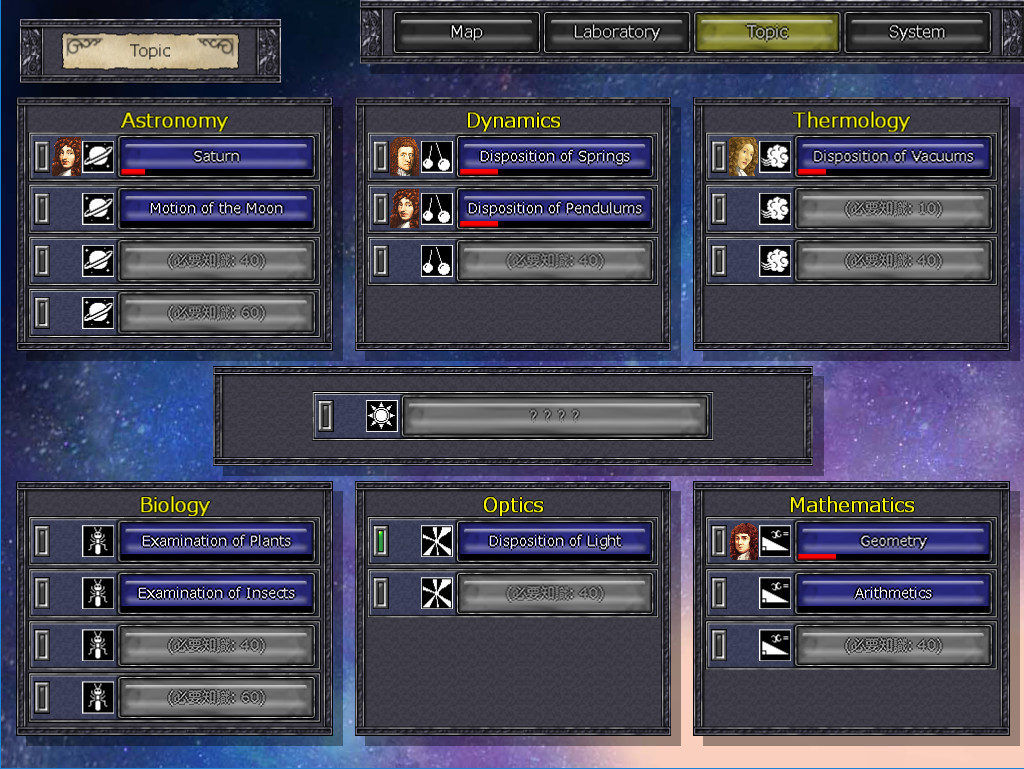
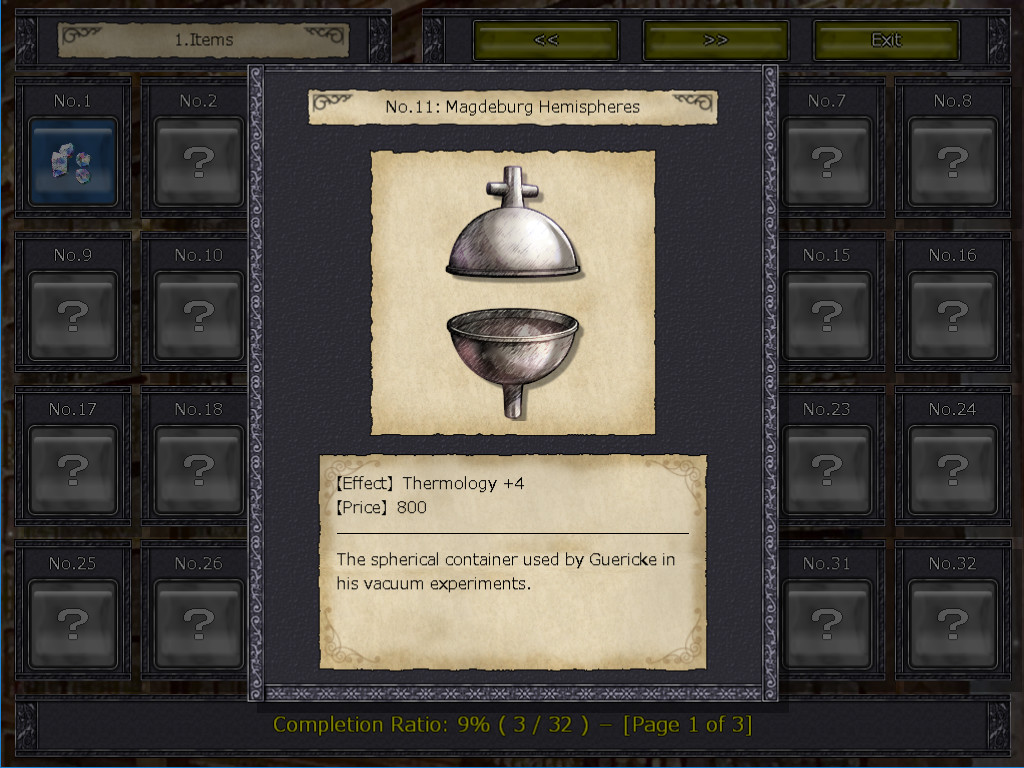
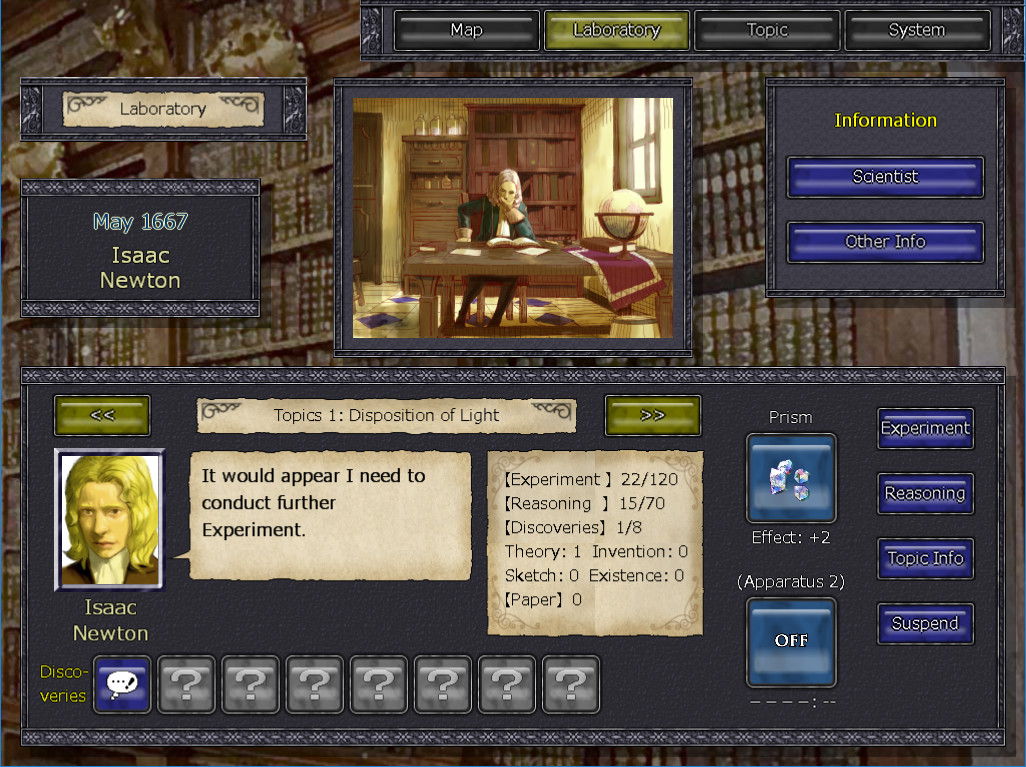
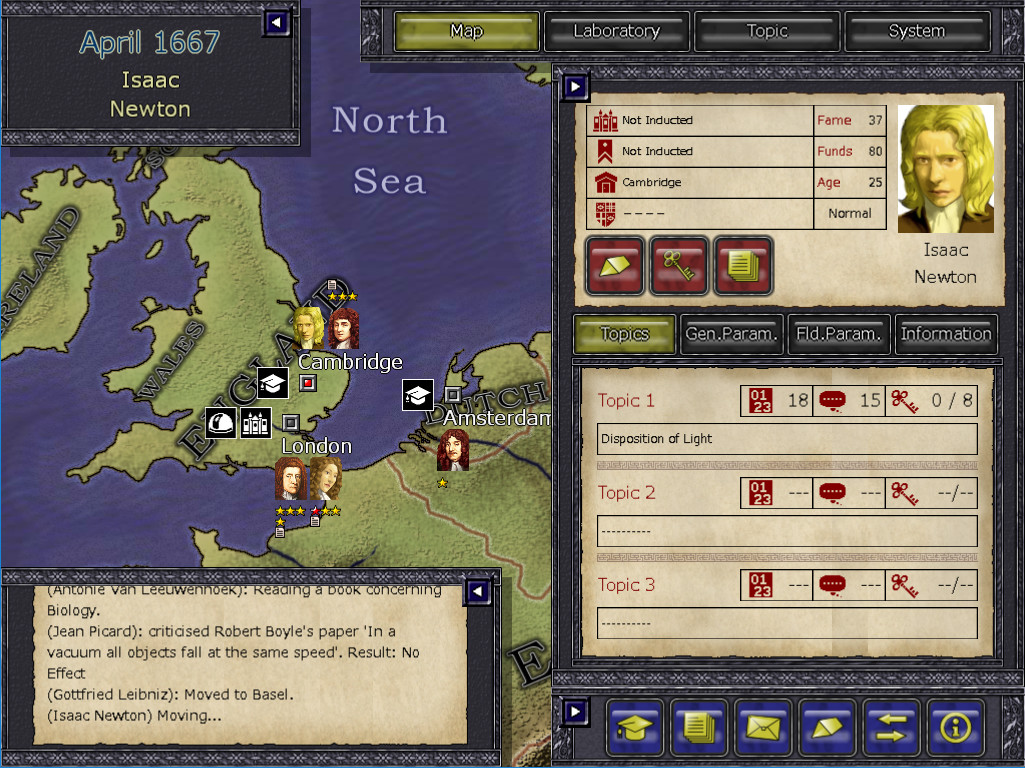
Summary A rather simple game with a huge potential. Overall, it is great now, but if the devs are able to improve on the concept by introducing more scientists, fields of science, and perhaps more locations/academies, it can become truly amazing. What works 1. You can pick one of about a dozen scientists from the era of enlightenment, and guide him throughout his career. You choose what to concentrate on, you can study, attend lectures, conduct experiments, compose scientific papers and much more. 2. There are multiple scientific fields to choose from - astronomy, dynamics, thermology, biology, optics, mathematics and a hidden one. Each fields has several topics, each with a lot of different experiments, concepts, theories to prove or disprove etc. 3. You can obtain - purchase or create - a lot of items that can help you in your studies. 4. You can choose your profession - lecturer, professor, fellow of the academy, diplomat, or a government official. You can unlock better ones by becoming more famous and you can earn money this way. 5. You can interact with other scientists - question their papers, defame them, correspond or give them money to further their studies. 6. You can move around Europe, with locations giving you access to different structures - universities, academies or observatories. 7. I really like the style - both graphics and music. What doesn't work 1. Once you're famous, you get attacked by an enemy every turn. In my playthrough as Newton I was slammed by Leibniz every turn, which usually caused the game to play the exact same animation of the Royal Academy hearing the case only to reject it every month. Tedious and ridiculous. 2. There are too few scientists to choose from in term of younger ones - only Leibniz and Newton are in their 20s, a lot of characters to choose from are in their 40s or 50s. 3. The game can get a bit repetitive after a while, having a more complex interaction with other scientists would certainly help a lot. What do I wish to see It's an EA game so I guess the devs might change it somehow. Graphics don't need to be changed in my opinion, they're perfectly fine. I would much prefer some more scientific fields to choose from - perhaps social sciences? Writing about the law or economy could bring a whole new level to the game. Plus it could really use some more younger scientists to choose from or the ability to create one.
6 hours played
Jan. 2018
I am a bit of a science history nerd, but this game is pretty boring and repeditive. The classical music can not be turned off in game, slowly drilling through your skull till you can not stand waiting for other scientists to complete their turn listening to the same song for the 100th time. I really appreciate that this game is a passion project so kudos to the game creators for following their niche interest and making a game that I can sometimes enjoy. This game drags out purely because you have to wait for other scientists to take their turns, if you did not have to wait for their turns or for text to scroll I could 100 % this game in a few minuets, because you have to wait it takes many hours. Be prepared to repedatively keep doing calculations so that your arithmetic calculation metre fills up, then repedatively keep clicking to fill up your reasoning for arithmetic, then repedatively keep trying to prove a peice of enlightenment science, then compose your paper, then publish that paper only to have Christiaan Huygens endlessly calling Royal Society meetings, accusing you of writing demonstrably false papers without being able to convince anyone else at that meeting. In this game Huygens would call me a bold faced liar for stating that 2+2=4 I do not think Principia is a good game, but that is because of game design flaws, I love that there are people who are passionate enough to make a game about being a scientist in enlightnment Europe, but the game is not fun. TLDR: Get this game if you like the history of science, though I am doubtful whether a game like this could spark an interest in a child for maths or science. I am probably the perfect target market for the game's topic but the game is not enjoyable. Hopefully the developlers learn more about game design so that they can continue to make niche games like this but also make those games enjoyable.

Frequently Asked Questions

PRINCIPIA: Master of Science is currently priced at 9.99€ on Steam.

No, PRINCIPIA: Master of Science is currently not on sale. You can purchase it for 9.99€ on Steam.

Yes, PRINCIPIA: Master of Science received 219 positive votes out of a total of 311 achieving a rating of 6.68.
😐

PRINCIPIA: Master of Science was developed by tomeapp and published by PLAYISM.

Yes, PRINCIPIA: Master of Science is playable and fully supported on Windows.

Yes, PRINCIPIA: Master of Science is playable and fully supported on MacOS.

No, PRINCIPIA: Master of Science is not playable on Linux.

This information about PRINCIPIA: Master of Science is not available yet.

This information about PRINCIPIA: Master of Science is not available yet.

No, PRINCIPIA: Master of Science does not support VR.

PRINCIPIA: Master of Science is a single-player game.

No, PRINCIPIA: Master of Science does not currently offer any DLC.

No, PRINCIPIA: Master of Science does not support mods via Steam Workshop.

No, PRINCIPIA: Master of Science does not support Steam Remote Play.

Yes, PRINCIPIA: Master of Science is enabled for Steam Family Sharing. This means you can share the game with authorized users from your Steam Library, allowing them to play it on their own accounts. For more details on how the feature works, you can read the original Steam Family Sharing announcement or visit the Steam Family Sharing user guide and FAQ page.

You can find solutions or submit a support ticket by visiting the Steam Support page for PRINCIPIA: Master of Science.

Data sources

The information presented on this page is sourced from reliable APIs to ensure accuracy and relevance. We utilize the Steam API to gather data on game details, including titles, descriptions, prices, and user reviews. This allows us to provide you with the most up-to-date information directly from the Steam platform.

Additionally, we incorporate data from the SteamSpy API, which offers insights into game sales and player statistics. This helps us present a comprehensive view of each game's popularity and performance within the gaming community.

Last Updates
Steam data 22 September 2026 17:25 UTC
SteamSpy data 13 October 2026 18:13 UTC
Steam price 27 October 2026 15:03 UTC
Steam reviews 21 October 2026 17:57 UTC

If you'd like to dive deeper into the details about PRINCIPIA: Master of Science, we invite you to check out a few dedicated websites that offer extensive information and insights. These platforms provide valuable data, analysis, and user-generated reports to enhance your understanding of the game and its performance.

  • SteamDB - A comprehensive database of everything on Steam about PRINCIPIA: Master of Science
  • SteamCharts - Analysis of PRINCIPIA: Master of Science concurrent players on Steam
  • ProtonDB - Crowdsourced reports on Linux and Steam Deck PRINCIPIA: Master of Science compatibility
PRINCIPIA: Master of Science
Rating
6.7
219
92
Game modes
Features
Online players
0
Developer
tomeapp
Publisher
PLAYISM
Release 09 Sep 2016
Platforms