

Inn Tycoon
Welcome to Inn Tycoon! Build, design, and manage your dream inn. Serve delightful meals, offer various services, and hire a stellar staff. Create a top-notch hospitality empire and become the ultimate Inn Tycoon!
Sync your Steam wishlist to track the lowest game prices instantly. No login required, just paste your Steam profile URL!
⚡ Try Wishlist Radar!
Sync your Steam wishlist to track the lowest game prices instantly. No login required!
⚡ Try Wishlist Radar!
Close

The Succession of Changing Kings on Steam - User reviews, Price & Information
Quick menu
Turn-based kingdom management simulator focused on decision-making. Will you survive and lead the kingdom to prosperity, or die in agony? The throne awaits.
The Succession of Changing Kings is a early access, medieval and 2d game
developed and published by KwaKwaGames.
Released on March 04th 2026 is available only on Windows
in 8 languages: English, Spanish - Spain, Russian, German, French, Korean, Traditional Chinese and Japanese.
It has received 327 reviews of which 288 were positive and 39 were negative resulting in a rating of 8.1 out of 10. 😎
The game is currently priced at 5.32€ on Steam with a 40% discount.
The Steam community has classified The Succession of Changing Kings into these genres:
Media & Screenshots
Get an in-depth look at The Succession of Changing Kings through various videos and screenshots.


Load More
System requirements
These are the minimum specifications needed to play the game. For the best experience, we recommend that you verify them.
Windows
- Requires a 64-bit processor and operating system
- OS: 10 (64-bit)
- Processor: Intel Core i3 2.0 GHz or equivalent
- Memory: 2 GB RAM
- Graphics: NVIDIA GeForce 8800 GT or equivalent
- DirectX: Version 9.0
- Storage: 12 GB available space
Steam Price & Best Deals
User reviews & Ratings
Explore reviews from Steam users sharing their experiences and what they love about the game.
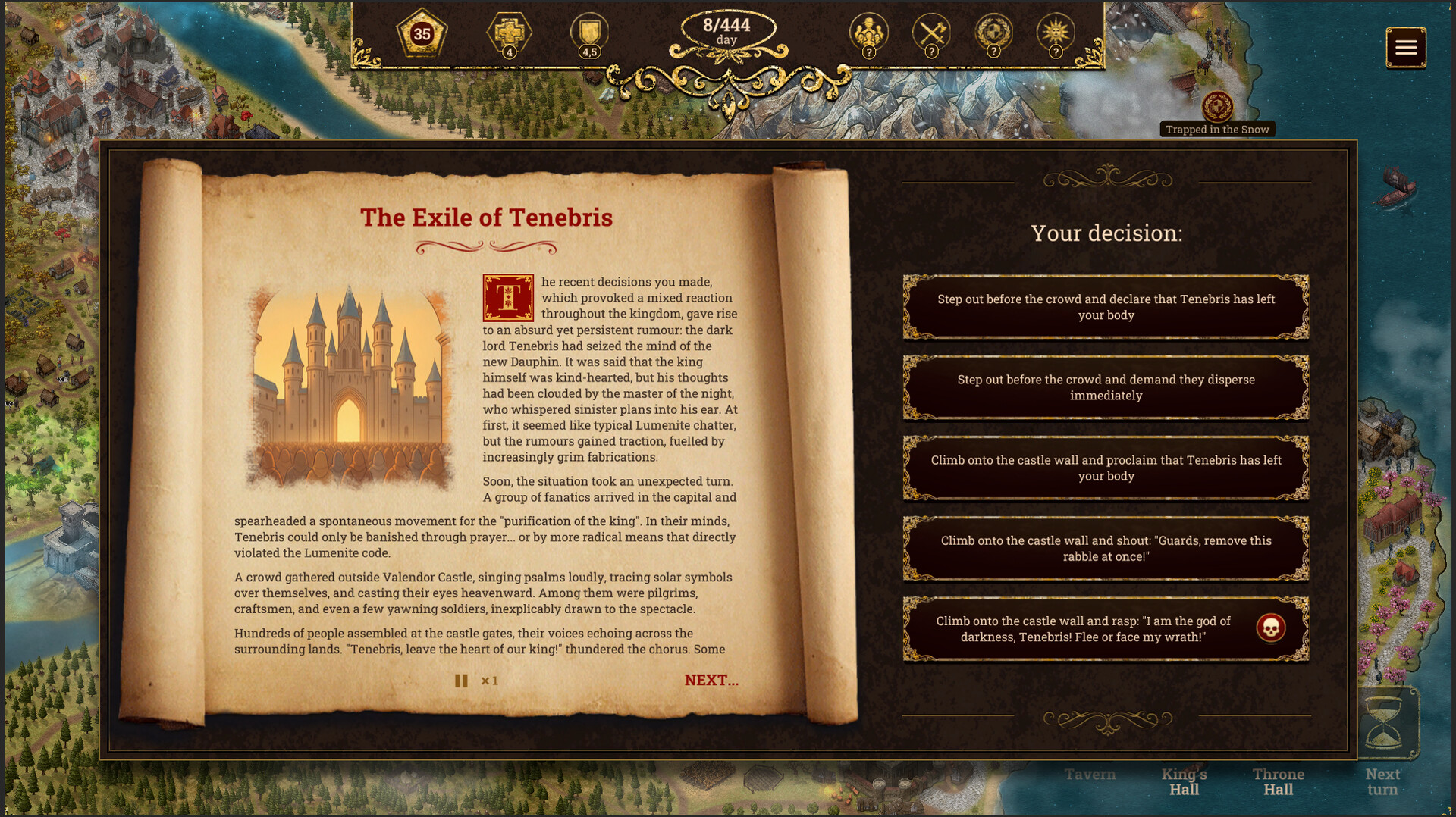
Needs a TLDR version for the events that pop up. All too often the events felt like they could be summarized in 1-3 sentences but instead there's like 6 paragraphs giving you irrelevant information. I'm only giving this a thumbs up because I appreciate the effort and would like to see more games like this, just I want them to stop monologuing. "Brevity is the soul of wit."
This is the second time i write a review. I have played this twice times in another account, and this is my 3rd playthrough. I have a mixed opinion on this game, although i will recommend this game because it certainly can be improved with several aspects. The good: 1. The developers understood to create a simple, but engaging gameplay. This game is probably inspired from several games, including Reign, King of Dragon Pass, Yes Your Grace, Six Ages, The King's Dilemma, and other narrative based strategy/kingdom management. They knew how to avoid The King's Dilemma's mistakes, which that game exported the Tabletop rules and made a game which is irrelevant for single-player games (such as too high military power will end your rule, and no connection between powers and outcomes), while this game understand that high relations equals support. A loyal and strong army would not turn against it's king and decided to form a military junta, if they consider the king is on their side. 2. Decisions does matter for some important stories, including Act events. Some starting decisions mattered for the ending, which made this game feels less railroaded compared to other narrative based strategy games. However, there are still plenty of improvements for stories that can be suggested, where many effects for your decisions should matter more (conquering Dalaran brings nothing including no mentions in the ending, the Varroks cannot be totally subjugated, and many things that should matter more. Conquering several territories of a neighboring kingdom should be a great achievement and economically beneficial, because that kingdom threatened yours just a few months ago). The Neutral: 1. Agents/Employees does matter, namely the detective and the physician. Herbalist and the Royal Guard matter sometimes. However, you can do many things without the Fencer and the Royal Guard. Armorers are generally useless except for opening the military buildings requirements. The informant is less capable than the detective for spying (this is weird, because the spy should be the one who is better on conducting espionage, while the detective should be the one who investigates leads). Some adjustment might have to be done for this, or add some events that relies on those agents rather than merely functional for non-event purposes (informant), or merely for safety (royal guards and the fencer.) 2. The important events' solutions are either too obscure (troy, house valarion, the ambassador and the prince), ot either too obvious (maimonides' events/the plague, stella cadence and how to win elections). There should be more options or tweaks on how to solve these important events with resources available. Can connect this with previous successes (such as winning the war, or ex stella cadence prisoners that can be tortured for information about Troy if you refuse Valarion's help). The bad: 1. AI generated pictures are controversial. Plenty of people has pointed this, i chose to let it slide knowing that the developers are open about it, and i hope that their future games utilizes human artists. This can only be done, if the developers gained enough revenue to create their future games with larger funding. I sincerely hope so. Recommendations: 1. tweak several events and scenarios for more connections between important decisions. 2. tweak several capabilities of agents, which informants should be used to spy, and the detective for investigating cases/criminals. It is weird to see that the detective is better in spying than the informants. More roles for the royal guard and other agents. 3. Economy should be more balanced, initiatives and economic currency can be differentiated if must be. Because, it is important to distinguish your own energy and economic resources. Some buildings like the farming improvements should bring more economic benefit, as well as they should be able to prevent famine events in Act 3, and prevent mouldy bread events when combined with bakery.
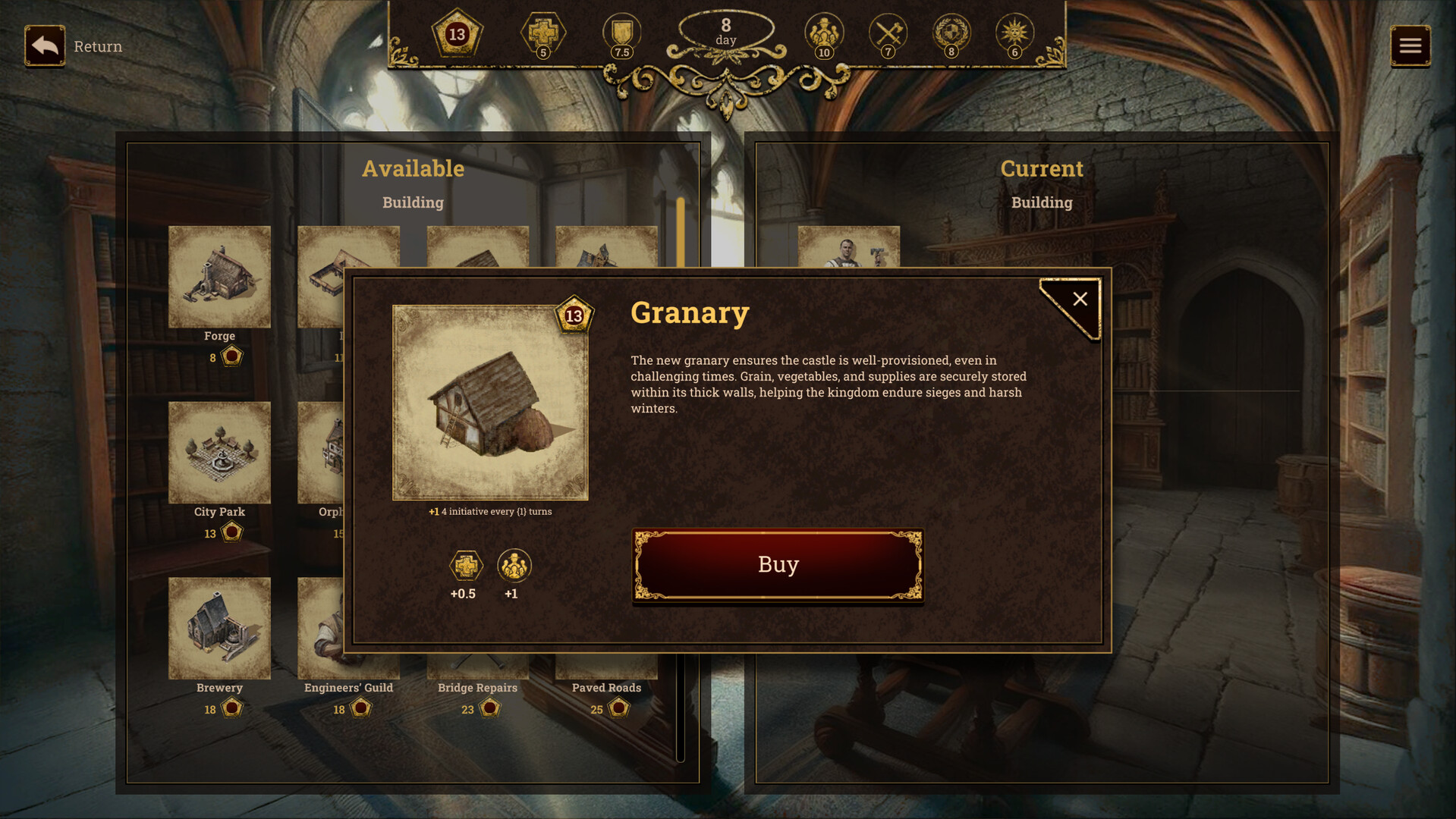
The Succession of Changing Kings is a narrative-driven kingdom management strategy game developed and published by the indie studio KwaKwaGames. Set within a troubled medieval realm, the game places players in the role of a newly crowned ruler tasked with restoring stability to a kingdom that has been steadily declining. Rather than focusing on traditional large-scale battles or real-time strategy mechanics, the game emphasizes decision-making, political balance, and long-term governance. Through a structured series of turns and narrative events, players must guide the fate of their nation while navigating internal politics, economic challenges, and the ever-present risk of collapse. The premise establishes a kingdom in crisis. Trade has slowed, citizens are leaving their homes, and the authority of the crown has weakened. Into this uncertain environment steps the player, inheriting a throne that carries both power and enormous responsibility. From the first turn onward, the player must begin rebuilding the country’s infrastructure, restoring public trust, and carefully managing the various factions that influence the kingdom’s stability. Each decision contributes to the direction of the realm, whether it strengthens the economy, improves relations with influential groups, or inadvertently creates new problems that must later be resolved. The structure of the game is divided into a set number of turns, representing the limited time a ruler has to secure their legacy. Over the course of roughly one hundred turns spread across multiple narrative chapters, the player encounters a large variety of events, quests, and political situations. These scenarios form the backbone of the gameplay experience. Every turn typically presents the ruler with choices about how to address issues ranging from resource shortages and diplomatic concerns to disputes between social classes. The player must decide which problems deserve immediate attention and which risks can be postponed. Central to the gameplay is the delicate balance between several powerful groups within the kingdom. The nobility, the army, the church, and the common people each represent a distinct political force with their own interests and expectations. Maintaining a stable relationship with these factions becomes one of the most important responsibilities of the ruler. Favoring one group too heavily can easily lead to resentment from the others, creating unrest that may spiral into rebellion or economic instability. Because every policy decision affects multiple factions at once, the player must constantly weigh the benefits and drawbacks of their choices. Economic management also plays a key role in shaping the kingdom’s future. Players are responsible for constructing buildings, organizing resources, and ensuring that the country continues to function despite its declining state. Some decisions may help restore trade routes or increase production, while others may improve public morale or strengthen military defenses. However, resources are often limited, and investing in one area may require neglecting another. This constant balancing act forces players to think strategically about the long-term health of the realm rather than simply solving problems as they appear. Another layer of tension comes from the game’s unpredictable event system. The ruler frequently encounters narrative situations that require immediate judgment, such as dealing with political conspiracies, responding to disasters, or mediating conflicts between rival groups. Many of these events involve moral dilemmas where there is no clearly correct solution. A decision that helps one faction might harm another, while a short-term fix might create a much larger issue later in the game. Because these events vary from one playthrough to another, each session can unfold in different ways, encouraging players to experiment with new strategies. The ruler’s personal safety is also far from guaranteed. The game includes numerous potential ways for the monarch to meet an untimely end, reflecting the precarious nature of power in a turbulent kingdom. Political betrayals, dangerous policy decisions, or failed attempts to satisfy competing factions can all lead to disastrous consequences. The possibility of losing the throne adds a sense of urgency to every choice, reminding players that ruling a nation is a fragile and dangerous responsibility. Visually, the game adopts a simple but effective two-dimensional art style that reflects its focus on narrative and strategy rather than visual spectacle. Character illustrations, event screens, and interface elements are designed to clearly present information while maintaining a medieval atmosphere. The restrained presentation allows players to concentrate on reading events and evaluating their decisions without unnecessary distractions. Although the graphics are modest compared to larger strategy titles, the visual design supports the tone of the game and helps convey its political themes. The narrative structure blends elements of strategy simulation with aspects of interactive storytelling. Many of the game’s most memorable moments come from reading the text-driven events and deciding how the ruler should respond. These scenarios gradually build a story about the fate of the kingdom and the legacy of the ruler guiding it. Because the events are numerous and varied, different playthroughs may reveal completely different narrative paths depending on the choices made. Replayability is further strengthened by the large number of achievements and possible outcomes included in the game. Players can experiment with different governing philosophies, choosing to rule through diplomacy, military strength, religious influence, or economic expansion. Each approach can lead to unique consequences, allowing players to explore multiple ways of managing the kingdom. Some strategies may result in a prosperous nation, while others may trigger political instability or even the downfall of the ruler. The pacing of the game is slower and more deliberate than many traditional strategy titles. Rather than focusing on rapid tactical decisions, the experience revolves around reading, analyzing situations, and making thoughtful choices. Players who enjoy narrative-heavy simulations and political strategy will likely find the system engaging, while those seeking action-oriented gameplay may find the experience more subdued. Despite being developed by a small studio, The Succession of Changing Kings manages to deliver a compelling simulation of leadership and political responsibility. The constant tension between competing factions, unpredictable events, and limited resources creates a sense that every decision truly matters. Guiding the kingdom toward stability requires patience, careful planning, and a willingness to accept the consequences of difficult choices. In the end, The Succession of Changing Kings stands as an interesting example of how strategy and storytelling can blend together to create a thoughtful management experience. Its emphasis on political balance, narrative events, and strategic governance offers a unique perspective on what it means to rule a kingdom. For players who enjoy decision-driven strategy games where the outcome depends on careful judgment rather than battlefield tactics, it provides a distinctive and engaging challenge. Rating: 8/10
Probably not the most complicated kingdom management game, it plays more like a point-and-click adventure, but that simplicity lets you focus on the better parts of the game: the story, the characters and your own take on what kind of king you are. Long story short: you are a soon-to-be-officially-crowned king who needs to get to his coronation without being killed, overthrown, betrayed or otherwise. You got around a year, good luck. Getting through my first few attempts was a slog: death after death after death. As soon as I've given up and turned down the difficulty I started to enjoy the game way more — and the story was very enjoyable. At first it seemed quite basic: just keep everyone more-or-less happy, avoid dangerous activities, choose options that seem logical and will lead to the best outcome. All that is basic, but the game really starts to shine when you realize you get to see through not just your own life, but the lives of your many subordinates. Is the priest corrupt or is he a necessary evil? Is your main general a seasoned veteran to rely on or is he a bloodthirsty maniac? Is that random encounter bard a useless headache-inducing jukebox or will he become the secret key to winning the race for the crown? In short, the stories (and the story overarching them) in this game are great and are a pleasure to uncover. Can recommend to those who like the topic of court politics and royal adventuring. Follow your gut and try to find out whether you got what it takes to be King
Similar games
View all
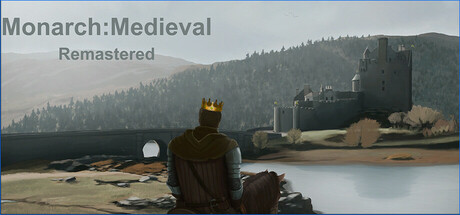
Monarch : Medieval Remastered
In the medieval era, assume the role of a lord and engage with other lords,develop fiefdoms, and employ strategies involving intrigue, warfare, and plunder. Expand your territory and strengthen your house lineage Or, be a god, manipulate the world? This game primarily strategic role-playing elements

Hollywood Animal
Make movies, even if someone has to die. Take the helm of a major Hollywood studio at the dawn of sound cinema, and guide it through decades of creative achievements and glamor, debauchery and dark deeds, tough choices and unpleasant compromises.
Frequently Asked Questions
The Succession of Changing Kings is currently priced at 5.32€ on Steam.
Yes, The Succession of Changing Kings is currently available at a 40% discount. You can purchase it for 5.32€ on Steam.
Yes, The Succession of Changing Kings received 288 positive votes out of a total of 327 achieving a rating of 8.14.
😎
The Succession of Changing Kings was developed and published by KwaKwaGames.
Yes, The Succession of Changing Kings is playable and fully supported on Windows.
No, The Succession of Changing Kings is not playable on MacOS.
No, The Succession of Changing Kings is not playable on Linux.
This information about The Succession of Changing Kings is not available yet.
This information about The Succession of Changing Kings is not available yet.
No, The Succession of Changing Kings does not support VR.
The Succession of Changing Kings is a single-player game.
No, The Succession of Changing Kings does not currently offer any DLC.
No, The Succession of Changing Kings does not support mods via Steam Workshop.
No, The Succession of Changing Kings does not support Steam Remote Play.
Yes, The Succession of Changing Kings is enabled for Steam Family Sharing. This means you can share the game with authorized users from your Steam Library, allowing them to play it on their own accounts. For more details on how the feature works, you can read the original Steam Family Sharing announcement or visit the Steam Family Sharing user guide and FAQ page.
You can find solutions or submit a support ticket by visiting the Steam Support page for The Succession of Changing Kings.
Data sources
The information presented on this page is sourced from reliable APIs to ensure accuracy and relevance. We utilize the Steam API to gather data on game details, including titles, descriptions, prices, and user reviews. This allows us to provide you with the most up-to-date information directly from the Steam platform.
Additionally, we incorporate data from the SteamSpy API, which offers insights into game sales and player statistics. This helps us present a comprehensive view of each game's popularity and performance within the gaming community.
Last Updates| Steam data | 30 August 2026 17:28 UTC |
|---|---|
| SteamSpy data | 11 September 2026 06:45 UTC |
| Steam price | 13 September 2026 02:52 UTC |
| Steam reviews | 11 September 2026 19:52 UTC |
If you'd like to dive deeper into the details about The Succession of Changing Kings, we invite you to check out a few dedicated websites that offer extensive information and insights. These platforms provide valuable data, analysis, and user-generated reports to enhance your understanding of the game and its performance.
- SteamDB - A comprehensive database of everything on Steam about The Succession of Changing Kings
- SteamCharts - Analysis of The Succession of Changing Kings concurrent players on Steam
- ProtonDB - Crowdsourced reports on Linux and Steam Deck The Succession of Changing Kings compatibility

Game modes
Features
Online players
3
Developer
KwaKwaGames
Publisher
KwaKwaGames
Release
04 Mar 2026
Platforms
Clicking and buying through these links helps us earn a commission to maintain our services.