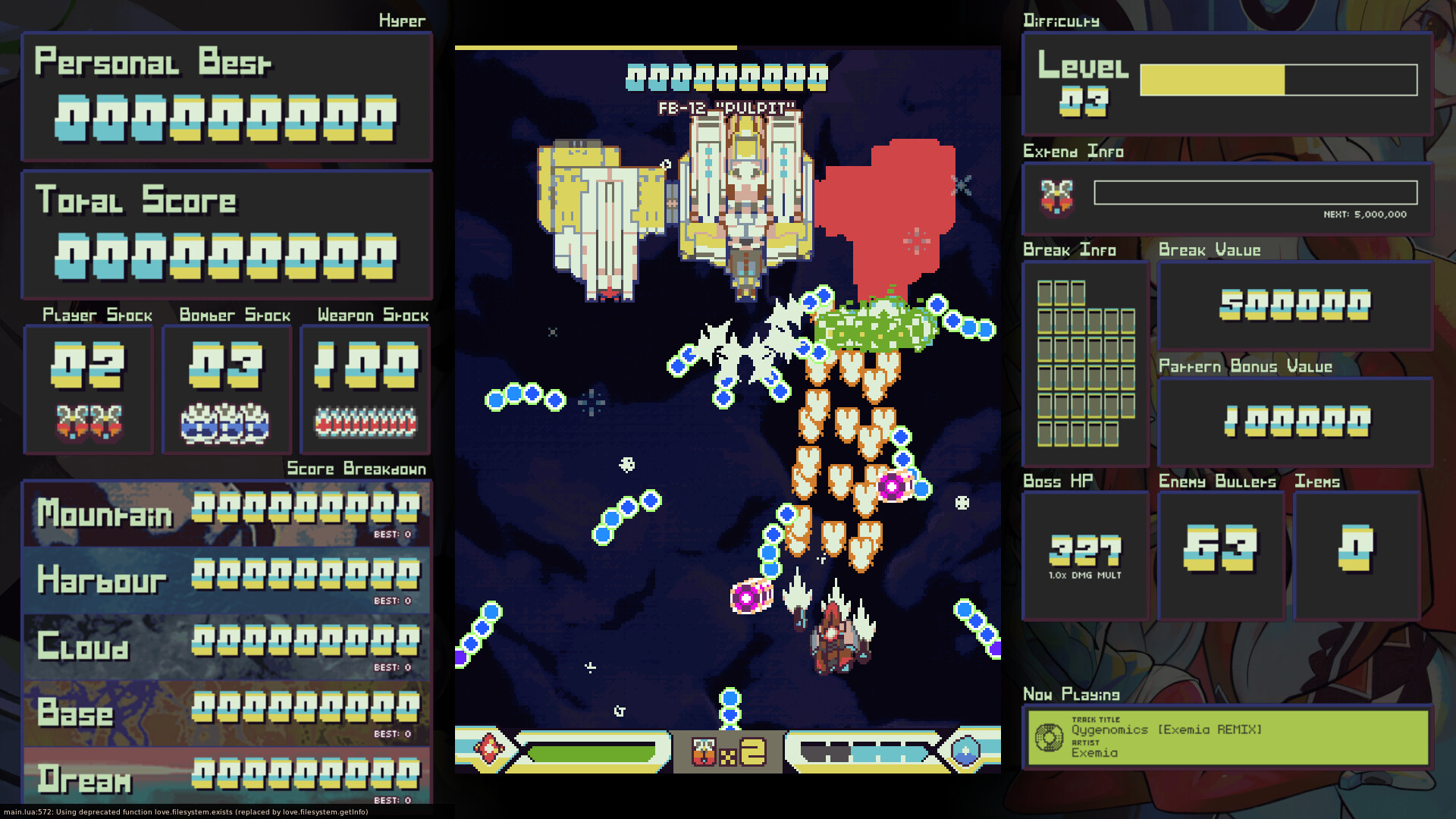
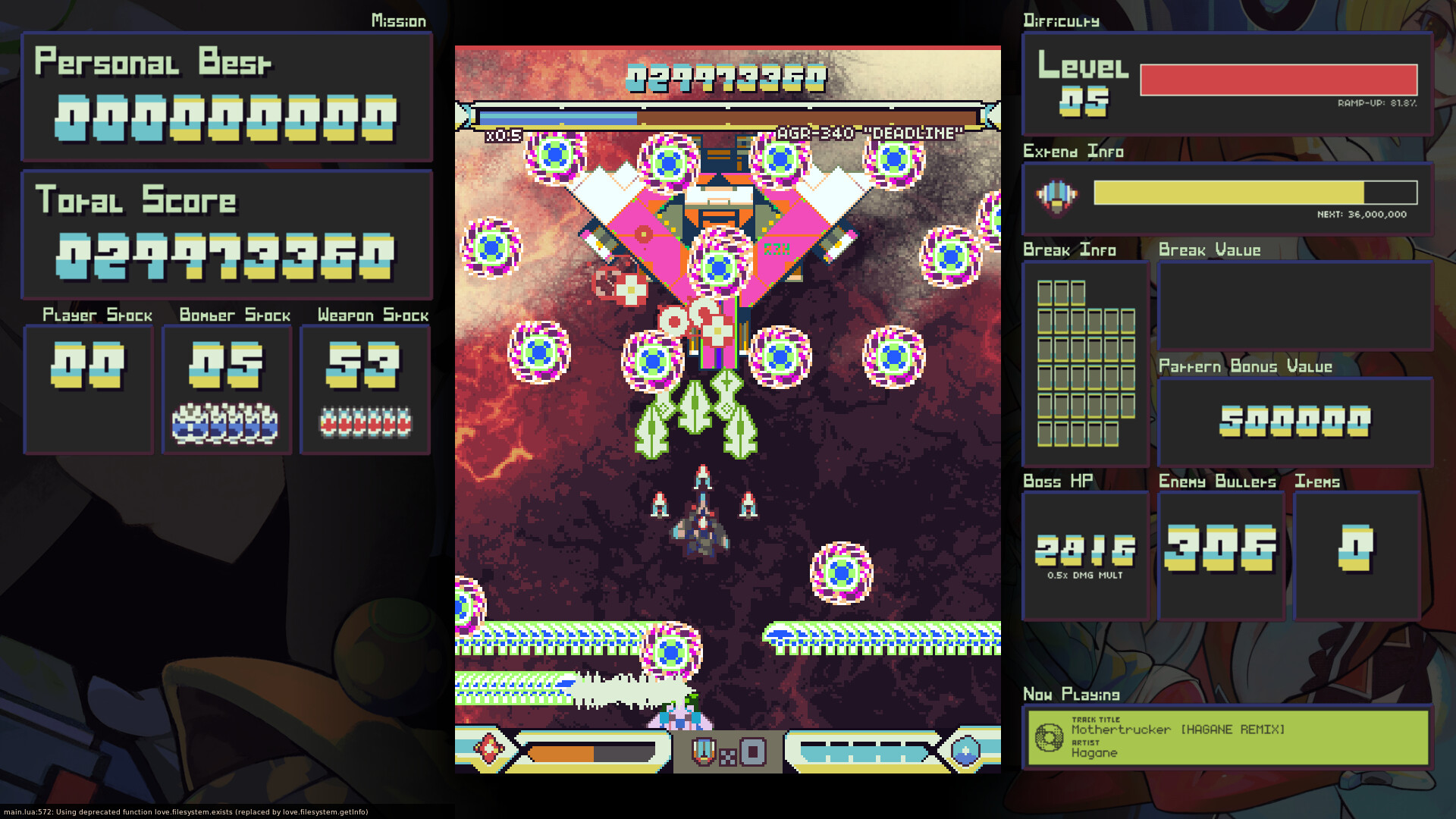
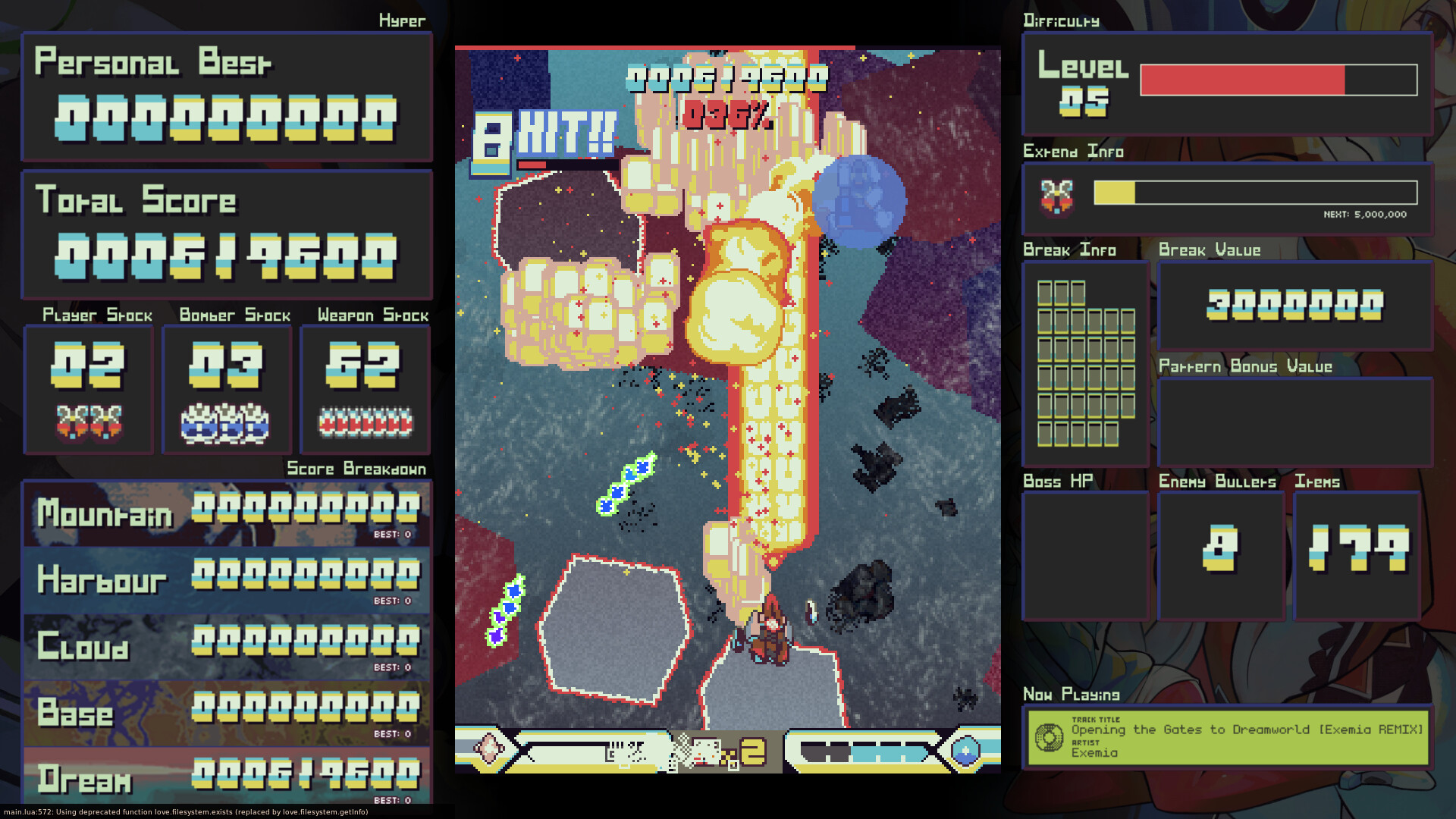
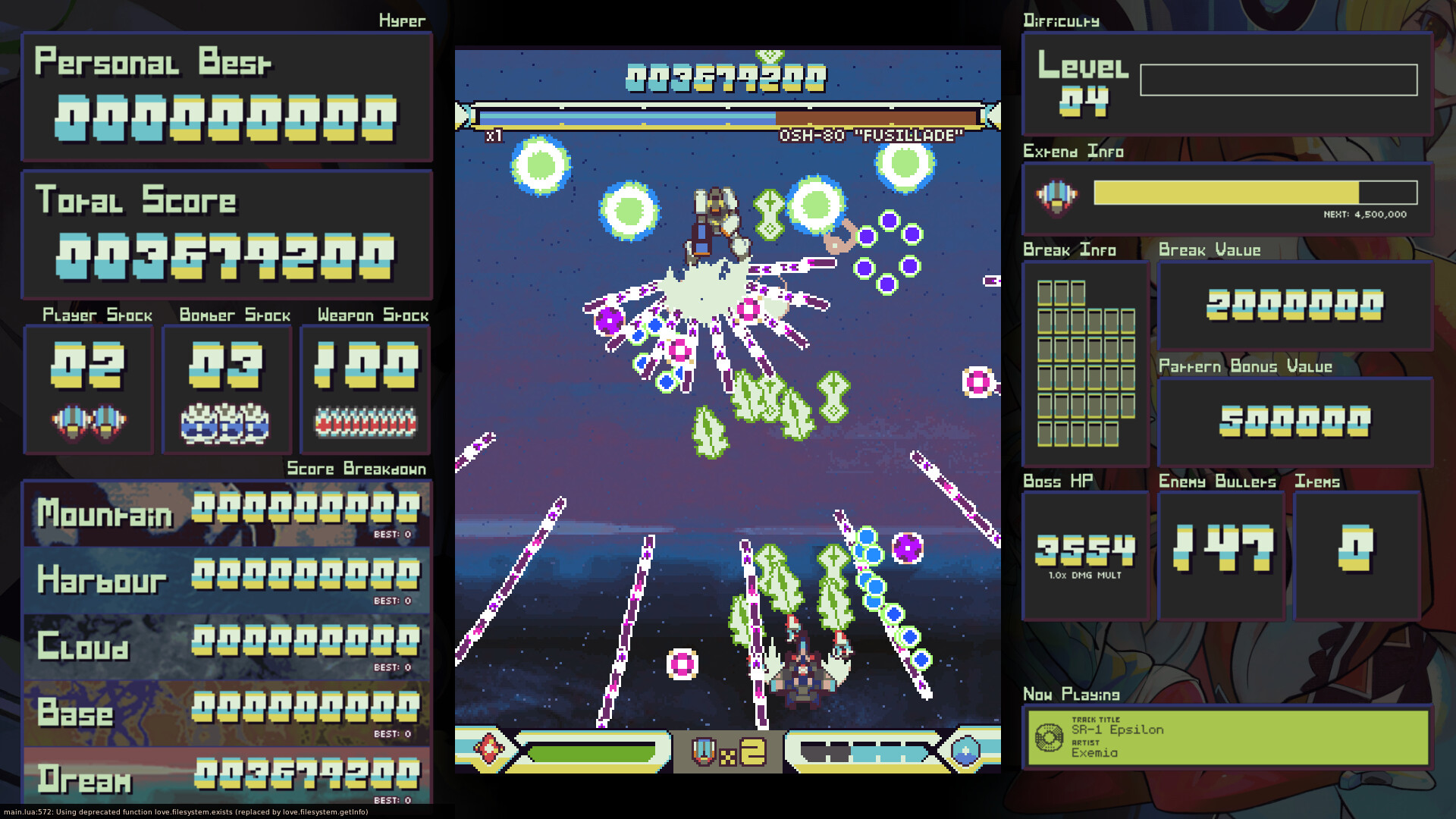
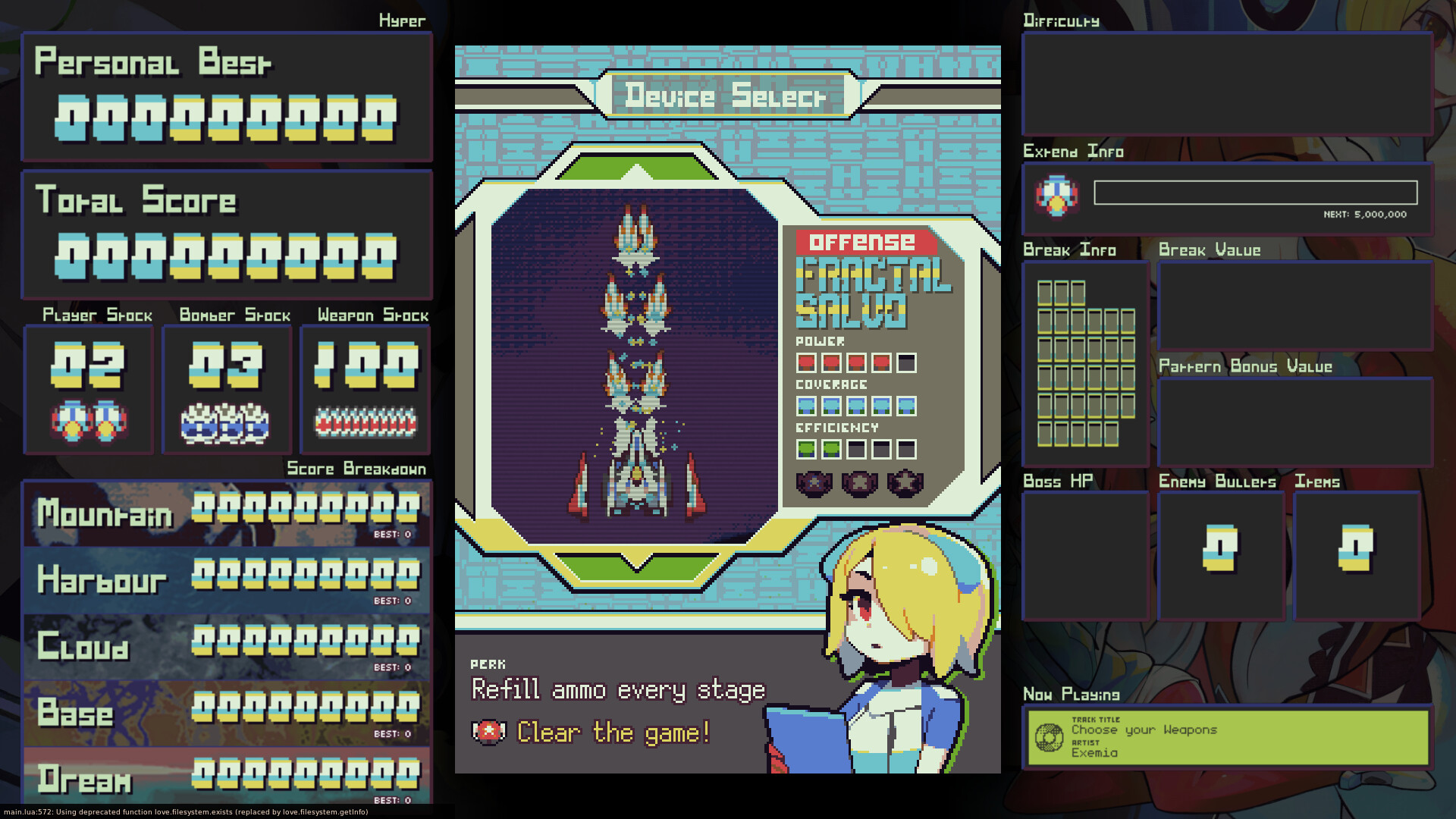
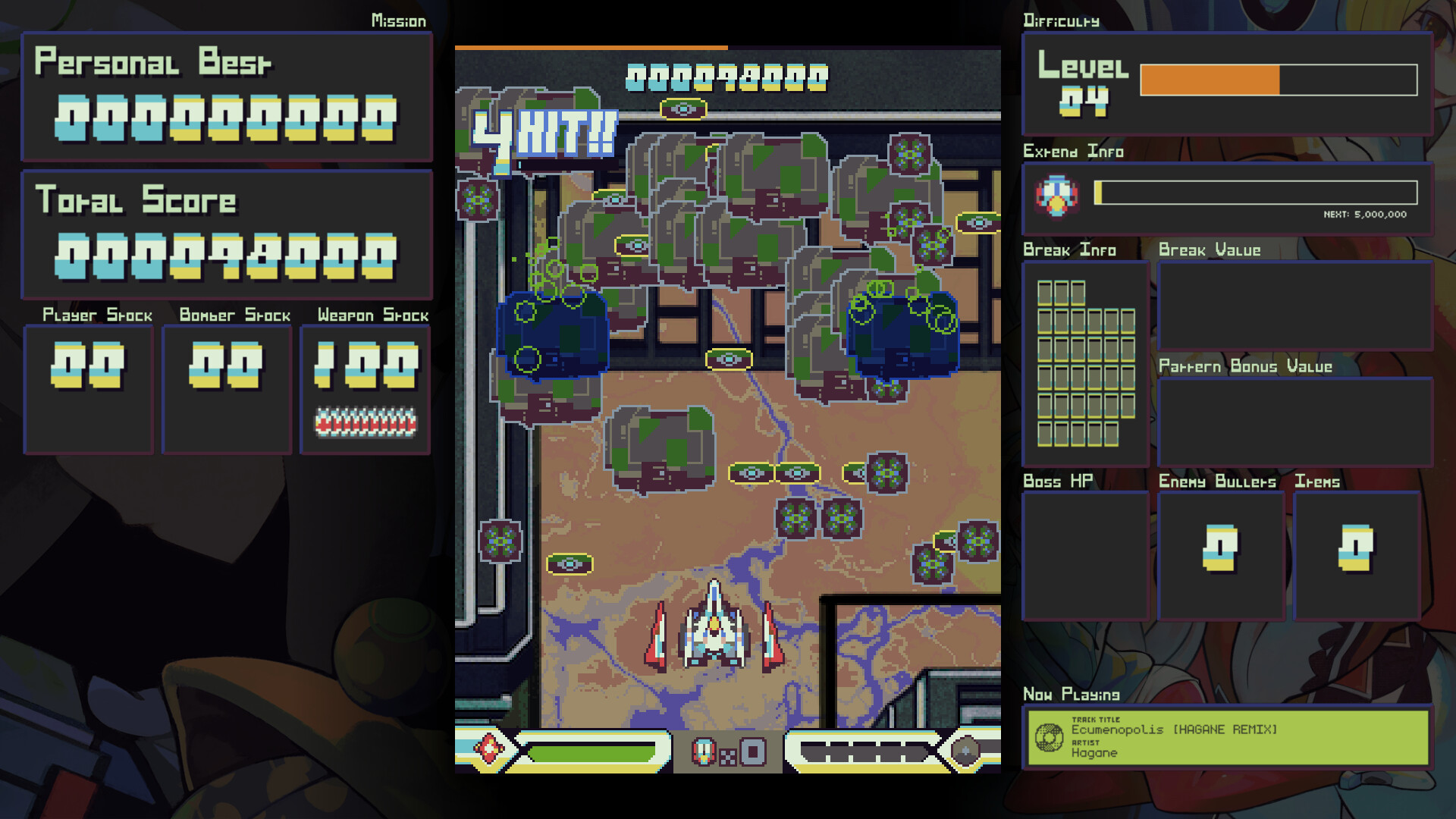
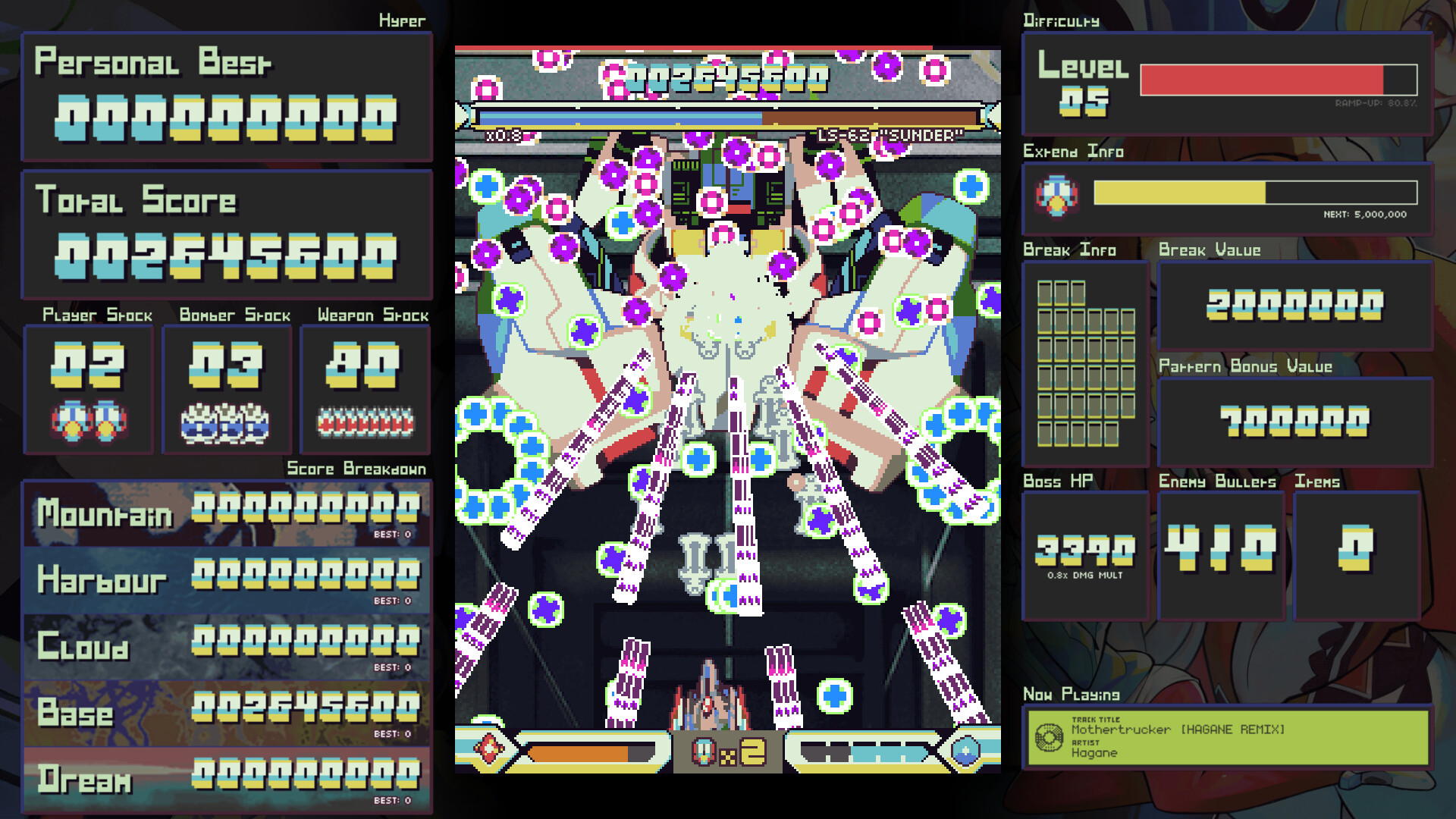
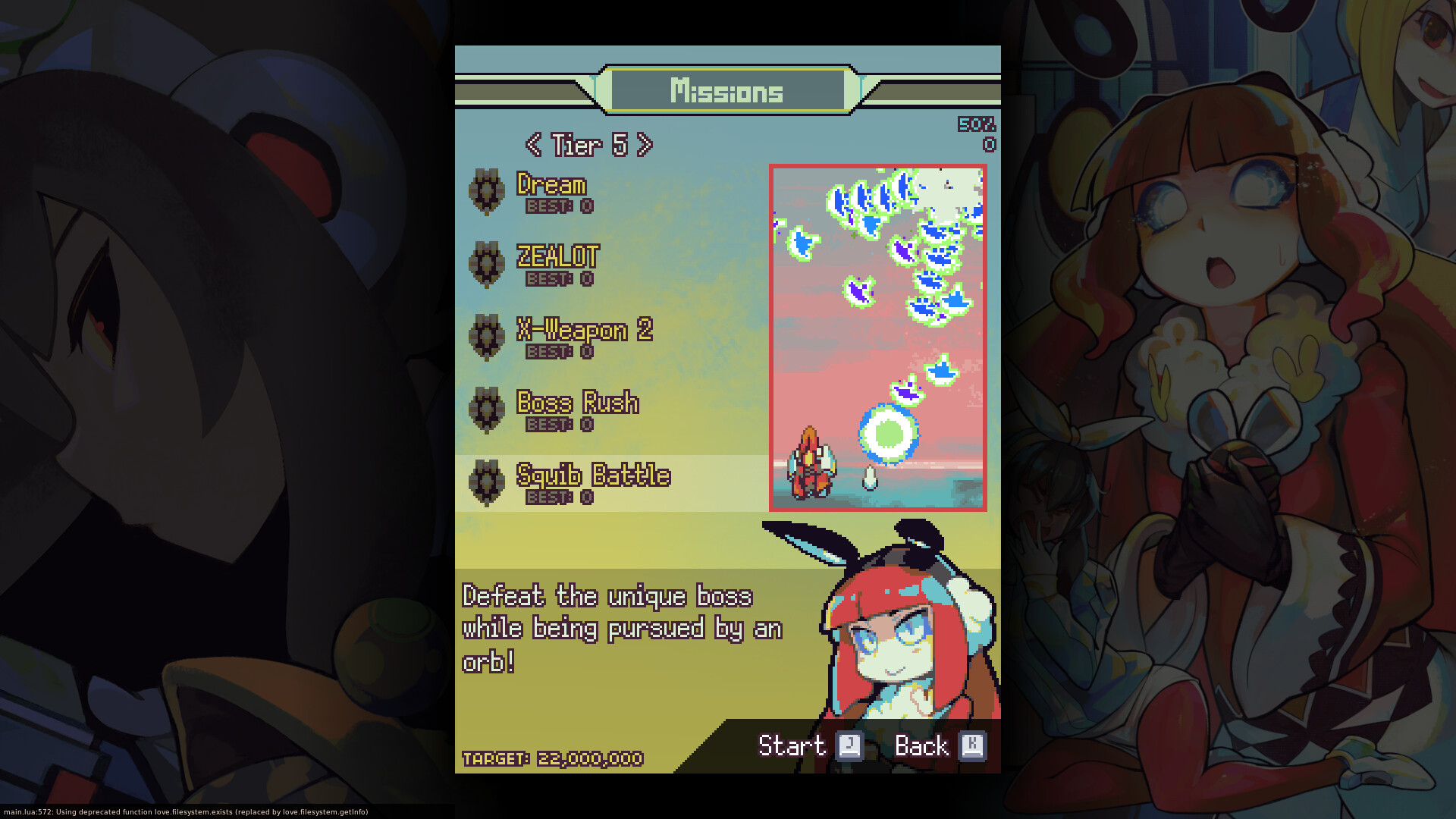
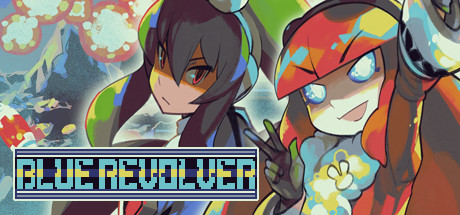
tl;dr - An absolute recommend to all STG enthusiasts, new and old. Blue Revolver: Double Action represents the definitive version of the game to play. I feel like it's time to finally write about this brilliant game. Sorry for the long review, but my rambling turned a bit passionate. From the early dev streams in 2015, the fun stage 1 community score attacks in early iterations, the v0.45 disc distributed at Touhoucon by woof that year (which came with a fantastic OST promotional minimix by Dyzphazia that I still listen to), to the eventual release in late 2016. While I wasn't keeping a keen eye on the game's development leading up to its release, when the game finally released its impact on the scene was large - marking what I believe was a pivotal point in the indie and doujin STG scene and contributing to the renaissance of the genre's future. When Blue Revolver first came out, the game was like a breath of fresh air. Easy-to-grasp scoring mechanics, brutal rank-based difficulty, a killer aesthetic thanks to woof's art style and Qygen & Novaturtle's soundtrack. While the game did commit to a pixel style in-game, the flair of woof's artistry was preserved through the simplicity of the sprites and choice of colours, aiming to offer a seamless transition between the two mediums. The music offered a mix of electronic hardcore genres like techno and psytrance, high tempo and high BPM to match the high octane pacing of the gameplay. As an indie shoot 'em up, Blue Revolver offered one of the most complete packages of its kind. The gameplay was everything you could expect from a bullet-hell STG: a large number of bullets, small player ship hitbox, evade and destroy them all to win the game. Easier said than done, of course. The game's scoring system is where the more intricate and technical aspect of the game lies. Destroy 8 ships (or objects) to max the hit counter, then cash it in by using your special shot to destroy things with a multiplier. Simple enough to understand so that new players wouldn't have to think too much when integrating it into their approach, but those seeking the elusive score extends may want to sit down and route out the optimal enemies to cash in on in the stage. The first set of extends are fairly obtainable without too much effort, with the score requirement subsequently increasing each time. The design isn't anything new but it offered a fun little taste for the lesser or uninitiated to try and push for more to increase their chances of survival. To make the scoring feel less stiff, the game introduced hidden "Break bonuses" throughout the run. They're a callback to a classic retro school of thought: If you perform some hidden requirement, you'll be offered bonus points. The number of Break bonuses in a stage are denoted by the Break counter at the end of a stage - with the exception Stage 5 which omitted the stage result screen (likely an intentional design to drive players like me insane on if we had found every Break). In similar fashion to the extends, the requirements for these hidden bonuses are usually lenient and new players will easily perform them on accident without any prior knowledge. This coupled with the Break counter in the stage result encouraged the player to try and approach sections differently and experiment, loosening the flow of the scoring system just enough so that they didn't feel completely anchored down when learning a level. The game was not without its flaws, however. Rank (dynamic difficulty) had always felt weird to me in the original iteration. In typical STG fashion, rank increases based on how well your perform/score and decreases when you die. While Normal and Parallel difficulty lock ranks at their respective values, Hyper took control of the full scale to provide a dynamic-feeling of difficulty. For me, I found that rank always raised faster than I could even hope to control it and often times I found myself wondering why I should even play Hyper when I usually found my rank in the realm of Parallel difficulty. To make things worse, certain sections of levels were designed a little too tightly to the core scoring system. This grew especially evident in the later stages where speedkilling would often result in "dead air" - an awkward state where you're waiting for 5-10 seconds with nothing to do until more enemies appear. At the time, I tolerated it, but as more indie/doujin STGs released, Blue Revolver unfortunately became the kind of game I could only recommend to genuine enthusiasts of the genre; there simply were better STGs out there. Blue Revolver walked so they could run. danbo, the developer for Blue Revolver, was aware of the inherent problems in some of the game's flow. Perhaps "aware" is an understatement; true scrutiny of a work can only truly be done by its creator. If anyone was aware of its issues, it would be him. Thus, Double Action was announced as a free arrange mode update, originally aiming to shift the gameplay of Blue Revolver and hopefully alleviate some of the problematic elements of its gameplay. To be included was a remixed soundtrack done by Exemia and Hagane. It sounded like it was going to breathe new life into the game. But Double Action was delayed. Forgive me ahead of time, I am far too lazy to do my research here and I didn't follow the development of Double Action too closely. I don't even recall when Double Action was announced other than it being what felt like ages ago, and soon my hype for it faded. The few glimpses I did see from danbo on twitter, however, made it clear that he was going through a rough patch in life. This was, in no doubt, exacerbated by the onset of the COVID-19 pandemic which shook our world and changed a lot of how we lived our lives. I'll refrain from the digression, but the simple explanation was that many things were preventing danbo from fully realizing Double Action. To me, the arrange mode would release when it was ready. Years went by and I completely forgot about the game. My life took a turn for a new career path and I was back in college in 2024 - when suddenly a public beta branch went up for Double Action, labeled as v1.50a (likely a reference to CAVE STGs having their infamous 1.5 rebalance). I played it for a run or two and really liked it, but my life was busy so that was as much as I played. Blue Revolver: Double Action released as a free update in November 2024 but I simply didn't have the time and completely forgot about it. Nearly a year later, I finally sat down and put in some decent time into the game. What was previously envisioned as an arrange mode turned out to be a full game rebalance. Although the core scoring system remains the same, extends, rank values, special cash-in timings, and much more were adjusted to allow the game to be much more freeform. Additionally, some stage sections and bullet patterns were completely redone, with stage 5 feeling like a completely new game. Hyper difficulty no longer quickly ramps up to some pseudo-Parallel difficulty mode and extends. Normal and Hyper have extends every X-million points, which encourages an engaging gameplay loop. Score hard, intentionally die to have more resources to score harder and get even more lives. Parallel's difficulty retains the fixed extends but with a bomb awarded every 10-million points, cementing its identity as a difficulty where resources are plentiful but dying is a very real consequence. Blue Revolver: Double Action became far more than just an arranged mode - it's the definitive version of the game to play. Double Action has pushed the game out of its pitfalls and secured itself alongside other shoot 'em ups in the hall of timeless masterpieces. Between the wonderfully vibrant visuals and choice of colours, it's robust, energetic, and pulsing soundtrack, and the rewarding scoring system amid its cut-throat gameplay, Blue Revolver has established an ageless identity for itself. And to me, that is true success.
Expand the review