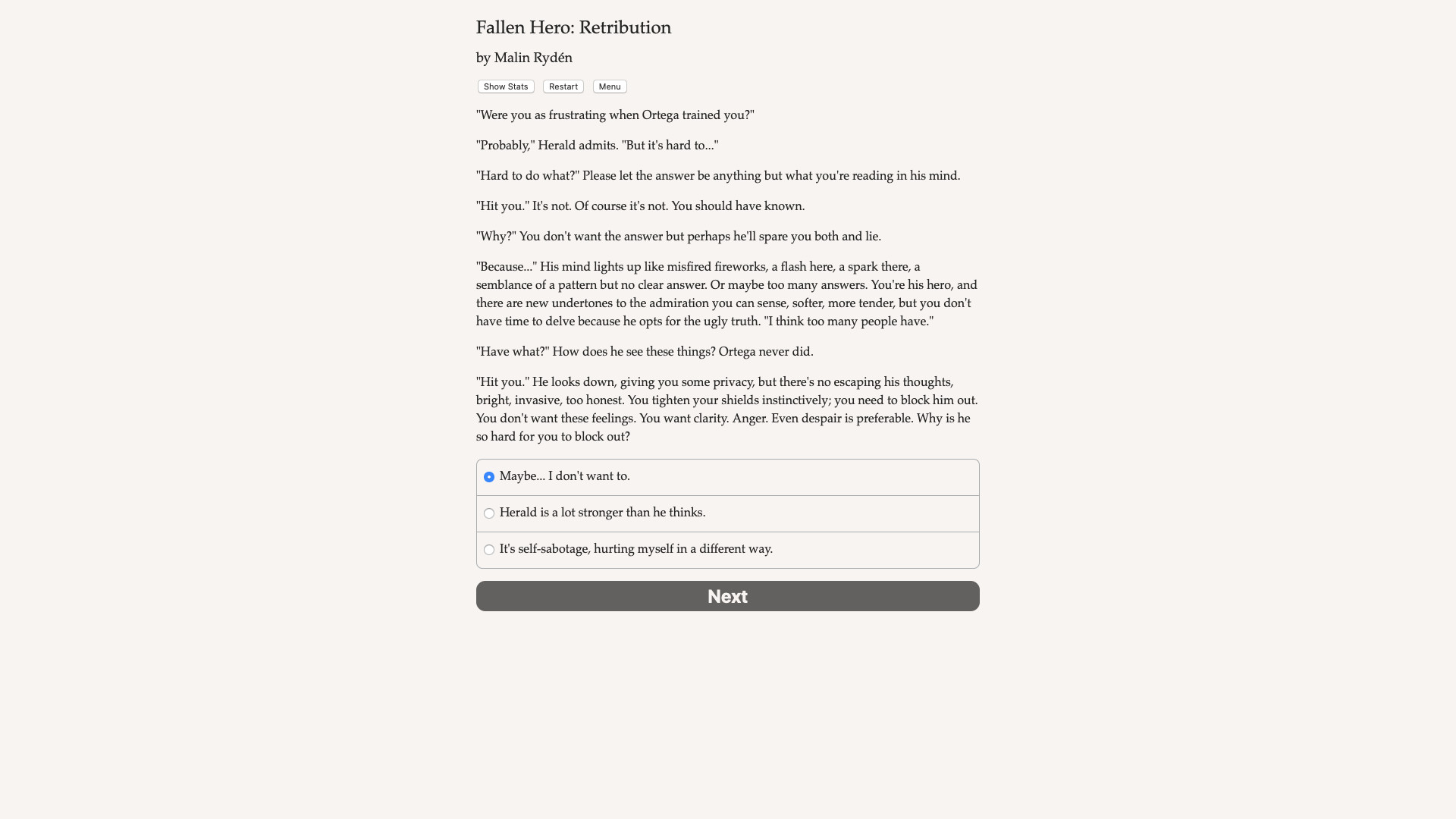
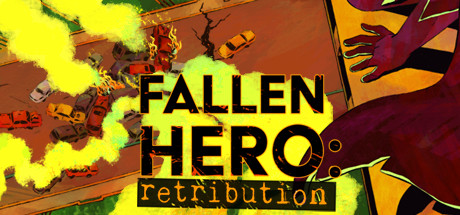
Reviewing (mostly) every game (or DLC) in my library, part 597: ⭐️⭐️⭐️⭐️⭐️⭐️⭐️⭐️⭐️⭐️ (10/10) [Inset Ben Affleck smoking.image here] YES, Fallen Hero: Retribution(“Retribution”) is exactly perfectly rated and deserves all the hype. I’m genuinely shaking after reading the last couple of chapters. It’s absolute CINEMA. I honestly don’t even know what to say because I’m putting my head in my hands. I try to be an objective reviewer, but I am literally frothing at the mouth right now. It’s fine. I’m fine. First, a warning that there will be MAJOR story/ending/character spoilers. I try to keep it vague for a potential buyer, but there’s no way to discuss Retribution without taking a look at the nitty-gritty. As such, I will assume a reader is familiar with Books 1 and 2. I gave the author’s first book, Fallen Hero: Rebirth (“Rebirth”), an 8/10. It was good—a fun premise, solid prose, eye-catching cast, but it didn’t blow me away like so many people on Reddit and the forums promised. To be fair to Rydén, my cons were purely personal; I felt like a vegan entering a steakhouse and wondering why I didn’t like the food. In sum, I was just not a fan of Sidestep being an unreliable narrator and being a semi-defined protagonist with—most importantly—a lot of trauma and baggage. It’s a valid writing design, but I’ve learned I need to know the MC’s motivations ASAP, and I have no patience for “wait, all will be revealed in time” or murky pasts. I need to understand why my character is acting the way they are early on, or I lose interest. Rebirth asked for patience I didn’t quite have, and when Retribution opened on a similar note, I braced myself for more of the same. I was wrong. Oh, so very wrong. Retribution has blown my expectations out of the water. So much so, in fact, that I have spent a pretty penny on Rydén’s Patreon. Hey, never let it be said that I don’t put my money where my mouth is. All my frustrations and critiques have been washed away. While the reader doesn’t get the full truth, not quite yet, there is an astounding amount of side characters, plot, main character, and romance development—so much so that I am flabbergasted. To put the cherry on top, the player choice and reactivity is unmatched. What truly fascinates me, however, is how Fallen Hero really focuses on the “Interactive” part of IF. Obviously, it’s a broad genre that encapsulates every different game under the sun. But part of FH’s mass appeal is its visceral, personal nature. It seems more “modern” than other works with its deliberate thematic focus on sexuality, gender, and duplicity. Of course, a modern audience would latch onto it. FH becomes what you choose to see in it. Pros: ✅ Clear(er) motivations. Finally. In the first couple of chapters, Sidestep came so close to spilling the beans, to thinking about the truth to themselves. But at the last second, Sidestep dismissed it. Wow, I felt lowkey edged. But the hints keep piling up until Sidestep breaks. Something has to, at least. And after hearing what Sidestep has to say? My opinion of their whininess and edginess has done a complete 180. Do I feel a little ashamed of ripping into them in my past review? Perhaps a tad. Do I think I was justified in jumping the gun? Perhaps more than a little. I’m only human, after all, and Rydén gets a bit meta with the unreliable narrator. Here, we don’t have a traditional external narrator correcting Sidestep. We live entirely inside Sidestep’s perspective. Their thoughts are immediate, raw, defensive. They justify. They deflect. They catastrophize. When they call themselves monstrous, it feels factual. When they insist they’re alone, it feels true. But the dissonance emerges from the friction between their internal monologue and the world’s response. And after hearing the big Tragic Backstory™️, the distance between player and protagonist finally closes. Sidestep is still kind of a loser, but I understand them now. ✅ Player choice. Now, I’m pretty sure I didn’t play the game the “right” way. I didn’t play a monster. I didn’t lean into the title of a fallen hero. Instead, I chose, stubbornly, almost defiantly, not to harm when I could have. I chose to tell the truth when lies would have been cleaner. I chose to unmask myself—twice. I chose to say I love you. I chose to reach out to old foes. I even chose to go to therapy! In short, I played the worst villain ever. My kingdom for a pretty woman, I guess. I chose connection over control, softness over spectacle. And somehow, I was playing a hero. Sidestep is still a mess and hasn’t labeled themselves so, but … Tell me why I got an achievement that says Or why the last achievement I got was Fallen Hero becomes the story you want to tell. If you want blood, it will give you blood. But I wanted forgiveness and justice, so I earned it myself. ✅ Relationship system. Rydén’s freedom philosophy extends to the cast and, especially, the relationship system, which is among the most dynamic I’ve seen in a ChoiceScript game. After looking into the code a bit, I believe Rydén’s use of variables (if that’s what they’re called) is how they create such a flexible, natural system. In quite a lot of IF, most relationships are based on stats. Let’s say, 80% of a relationship bar gets you a passionate romance scene, but 70% gets you a chaste romance scene. There’s not much room for callbacks or to do anything fun with a stat. But by using a variable that tracks specific emotions—like whether Ortega bit you or whether your Sidestep regrets killing—callbacks are naturally easier. It’s a lot more work, but god, does it pay off. So, your relationships aren’t just basic “Ortega loves you,” but you can choose whether to be allies, friends, enemies, lovers, or even how you feel toward them. ✅ Romance. Okay, first off. I have to praise Retribution for its flexibility. I, ahem, flirted with Ortega. And Lady Argent. And Mortum, both (triple?) as Sidestep, Puppetmaster, and my puppet. I’m not ashamed either! I loved how the narrative and characters make pointed questions, ask heavy questions, and reference your flirting. Quite a bit. I love the characters, too. All right, I can’t even be objective anymore. The chemistry between Sidestep, Ortega, and Argent is unreal. UNREAL. Ortega brings history, softness edged with hurt, that sense of “the one that got away.” Argent is all sharpness, dominance, and rivalry. The poly relationship has some of the best chemistry I’ve read in a while. That ♥♥♥♥ had me giggling and kicking my feet. No notes. 10/10. I need more poly content. Please? Cons: 🟥 I think the buy-in will be hard for readers like me who were put off by Book 1. Book 2 is phenomenal, but it still builds on foundations laid in Rebirth. If you bounced off the first game because of Sidestep’s opacity or the slow burn of its reveals, this sequel asks you to trust that those frustrations are intentional. That’s a big ask, tbh. Not everyone will want to make it. I don’t subscribe to the idea that mediocrity is automatically justified by a strong payoff, or that audiences are obligated to endure five uneven episodes to earn a good sixth. A story should stand on its own merits at every stage. But I'll give this book a pass. Just this once! If you enjoyed this review, please check out my curator page to find more: [url=https://store.steampowered.com/curator/45814768-Verdict-Play-or-Pass/]Verdict: Play or Pass. Also, please leave a like and visit [url=https://steamcommunity.com/groups/Indie_Gems]IndieGems and our [url=https://www.youtube.com/@IndieGems2]YouTube channel for more reviews like this one.
Expand the review