
Democracy 3
Have you ever wanted to be president? or prime-minister? Convinced you could do a better job of running the country? Let's face it, you could hardly do a worse job than our current political leaders.
Sync your Steam wishlist to find the lowest game prices instantly. No login required, just paste your Steam profile URL!
⚡ Try Wishlist Radar!
Sync your Steam wishlist to find the lowest game prices instantly. No login required!
⚡ Try Wishlist Radar!
Close

Lawgivers on Steam
Quick menu
Lawgivers is a turn-based political simulation game. Run for elections with your own party and enter parliament to approve or abolish laws. Appoint the president and decide whether you want a democracy or just a fake one instead.
Lawgivers is a political sim, simulation and choices matter game
developed by Damian Bernardi
and published by SomniumSoft.
Released on April 02nd 2020 is available on Windows, MacOS, Linux, Steam Deck and Steam Machine.
It has received 385 reviews of which 325 were positive and 60 were negative resulting in a rating of 7.9 out of 10. 😊
The game is currently priced at 1.74€ on Steam with a 75% discount.
The Steam community has classified Lawgivers into these genres:
Media & Screenshots
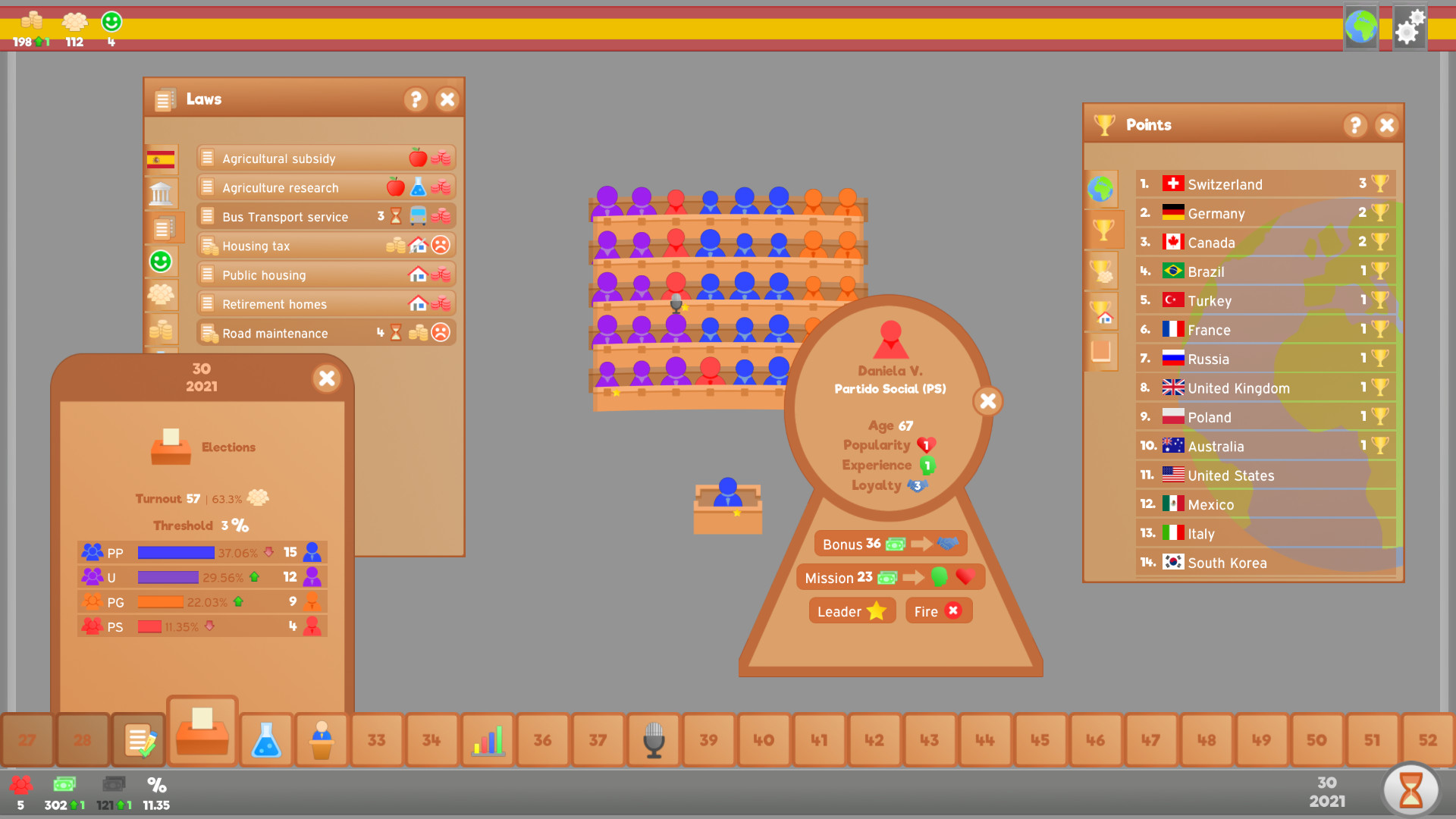
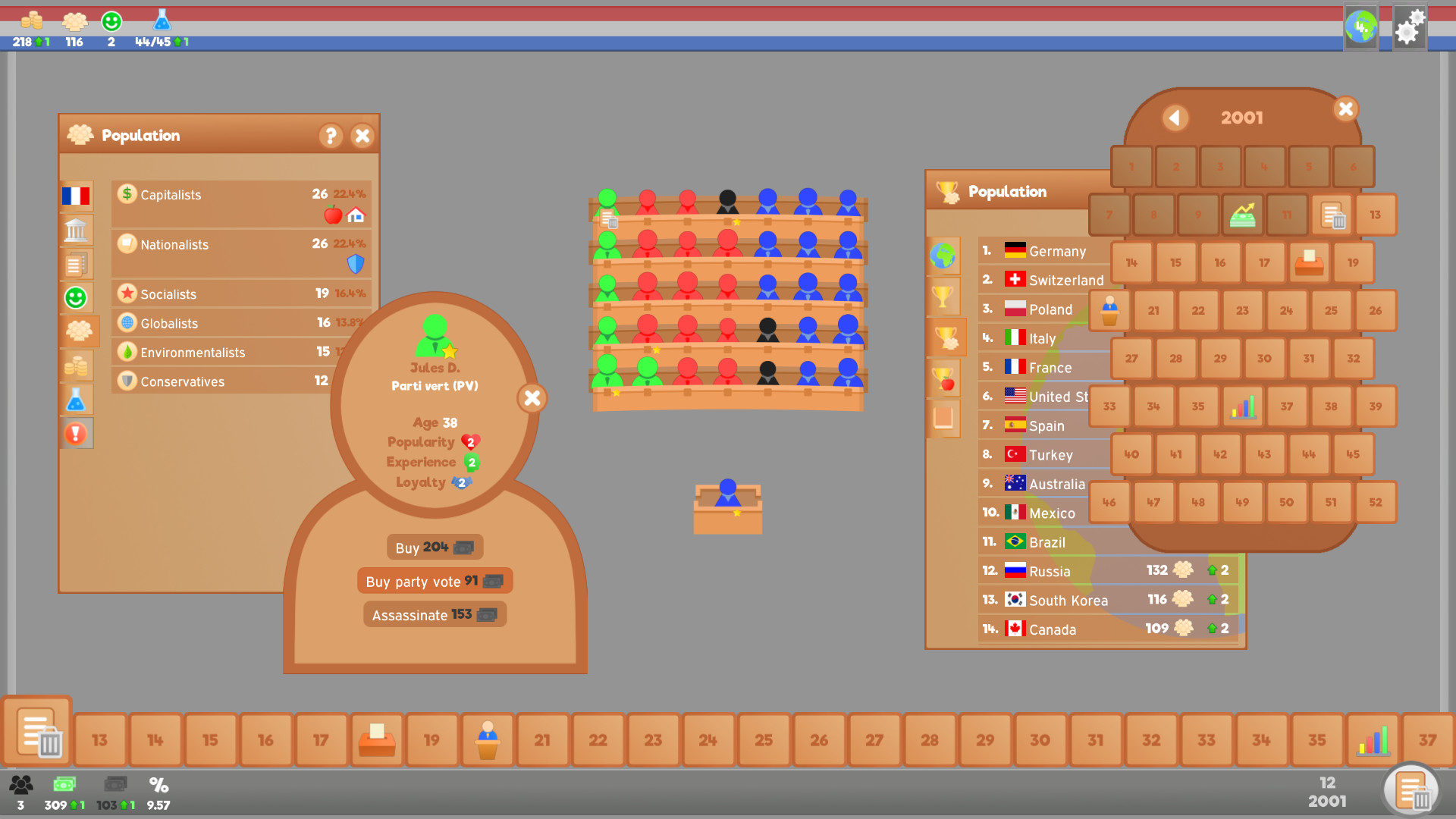
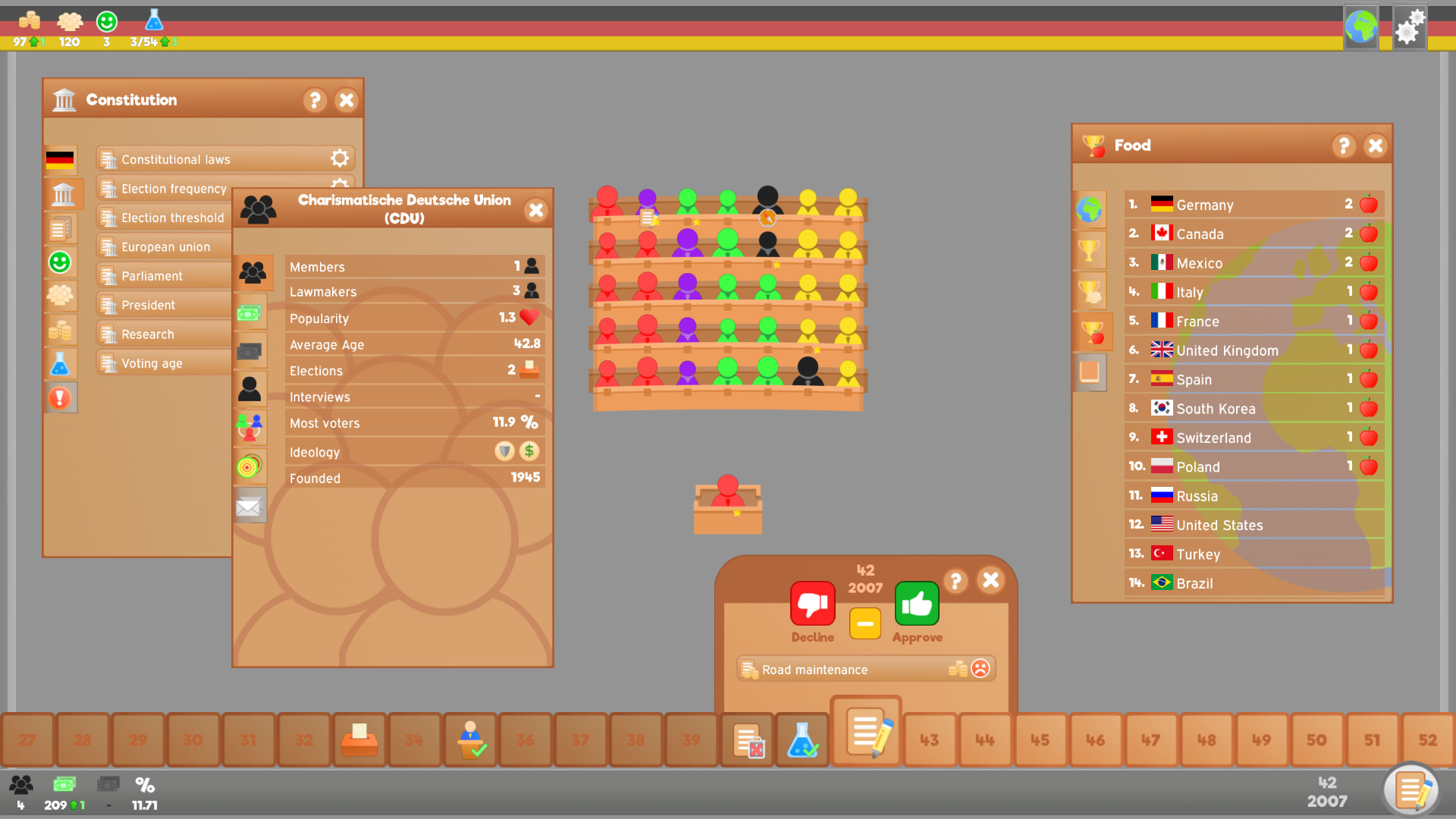
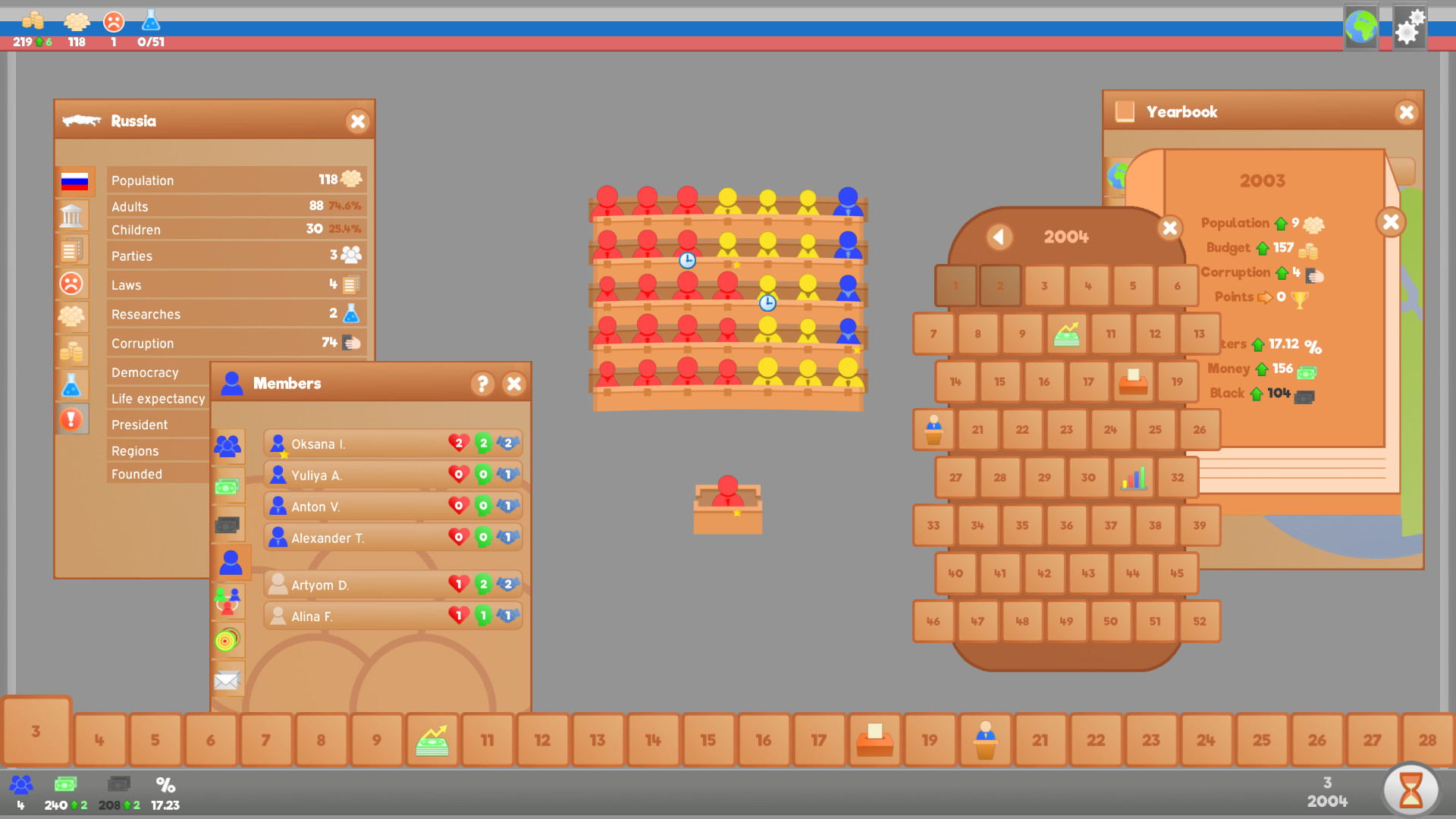
Get an in-depth look at Lawgivers through various videos and screenshots.

System requirements
These are the minimum specifications needed to play the game. For the best experience, we recommend that you verify them.
Windows
- Processor: 1.2 Ghz Dual Core
- Memory: 3 GB RAM
- Graphics: Intel HD Graphics 3000 or equivalent AMD/Nvidia
- Storage: 500 MB available space
MacOS
- Processor: 1.2 Ghz Dual Core
- Memory: 3 GB RAM
- Graphics: Intel HD Graphics 3000 or equivalent AMD/Nvidia
- Storage: 500 MB available space
Linux
- Processor: 1.2 Ghz Dual Core
- Memory: 3 GB RAM
- Graphics: Intel HD Graphics 3000 or equivalent AMD/Nvidia
- Storage: 500 MB available space
Steam Price & Best Deals
User reviews & Ratings
Explore reviews from Steam users sharing their experiences and what they love about the game.
Lawgivers takes the complicated world of elections, political parties, parliamentary voting, and legislation and transforms it into an approachable turn-based strategy experience. Developed by Damian Bernardi and published by SomniumSoft, the game focuses less on running every detail of a nation and more on the struggle required to obtain and maintain political influence. Elections are only the beginning, as gaining seats in parliament opens the door to proposing laws, negotiating with rival parties, managing politicians, and gradually changing the political direction of the country. Campaigning establishes the foundation of each playthrough. Your party needs enough public support to gain representation, and promises can be used to attract voters with different priorities. The interesting part is that electoral promises are not simply objectives that must automatically be completed. Players can decide how seriously they intend to honor them once the election is over. This creates an amusing political balancing act between satisfying voters, strengthening the party, and pursuing whatever long-term agenda you have established. It is a relatively simple system mechanically, but it effectively captures the difference between campaigning for power and actually exercising it. Parliament is where the strategy becomes more engaging. Laws can be proposed, approved, or abolished, but having a political objective does not necessarily mean possessing enough votes to accomplish it. Relationships with other parties therefore become important, particularly when your party lacks a commanding majority. Building cooperation can provide the additional support needed to pass legislation, while less honorable methods such as bribing politicians offer alternative solutions. There is also involvement in presidential appointments, allowing parliamentary influence to extend beyond ordinary legislation. Individual politicians are more than decorative names attached to parliamentary seats. Experience, popularity, and loyalty influence how useful representatives are to the party, giving players another collection of variables to manage between elections. The character management is intentionally streamlined rather than being a complex social simulation, but it adds enough personality to prevent the political system from feeling completely mechanical. Maintaining a successful party consequently requires attention to internal stability as well as competition with political opponents. One of the strongest elements is the selection of legislation available. More than 140 ordinary and constitutional laws provide plenty of opportunities to alter the political environment, while dozens of scientific advances can unlock additional events and missions. Constitutional laws are especially interesting because they allow players to influence the underlying rules rather than simply adjusting individual policies. This supports the sandbox nature of the game extremely well. A campaign can begin as a conventional attempt to win democratic elections and eventually evolve into something considerably more ambitious depending on how the player chooses to manipulate the system. There are 20 playable countries, including major nations such as the United States, United Kingdom, Germany, Russia, and South Korea. These should be viewed as settings for the game's political mechanics rather than perfectly detailed simulations of their real-world institutions. Lawgivers deliberately abstracts many complicated aspects of government so that players can quickly understand what their decisions accomplish. That accessibility makes it easier to experiment with different parties and strategies, although anyone expecting an exhaustive simulation of economics, diplomacy, demographics, bureaucracy, and constitutional procedure may find the experience somewhat simplified. Visually, the game prioritizes clarity over spectacle. Most of your attention is spent navigating menus, examining political information, monitoring representatives, and making strategic decisions. The modest 2D presentation works reasonably well because elaborate graphics would contribute little to the central gameplay. Hardware requirements are correspondingly lightweight, making the game accessible even on relatively modest computers. Steam achievements and Steam Cloud support provide some additional convenience for players interested in completing multiple campaigns. Steam Deck compatibility is officially categorized as Playable rather than fully Verified. Performance with the default graphics configuration is considered suitable, and the game can run successfully on SteamOS. However, handheld players should expect compromises. Some functionality is not fully accessible through the default controller configuration, touchscreen interaction or a community controller layout may occasionally be useful, and text entry can require manually opening the virtual keyboard. Some interface text may also appear small, while certain prompts can display keyboard, mouse, or non-Steam Deck controller icons. It is therefore functional on the Deck, but the experience is less seamless than a fully optimized handheld release. The main limitation is that its accessibility inevitably comes at the expense of simulation depth. Political systems that are enormously complicated in reality are condensed into understandable mechanics, and experienced strategy players may eventually learn how to manipulate those mechanics efficiently. Yet this simplification is also a major reason the game works. It delivers the fantasy of building a political movement, winning elections, forming alliances, controlling parliament, changing legislation, and reshaping a country without burying the player beneath endless administrative detail. Lawgivers is ultimately an enjoyable political sandbox for players who want strategy centered on elections and parliamentary maneuvering rather than warfare or conventional empire building. Its legislation system, multiple countries, party management, political relationships, and willingness to let players pursue both respectable and questionable routes to power give campaigns considerable personality. It may not be the deepest political simulator available, but its combination of accessibility, freedom, and replayability makes it easy to become absorbed in the pursuit of political influence. Rating: 8/10
Similar games
View all

Democracy 3 Africa
Democracy 3: Africa is the new standalone 're-imagining' of the hit political strategy game 'Democracy 3'. Set entirely in countries on the continent of Africa, D3:A puts you in charge of these countries and challenges you to stay in power whilst fixing each country's problems, improving the quality of life for your electorate, and...

Lawgivers II
Lawgivers II is a political sandbox game that features multiple electoral systems, approve/reject bills and govern a country. Start out your career from the very bottom, and perhaps one day, lead your nation to become the most influential in the world.

Ostalgie: The Berlin Wall
The confrontation between the East and the West is coming to an end, but not between East and West Germany. The old party leaders are still sitting in their offices, not changing anything and waiting for exclamations from Moscow. But their end is close – Gorbachev and Kohl have already decided...

China: Mao's legacy
Year 1976, the stormy Cultural revolution has died down, hard times of hongweibing and public critics are coming to an end. Old and sick Mao Zedong will soon leave China to his comrades from CPC. The Cold War is coming into a new phase...

Fate of the World
Fate of the World is a dramatic global strategy game that puts all our futures in your hands. The game features a dramatic set of scenarios based on the latest science covering the next two centuries. You must manage a balancing act of protecting the Earth’s resources and climate versus the needs of an ever-growing world population, who...

Crisis in the Kremlin
Don’t let the Soviet Union collapse, and fall in the darkness of history or lead the Union by a new path – democracy and free market! But before you decide something, think – wouldn’t it cause more harm than good?

Democracy 4
Democracy 4 lets you take the role of President / Prime minister, govern the country (choosing its policies, laws and other actions), and both transform the country as you see fit, while trying to retain enough popularity to get re-elected...

Orwell: Ignorance is Strength
Step into the shoes of a government official in a top-secret department of the Orwell surveillance program. Given the power to both uncover and fabricate "the truth", how far will you go in the service of your country? Season 2 of Orwell, the award-winning surveillance thriller.

The Political Process
Explore a dynamic world of politics in this turn-based, political simulator. Create a character, run for political office, write legislation, balance budgets, and more as you move up the political hierarchy.


Orwell: Keeping an Eye On You
Big Brother has arrived - and it’s you. Investigate the lives of citizens to find those responsible for a series of terror attacks. Information from the internet, personal communications and private files are all accessible to you. But, be warned, the information you supply will have consequences.
Frequently Asked Questions
Lawgivers is currently priced at 1.74€ on Steam.
Yes, Lawgivers is currently available at a 75% discount. You can purchase it for 1.74€ on Steam.
Yes, Lawgivers received 325 positive votes out of a total of 385 achieving a rating of 7.87.
😊
Lawgivers was developed by Damian Bernardi and published by SomniumSoft.
Yes, Lawgivers is playable and fully supported on Windows.
Yes, Lawgivers is playable and fully supported on MacOS.
Yes, Lawgivers is playable and fully supported on Linux.
Yes, Lawgivers is playable on Steam Deck, though it might require a few minor tweaks. Make sure to check the Steam store page and community feedback on ProtonDB for exact compatibility details.
Yes, Lawgivers is playable on Steam Machine, though it might require a few minor tweaks. Make sure to check the Steam store page and community feedback on ProtonDB for exact compatibility details.
No, Lawgivers does not support VR.
Lawgivers is a single-player game.
No, Lawgivers does not currently offer any DLC.
No, Lawgivers does not support mods via Steam Workshop.
No, Lawgivers does not support Steam Remote Play.
Yes, Lawgivers is enabled for Steam Family Sharing. This means you can share the game with authorized users from your Steam Library, allowing them to play it on their own accounts. For more details on how the feature works, you can read the original Steam Family Sharing announcement or visit the Steam Family Sharing user guide and FAQ page.
You can find solutions or submit a support ticket by visiting the Steam Support page for Lawgivers.
Data sources
The information presented on this page is sourced from reliable APIs to ensure accuracy and relevance. We utilize the Steam API to gather data on game details, including titles, descriptions, prices, and user reviews. This allows us to provide you with the most up-to-date information directly from the Steam platform.
Additionally, we incorporate data from the SteamSpy API, which offers insights into game sales and player statistics. This helps us present a comprehensive view of each game's popularity and performance within the gaming community.
Last Updates| Steam data | 14 October 2026 22:49 UTC |
|---|---|
| SteamSpy data | 21 October 2026 19:07 UTC |
| Steam price | 26 October 2026 19:56 UTC |
| Steam reviews | 20 October 2026 07:54 UTC |
If you'd like to dive deeper into the details about Lawgivers, we invite you to check out a few dedicated websites that offer extensive information and insights. These platforms provide valuable data, analysis, and user-generated reports to enhance your understanding of the game and its performance.
- SteamDB - A comprehensive database of everything on Steam about Lawgivers
- SteamCharts - Analysis of Lawgivers concurrent players on Steam
- ProtonDB - Crowdsourced reports on Linux and Steam Deck Lawgivers compatibility

Game modes
Features
Online players
3
Developer
Damian Bernardi
Publisher
SomniumSoft
Release
02 Apr 2020
Platforms