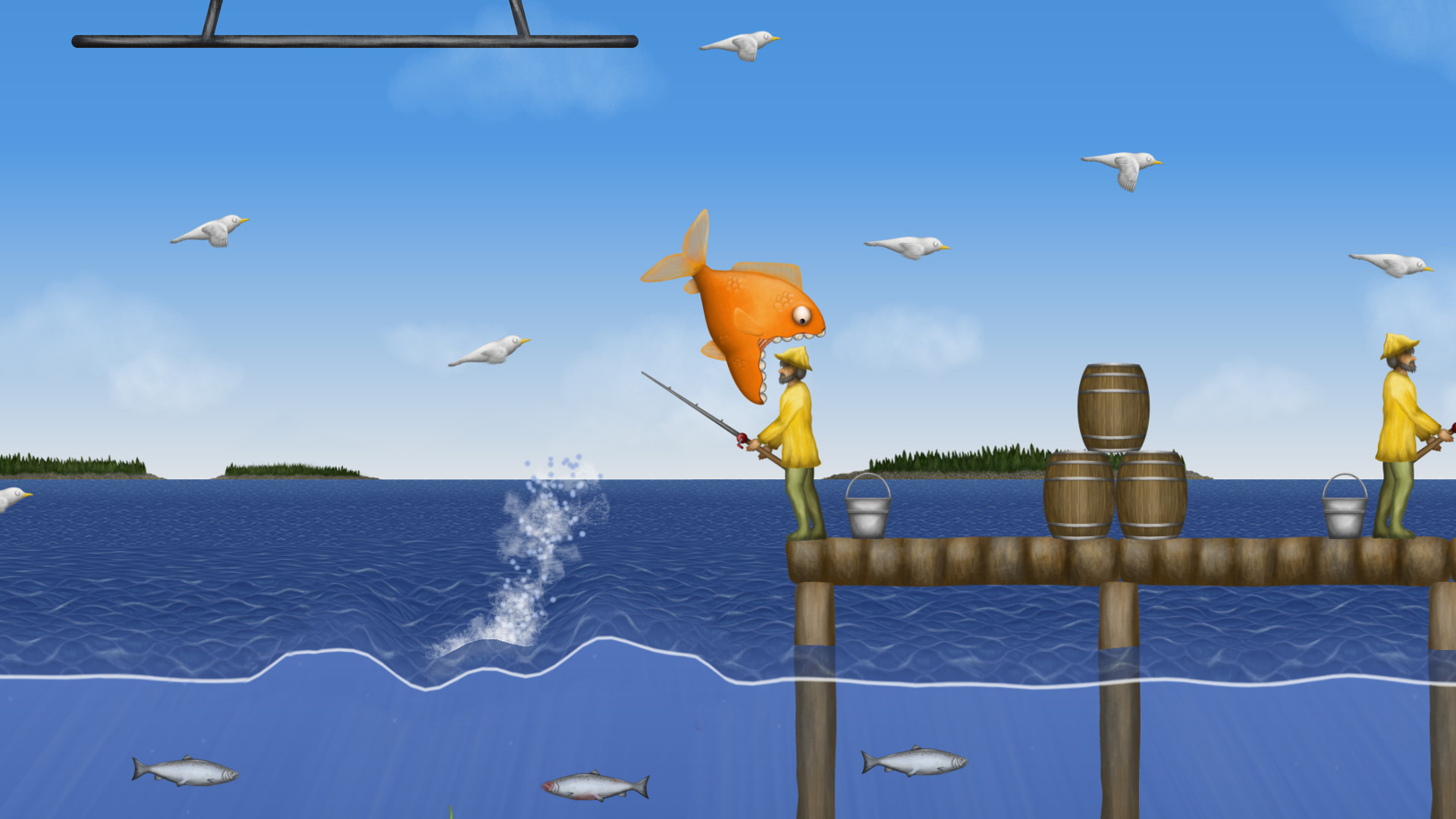
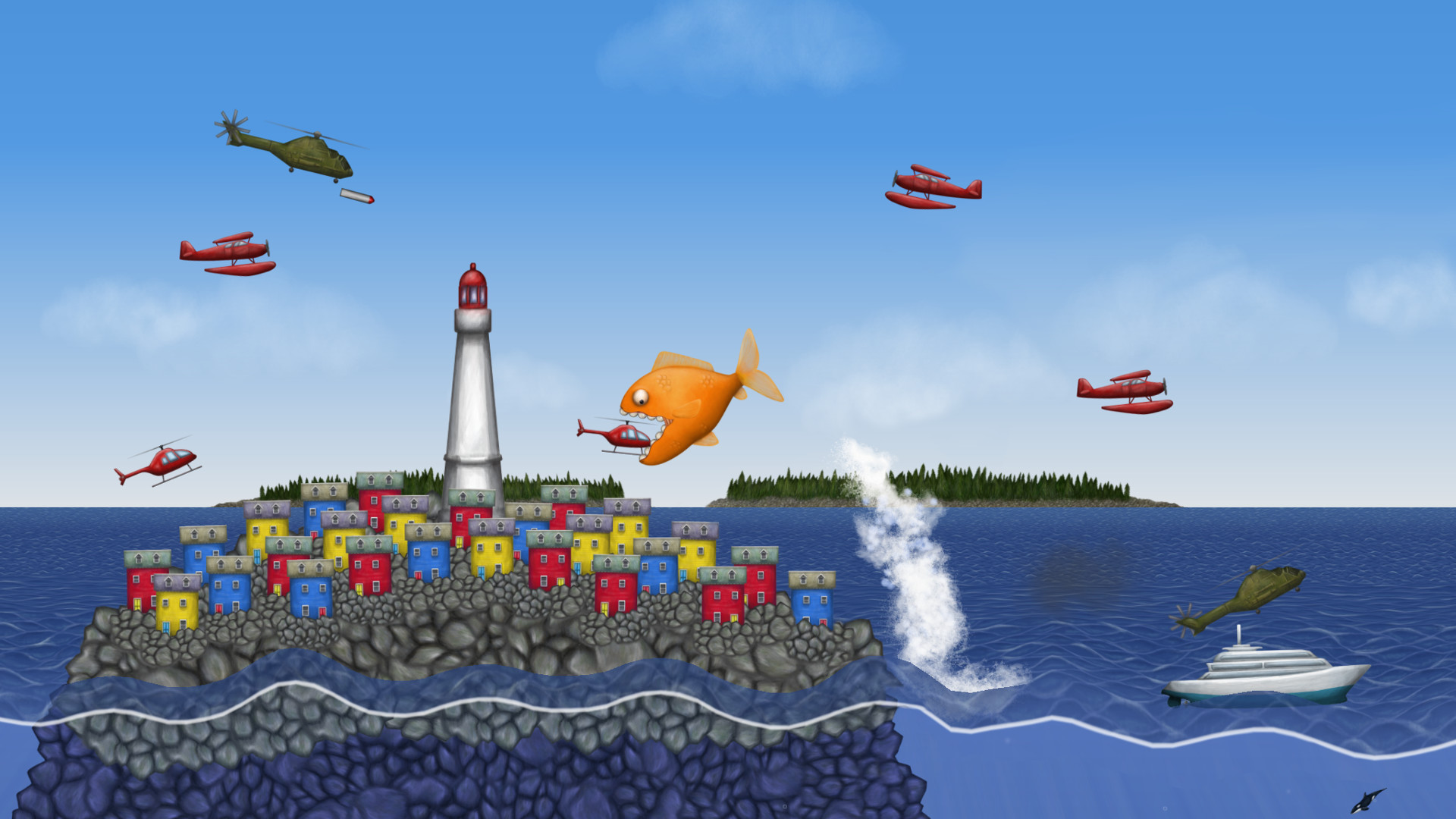
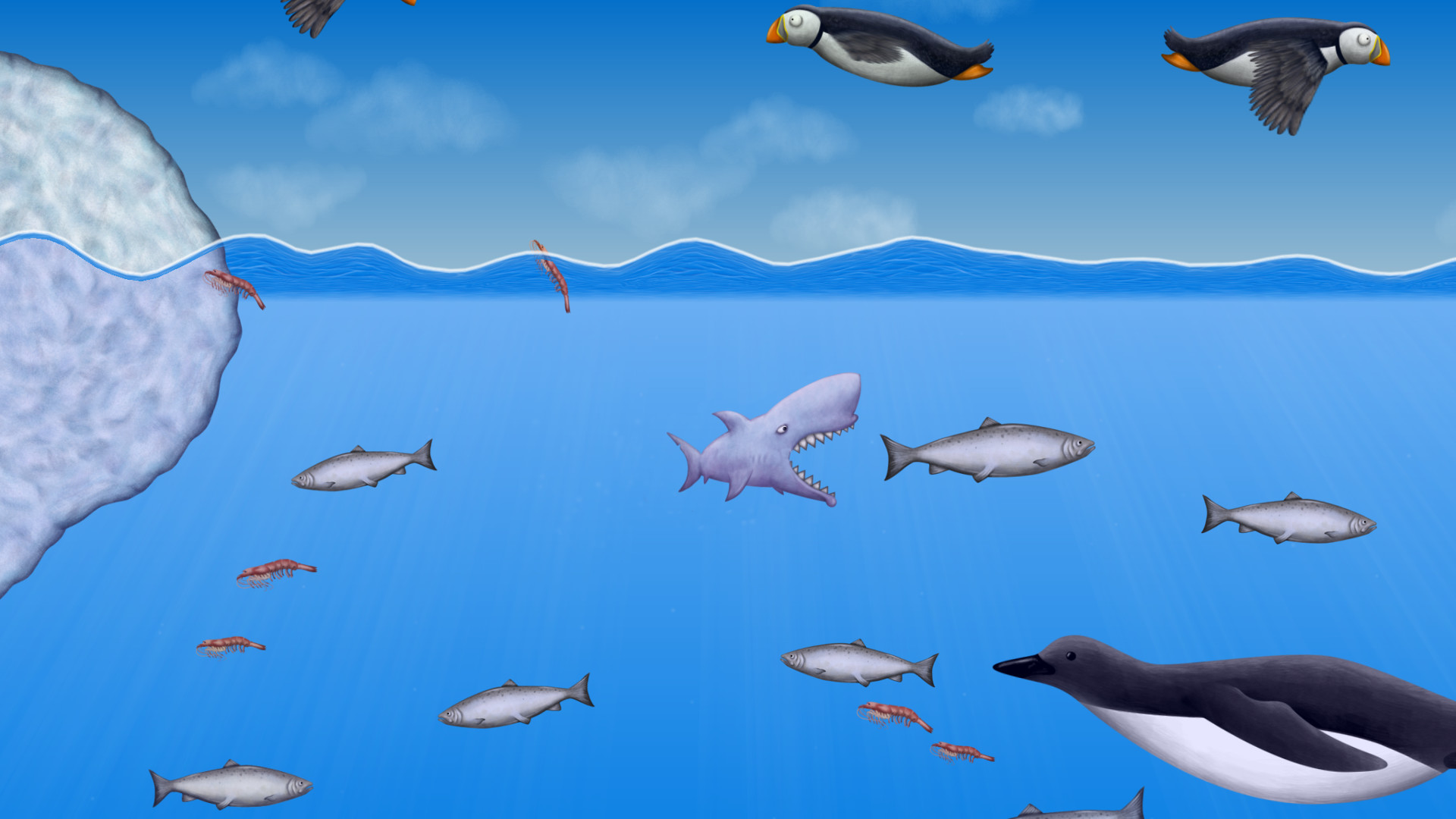
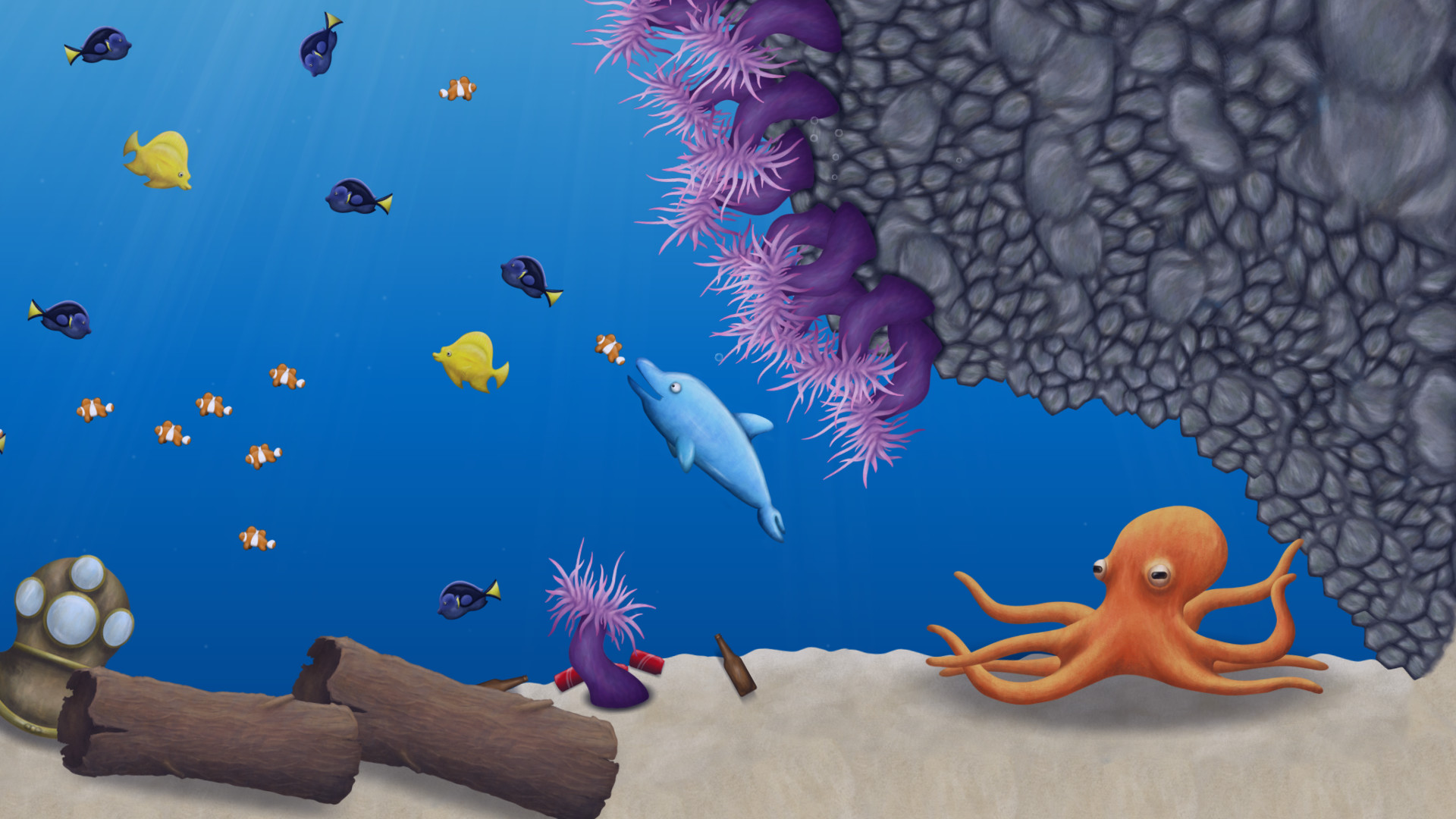
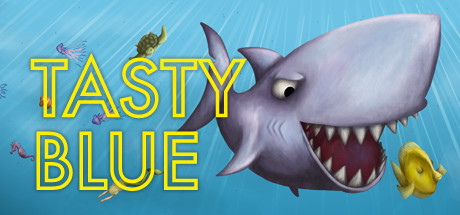
Tasty Blue, developed and published by Dingo Games, takes a concept so simple it borders on ridiculous—an ordinary goldfish that won’t stop eating—and transforms it into a surprisingly engaging and gleefully destructive arcade adventure. The premise wastes no time establishing its absurdity: a neglected pet escapes its tiny bowl and immediately begins devouring anything smaller than itself. From that moment forward, the game becomes a steady escalation of size, appetite, and chaos, gradually pushing the player from domestic aquariums into the open ocean, populated beaches, sprawling coastal cities, and eventually places no aquatic animal should realistically be. It plays like a children’s picture book that slowly mutates into a lighthearted disaster movie, yet maintains a cheerful, nonthreatening tone throughout. That tonal consistency is important—while destruction and consumption define the gameplay, everything is framed as slapstick comedy rather than violence. The core mechanics revolve entirely around movement and consumption, yet the execution gives the game more longevity than expected. The player swims through two-dimensional levels, steering toward fish, crustaceans, debris, and unsuspecting humans, each bite contributing to growth. As the goldfish increases in size, the hierarchy of dangers gradually reverses—predators that once threatened the tiny creature eventually become snacks, and once-impassable barriers crumble under immense mass. This sense of continuous progression is the game’s engine, and Dingo Games has carefully structured levels to highlight the satisfaction of crossing those invisible thresholds, whether it’s the moment you finally eat a scuba diver or the first time you consume a boat. Even without complex controls, each stage feels like a miniature puzzle, asking players to find the safest, fastest, or most efficient route through the edible ecosystem. To prevent the formula from becoming too predictable, the game introduces additional playable characters whose perspectives reshape familiar mechanics. The dolphin’s narrative, framed around intelligence and rebellion, introduces faster, sharper movement, while the shark’s campaign leans into brute force and unstoppable hunger. Though the gameplay remains largely unchanged, the change in physics, personality, and environmental design keeps the experience from stagnating. Levels gradually evolve in structure, incorporating timed escapes, maze-like layouts, hazards such as mines or harpoons, and escalating human responses ranging from panicked swimmers to military intervention. The humor intensifies as the player gets larger—seeing scientists, sailors, or submarines desperately attempt to stop an impossibly huge fish never loses its absurd charm. Visual presentation plays a significant role in maintaining that charm. The art style is clean, colorful, and intentionally exaggerated, striking a balance between cartoon whimsy and environmental clarity. Characters have expressive panic animations, background details reinforce storytelling without slowing gameplay, and the overall aesthetic remains family-friendly even as the scale of destruction increases. Sound design enhances the absurdity—each gulp, crunch, and splash is exaggerated like a comedic sound effect, and the upbeat soundtrack reinforces the sense that nothing happening on-screen should be taken seriously. Tasty Blue is not trying to immerse players in realism; it’s inviting them into a sandbox of escalating silliness where the impossible becomes routine. The game’s simplicity is both its design philosophy and its primary limitation. Because the mechanics remain consistent across campaigns, extended play sessions may begin to feel repetitive for players seeking strategic depth or mechanical evolution. There are no complex upgrade trees, branching storylines, or major systems layered on top of the core experience. Instead, replay value comes from perfecting levels, attempting to move efficiently, and enjoying the spectacle of unchecked growth. For some, especially younger players or fans of bite-sized arcade titles, this straightforwardness will feel refreshing. For others, it may limit the game’s staying power. However, the developers clearly understood their intended audience—those who want immediate, uncomplicated fun—and built the game with that clarity in mind. What sets Tasty Blue apart from other casual growth-based games is its genuine sense of momentum. The escalation never feels abrupt or unearned; rather, players experience a continuous chain of small triumphs that lead to increasingly ridiculous outcomes. There is joy in simply moving through the world, testing boundaries, and discovering what new creature or construct will become edible next. The game encourages curiosity more than competition, chaos more than mastery, and delight more than dominance. It’s a rare example of a game that embraces absurdity without relying on shock value or cheap humor—its comedy emerges naturally from gameplay consequences rather than scripted jokes. Tasty Blue succeeds because it understands exactly what it wants to be: a lighthearted, accessible, visually amusing power fantasy built around one core loop that always feels satisfying. It doesn’t ask players to invest emotionally, analyze systems, or commit to long sessions. Instead, it offers carefree entertainment—easy to start, hard to stop, and consistently amusing from beginning to end. Players of all ages can appreciate its charm, making it a great shared experience for families, casual gaming groups, or anyone who needs a joyful break from heavier or more demanding titles. Ultimately, Tasty Blue is not memorable because of narrative depth, mechanical complexity, or technical innovation. It resonates because it captures the simple delight of play—of growing, exploring, and causing harmless mayhem in a world designed to support imagination rather than realism. It’s a reminder that games can still be funny, weird, and charming without overthinking themselves, and that sometimes all you need is a hungry goldfish and a world foolish enough to feed it. Rating: 8/10
Expand the review