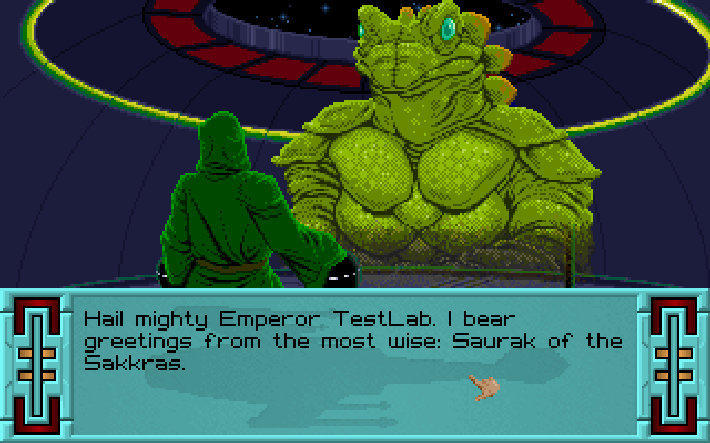
"Never replicated 4X perfection" I've only started playing a few years ago now. Coming from the sequel, it took me many tries to get a hang of it and even then, my win ratio is abysmal. Given that, would it be strange to say that it changed my life? As an avid 4X player, perhaps. A DOS game from thirty years ago? How so? Well, as Antoine de Saint-Exupéry said ( Civ4 fans will surely know this one ): " The designer knows he has achieved perfection; not when there is nothing left to add, but when there's nothing left to take away ". Master of Orion 1 lives by this rule and I intend to prove it. Let's expand upon this concept with three " nothings ". Nothing is irreplacable . You can explain the core of the game in a few minutes, all nuts and bolts included. Almost every mechanism comes down to easily understood dice rolls as so. Try explaining how Civilization IV 's combat works in comparison! Most techs do previous things better, nothing new. If 'ECM I' improves missile evasion, you can figure out what 'ECM III' does. The tech tree is vast, but easy to understand and follows the game's unique vision perfectly. This is not a puzzle game with a set solution. No crazy gambits either that lead to a convulated meta-game. You are given a set of options and you choose the one you need the most in the given situation. If you understand how the game works, you'll be able to adapt to the circumstances on the way. This is the thought behind Master of Orion . Recognize the current weaknesses of you and your opponents and adapt . Second: nothing is unnecessary . Master of Orion 1 is also one of the few games where there is hardly anything extraneous to remove. No unwarranted distractions or unnecessary mechanics. It's like a Jenga tower where if you remove a building block, any block, the whole thing would collapse. Bombs, missiles, bases, all of them serve a purpose and everything just fits together. This streamlined gameplay has a profound effect on the skill curve as well. Just like in chess: you can't win if you don't bother learning how horses or bishops move. Yet using them is simple, while using them effectively is not. Ignore force fields and you'll get bombed or shot with thousands of lasers. Ignore propulsion and you'll get kited. Ignore weapons and your shoots will bounce off. Focus too much on one thing and get countered by others. It's a well-designed machine that works the way it is intended and the developers have foreseen. On the flip side, what could have been removed was removed, leaving the UI clear and on the point. With a few clicks, you can move thousands of ships, change production lines, decimate waves of enemy fleets. The controls are highly scalable . A hundred planets do not take more effort to control than merely ten. No waves of units having traffic jams. No complicated rules that the AI cannot comprehend ( imagine selling a racing game where the opponents cannot even start their car! ). Nothing, nothing to divide your attention. And yet, everything has it's use sometimes . Finally: nothing is necessary . Master of Orion 1 also has something more going on: you don't need anything in particular to win. I had games where I did fine with lasers and nuclear missiles for a while. Ion rifles sign that you should go invade someone, while planetary shields nudge you towards a defensive position. Sometimes soil enrichment decides the game, yet other times, it doesn't matter at all. You make better choices by having less options available. Does that make sense? There's no fake replayability involved either, like in Civilization V for example, where each playthrough forces you to make the same lopsided choices over and over again due to poor balance. The sequel, Master of Orion 2 has the same problem: let's see how far you can go without 'Automated Factories' or 'Research Labs'! Many options, but most of them are absolutely terrible! Not much to ponder about and the game will become a routine soon enough. Master of Orion 1 does the opposite: it takes away your options and forces you to adapt! Nothing hurts to have, but it all depends on timing and competing priorities; you simply can't have them all. You are not building a theme park masquerading as an empire that's focused on a specific thing. You are an empire that happens to be good at certain things and worse at others, but always seeks to win, no matter the cards given. This is completely different from the usual sandbox-like approach that most 4X games tend to aim for . Launching Master of Orion , you don't sit down and decide: " hmm... today I'll build a cultural tall empire (theme park) ", then mindless pick whatever increases your cultural output because otherwise you'd lose ( or worse: not win the way you wanted to !). You decide to play "Alkari", generally focus on smaller ships, but nothing is written before you start the game. Pick poorly and suffer; choose wisely and win . This is what leadership should entail. Many more things could be said, but now for some negatives . It's a DOS game; you'll need to get used to it. The AI is not dumb , but really, really unfair to play against. Most spiteful I've ever seen; happy to vote for its own demise. Some extreme powerspikes may scare away new players: nothing like an auto-reparing huge bomber one-shotting your capital. There's no multiplayer. Likely related: there are some ridiculous balance issues. There's not much of a theme, as it's typical of sci-fi games, but I find the art and sounds endearing. Most characters are really cute and personable and the music complements their screens well. ✅ Good : [*] Unique tech tree that forces you to adapt [*] Minimal design that makes the game easy to play [*] Great AI for its age that knows all the elements fine [*] Satisfying combat that scales incredibly well [*] Pragmatic AI and diplomacy that's hard to cheese [*] Fun races that provide different approaches to the same gameplay ❌ Bad : [*] Spiteful AI that blatantly cheats and discriminates against the human player [*] BS Galactic vote system doesn't mesh well with the said AI [*] Too random maps that can make certain starts either unwinnable or too easy [*] Gaps in the tech tree can be often too hard to reliably overcome [*] Weird diplomatic rules that can lead to unintended invasions and other oddities [*] Some of the balance could be clearly better; looking at the Psilons in particular [*] No multiplayer, hall of fame, auto-combat... lacks many "modern" features So, is it worth getting into in the Year of Our Lord? Well, what more could I say? I consider Master of Orion something timeless, even like chess or go. Same answer as why would you play one of those. If there was multiplayer support, perhaps a proper remaster, I believe this game would've gotten universal admiration by now. Until then, this release is the next best thing we've got. Even if you don't click with it, the design is among the best ones you could imagine. True textbook example of ideas executed right. I ragequit often after being dogpiled on or voted out, but I still respect the game for what it is. Don't be surprised if your enthusiasm towards other 4X games falls... every aspiring game developer should learn from Master of Orion 1 . I paraphased many thoughts of veteran player [url=sullla.com/MOO/mooeditorial.html]Sullla whose reviews should be the gold standard for anyone interested in thoughtful criticism. His reviews for Civilization V also highlight many design patterns or anti-patterns: [url=sullla.com/Civ5/whatwentwrong.html]one , [url=sullla.com/Civ5/bnwreview.html]two . Check them out, if you have some interest and time.
Expand the review