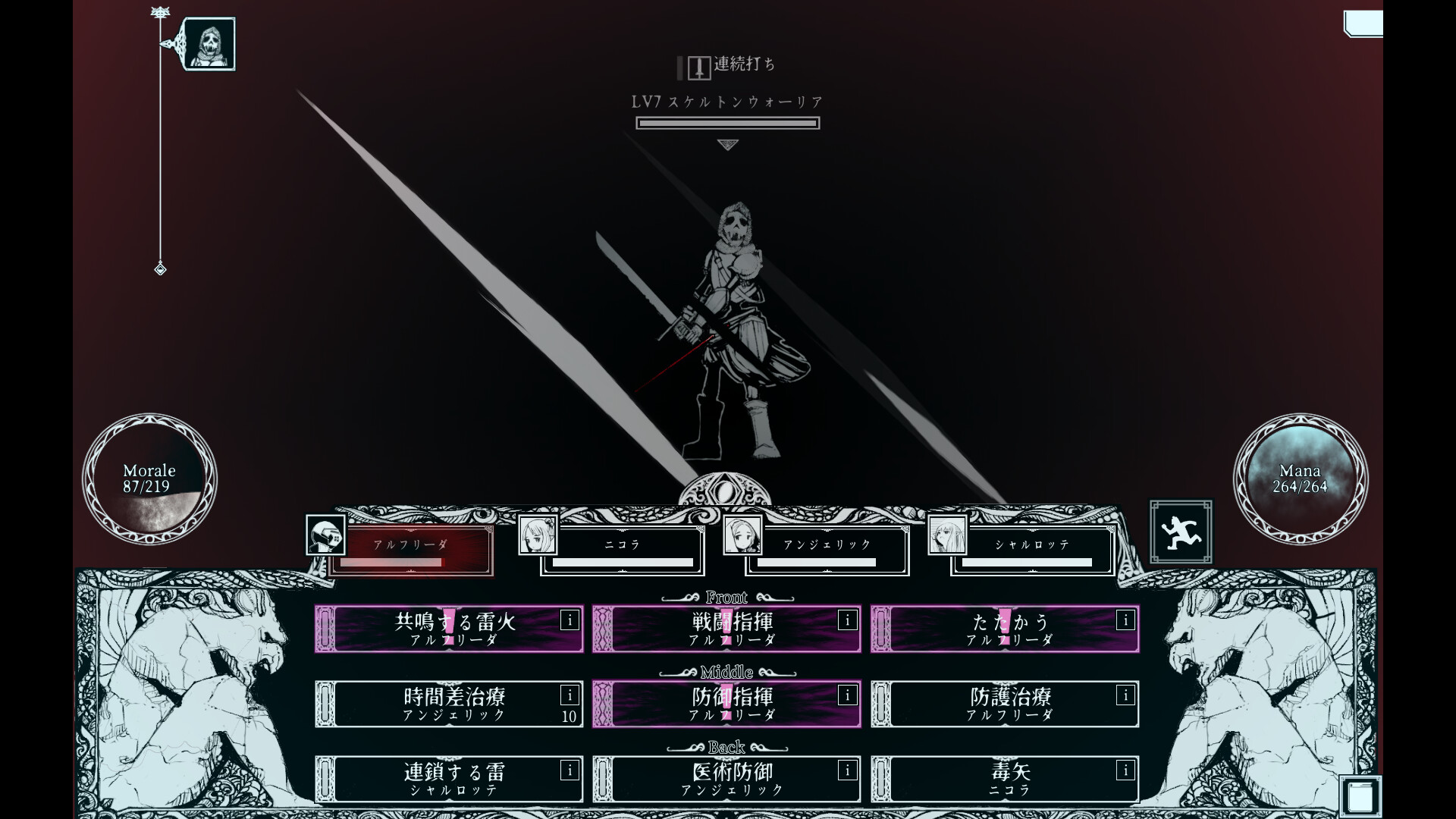
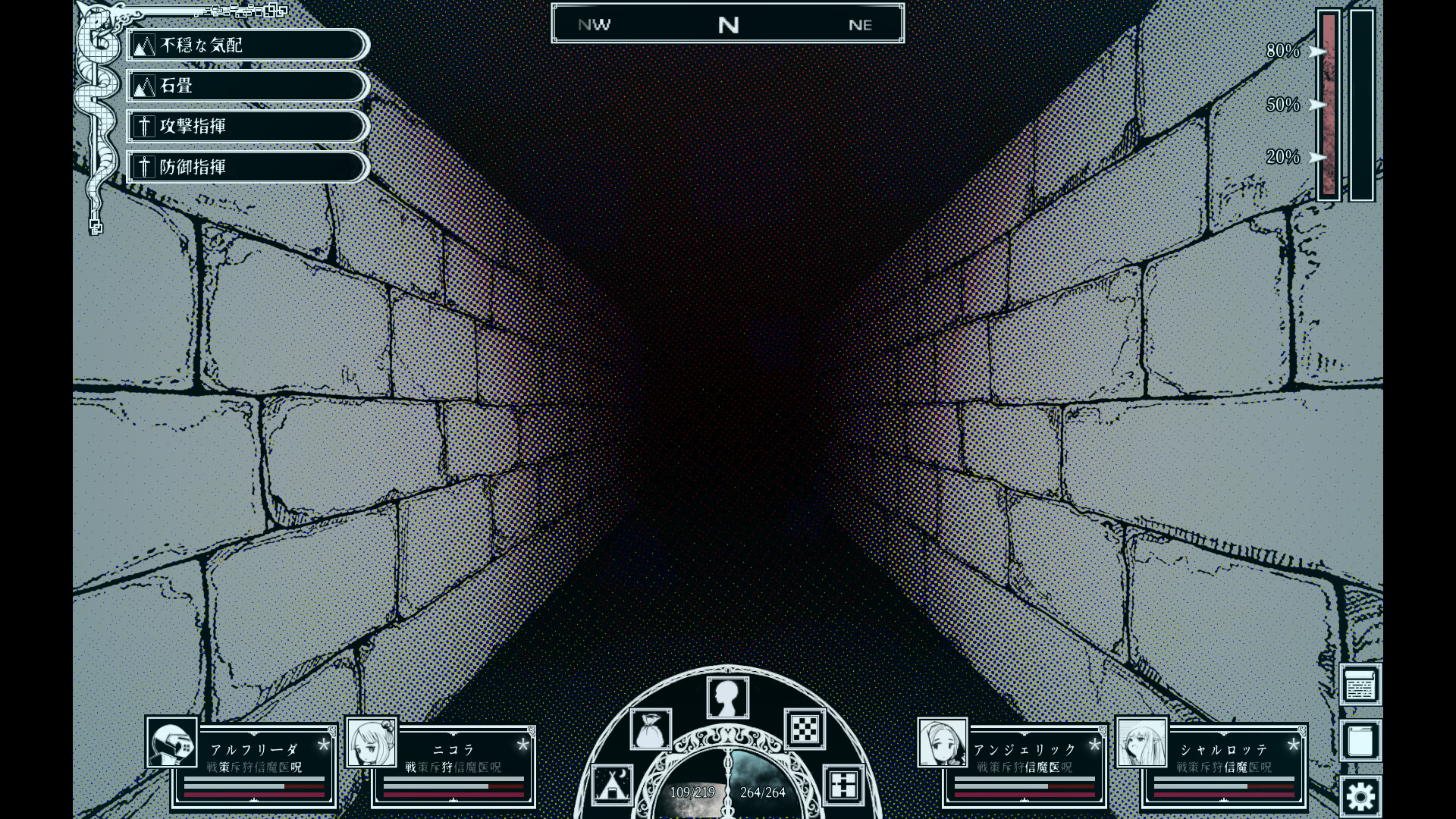
In many ways, Path of the Abyss is a 'blobber' - a first-person dungeon crawl where you control a party of characters who all move together as a single blob. Think Wizardry, Might and Magic, Eye of the Beholder. In particular, it draws on some parts of the Wizardry tradition, not least in its (mostly) black and white aesthetic but also in things like the risk of a slain character turning to ash (though Path is more forgiving than Wizardry - the character isn't lost forever). You might think that if you like blobbers then you'll like this game, or conversely that if you don't then you won't, but neither of those is really an accurate assumption. What will really determine whether you enjoy Path of the Abyss or not is how you respond to the combat system. Most of the criticism I've seen directed at this game is about the combat system, but for me it was the strongest aspect of the whole experience. How you feel about it will make or break the game for you. This is where Path of the Abyss steps out from the shadow of blobbers of yore and does its own thing. I'll do my best to explain it, but it's a bit weird. As your characters advance and gain levels they'll also unlock skills, dependent on where you allocate their points. So far, nothing shocking. Where it gets strange, though, is that you can't use the vast majority of unlocked skills at any given time. That's right, most of the skills you technically have access to won't be usable in any given battle. Sounds nonsensical, but once you get what it's doing, this system actually works very well. You see, in order to have a skill (this also includes ordinary attacks, by the way) available to use in battle, you have to place it in a three-by-three grid of squares. Each skill needs a square, and the grid never grows. This means that at any given moment, you have access to a *maximum* of nine skills *for your whole party*. I didn't mention that the grid is shared? Well the grid is shared. Nine skills. That's basic attacks, special attacks, offensive spells, healing spells, buffs, debuffs - even passives. Yes, *passives* also occupy squares in the grid, meaning that every passive you take is one fewer active skill available. This is what trips up the people who hate the combat system. They can't take it. They fume at being so restricted. They chafe at the lack of options, at the risk of not having the option to respond appropriately to absolutely anything that comes up in a fight. But *that's the point*. This restrictiveness forces you to make agonising decisions about which skills you absolutely must have available, and which ones you'll reluctantly do without. It also forces you to adapt to the current threats - if you're up against a lot enemies that can poison you then you probably need to swap out one of your skills for one that will deal with poison. You can't just sit back and stomp your overpowered party through whatever gets in the way, because you never have enough room to be that well prepared. It doesn't stop there, though. The grid is clever than that. The position of skills in the grid is vitally important too. Some healing/buff skills have an area of effect - maybe they only affect the same row they're on, or the four squares immediately around them. Some have synergies which incentivise positioning them next to each other. And, crucially, the positions of the skills in the grid also determine how you're attacked. Enemy attacks will target specific squares or patterns, inflicting damage on whichever character owns the corresponding skills. If an enemy only attacks the front row, then placing a skill from your squishy spellcaster up front means they'll take a lot of hits. Some enemies will attack in a cross shape, or aim at specific squares, so you always need to be aware of who you're placing at risk. You have to balance positioning skills in the best place to use them against how vulnerable that leaves squishier characters. It. Is. Genius. It's not a complicated system but it gives you so many things you have to think about, resulting in constant agonising (and thus satisfying) decisions about how to fill up your grid. If you can get past the initial feeling of the restrictions being stifling, the strengths of this system really come through. It also means that combat is fast. With a maximum of nine things you can do (less if you have some passives in there), there isn't a lot of messing around with finding and using the skill you want. You can even set skills to activate automatically whenever they're ready, for the go-to attacks or buffs that you want to keep re-using. It makes combat zip past very quickly, and alleviates some of the feeling of combat being a slog that can plague this genre at times. The game isn't flawless, of course. It does a bad job of explaining itself (partly due to a wonky translation) and there are aspects of it that I never figured out. It can also need bouts of grinding from time to time, and levelling doesn't come particularly quickly so this can feel like a real chore. These flaws in no way sink the game though. Between the unconventional combat system and the poor explanations, there's a learning curve - enough so that it almost put me off the game entirely, and I dropped it for months. But if you persist through the early game, it turns into a great and satisfying dungeon crawl. It has some excellent music too, incidentally. The tune from the first dungeon is probably going to be in my top game music of the year list. Path of the Abyss turned out to be a very pleasant surprise, and if you like dungeon crawlers then it's well worth checking out. Be prepared to spend some time going "What? What does that mean??" early on (and, frankly, later on too) but once you start to get the core systems here, it reveals itself as a cleverly designed and rewarding take on the genre.
Expand the review