
The Signal State
Set in a post-apocalyptic future, The Signal State puts your logic skills to the test with complex puzzles inspired by modular synthesizers. Repair machines, rebuild an abandoned farm, and be part of a revolution that will change the fate of agriculture once and for all.
Sync your Steam wishlist to find the lowest game prices instantly. No login required, just paste your Steam profile URL!
⚡ Try Wishlist Radar!
Sync your Steam wishlist to find the lowest game prices instantly. No login required!
⚡ Try Wishlist Radar!
Close

Word Factori on Steam
Quick menu
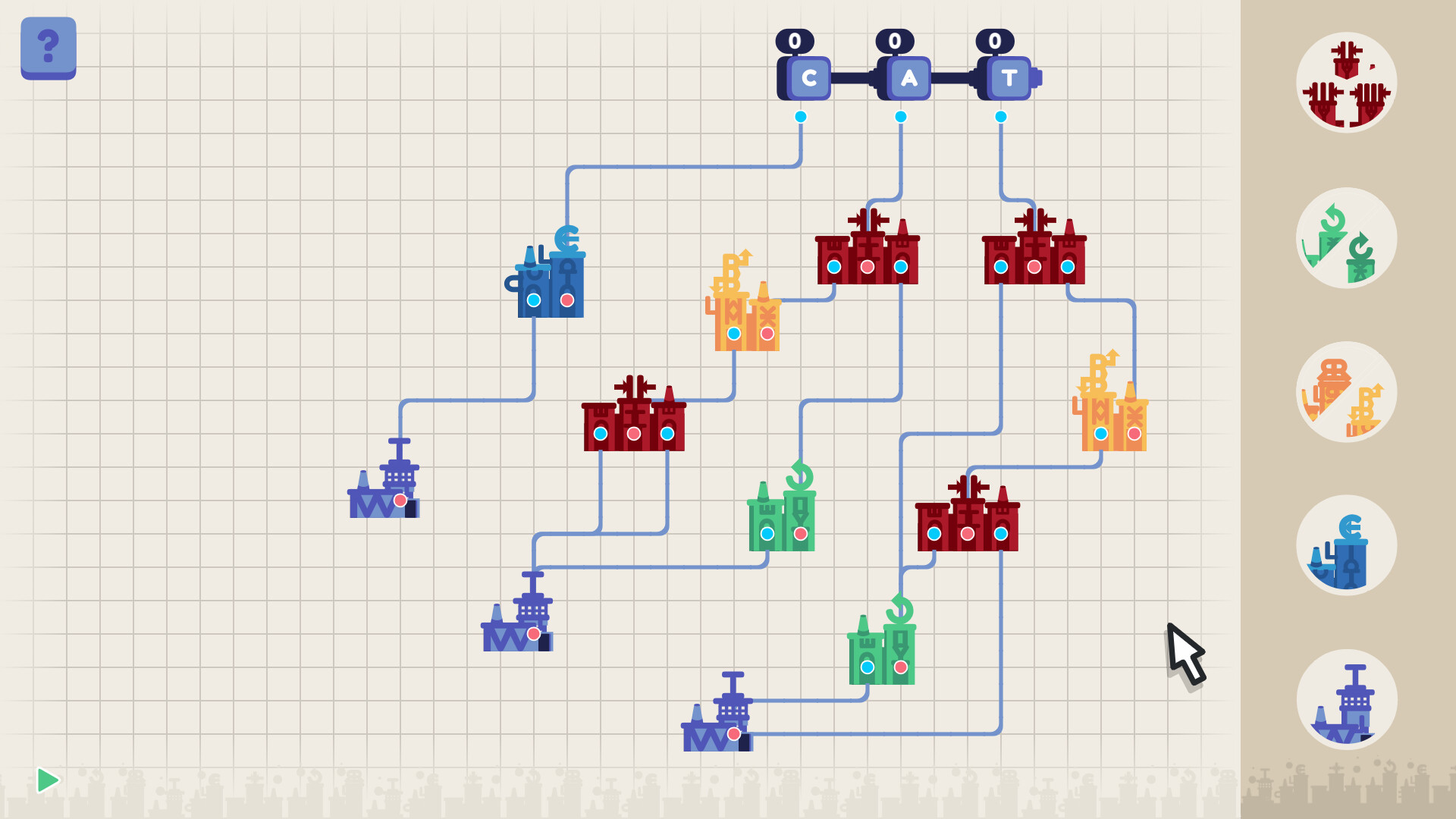
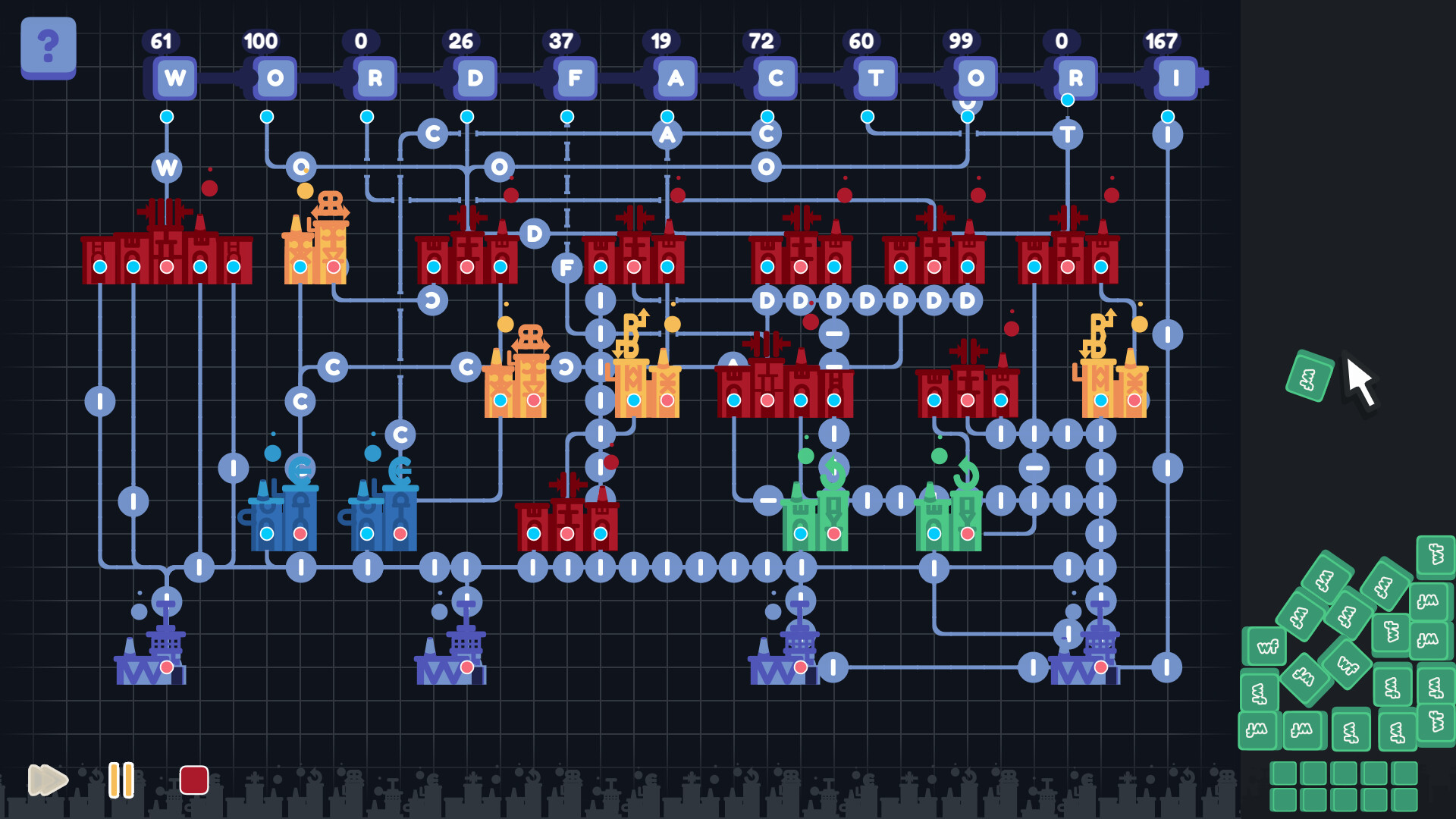
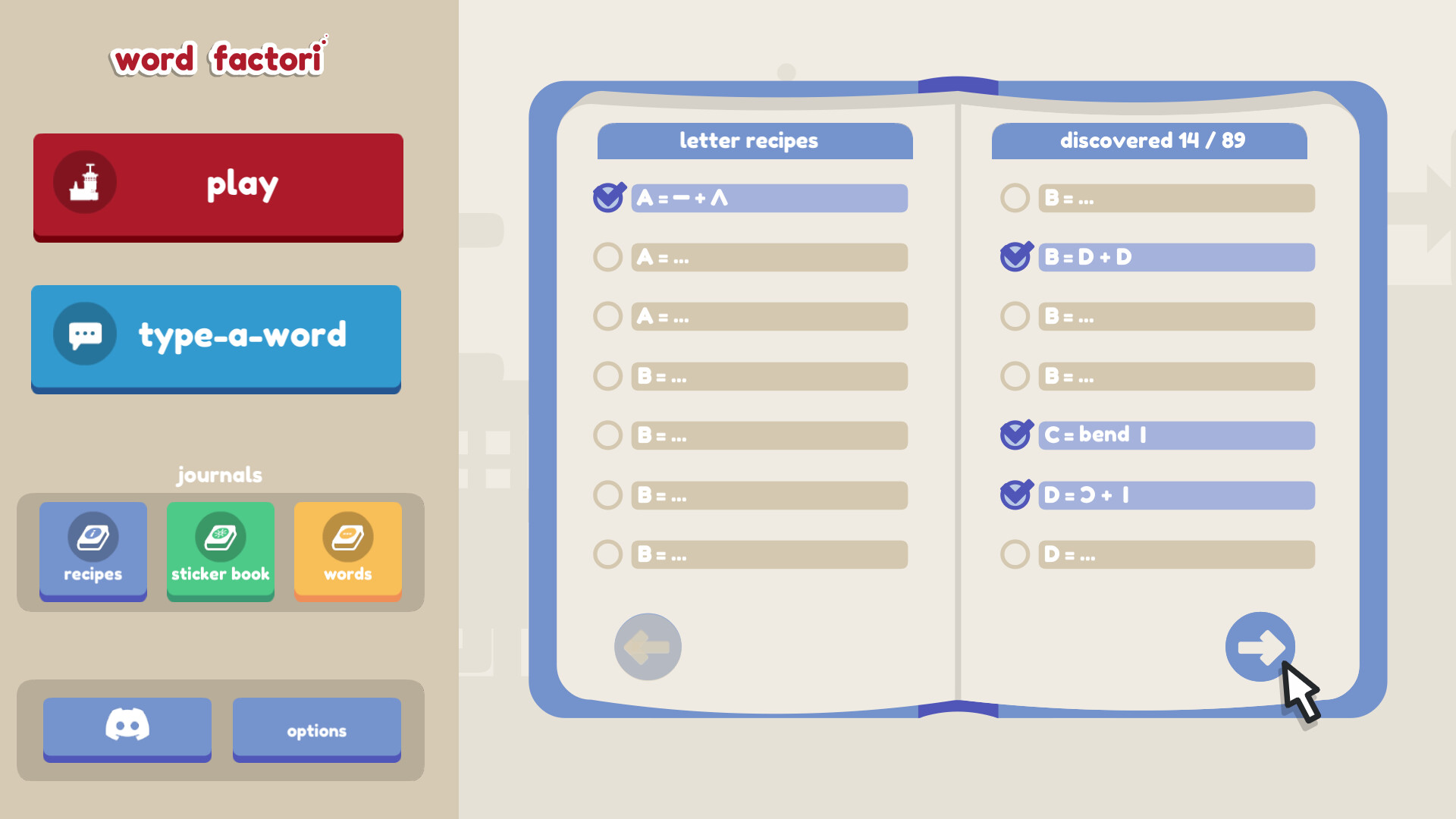
Word Factori is a word-building game where your only resource is the letter "i". Build a chain of factories to bend, rotate, reflect, and merge "i" into more complex letters. Discover secret letter recipes, unlock hidden word art, and optimize your factory chains for high scores.
Word Factori is a puzzle, programming and logic game
developed and published by Star Garden Games.
Released on August 03rd 2023 is available on Windows, Steam Deck and Steam Machine.
It has received 460 reviews of which 382 were positive and 78 were negative resulting in a rating of 7.8 out of 10. 😊
The game is currently priced at 5.89€ on Steam.
The Steam community has classified Word Factori into these genres:
Puzzle
Programming
Logic
Automation
Simulation
Management
Word Game
Sandbox
Building
Typing
Strategy
Indie
Singleplayer
Top-Down
2D
Abstract
Minimalist
Family Friendly
Relaxing
Cute
Here is the detailed breakdown of supported languages for Word Factori:
| UI | Subtitle | Audio | |
|---|---|---|---|
| English |
Media & Screenshots
Get an in-depth look at Word Factori through various videos and screenshots.
System requirements
These are the minimum specifications needed to play the game. For the best experience, we recommend that you verify them.
Windows
- OS: Windows 10 64 bit
- Processor: Dual core 1Ghz+
- Memory: 2 MB RAM
- Graphics: Any
- Network: Broadband Internet connection
- Storage: 15 MB available space
Steam Price & Best Deals
User reviews & Ratings
Explore reviews from Steam users sharing their experiences and what they love about the game.
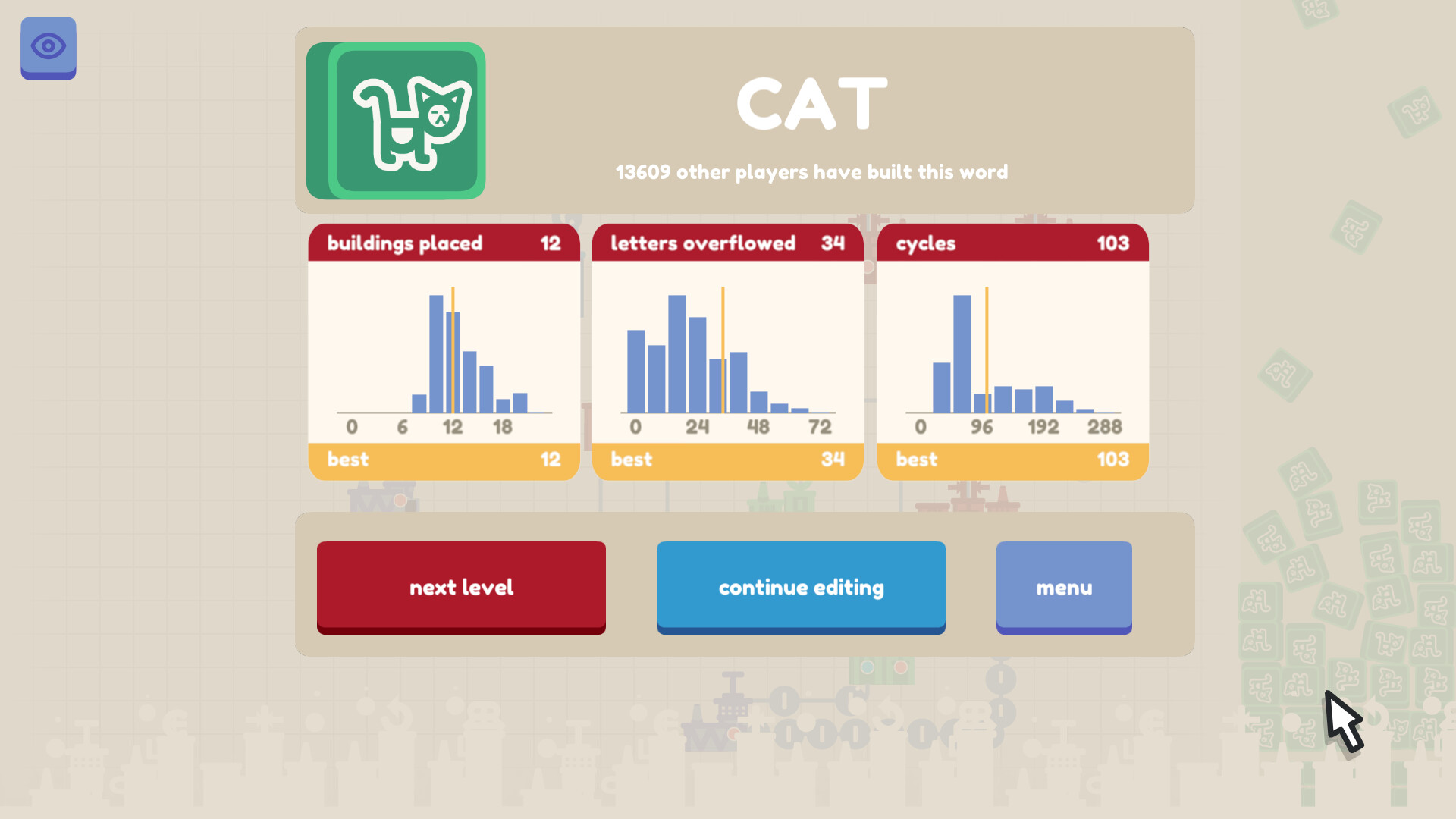
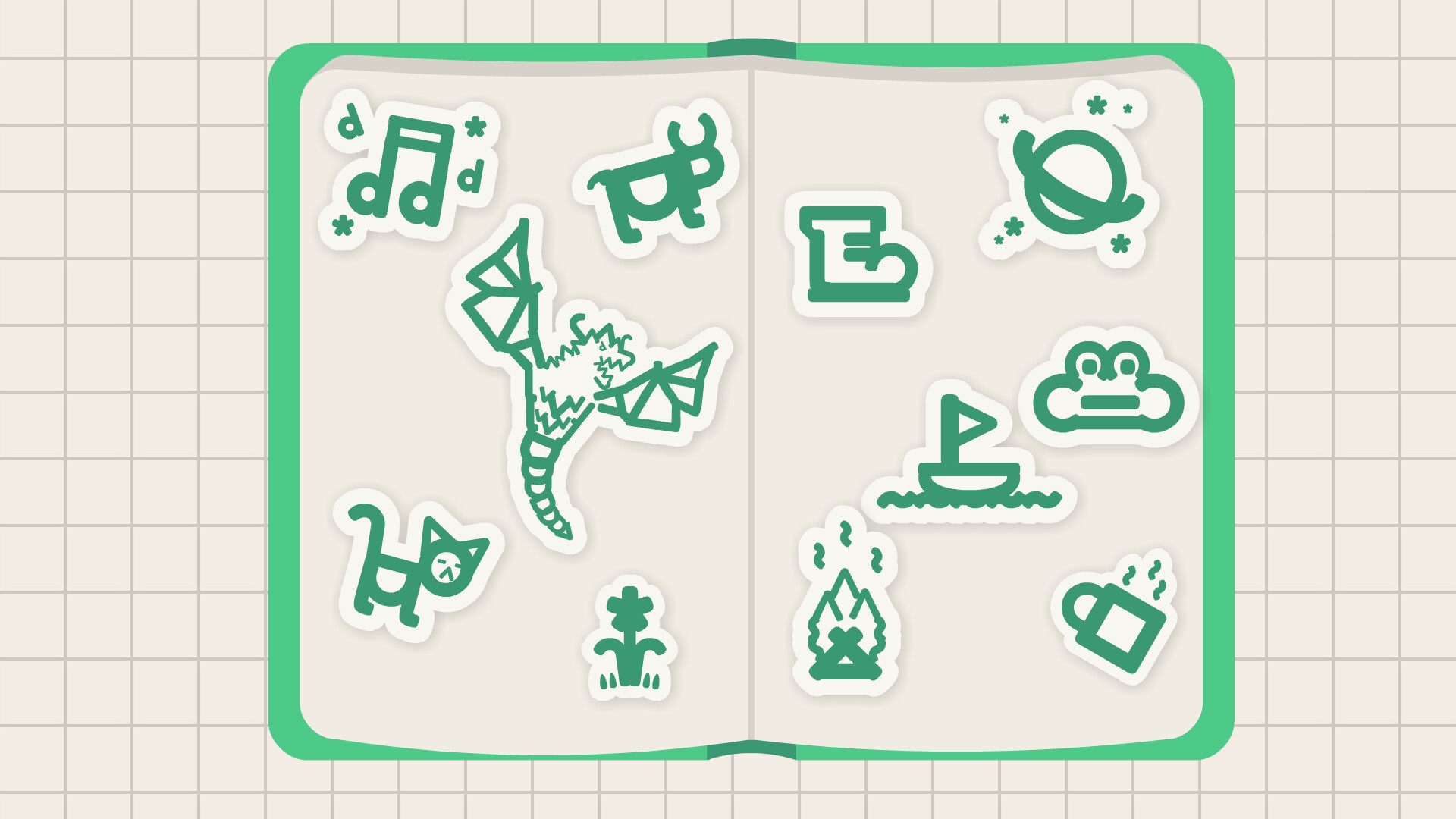
Word Factori takes a wonderfully strange premise and turns it into an intelligent automation puzzle where language, geometry, and factory construction become parts of the same system. Developed and published by Star Garden Games, the game begins with one deliberately restrictive resource: the lowercase letter “i.” From that humble starting point, the objective is to manufacture the rest of the alphabet by sending letters through interconnected machines. It sounds simple, but the idea develops into an impressively thoughtful exercise in visual reasoning and optimization. The central mechanic revolves around transforming shapes. Machines can bend, rotate, reflect, and merge the basic letter into increasingly complicated forms. Creating an “O,” for example, can involve bending an “i” into a curved shape, producing its reflection, and merging the resulting pieces together. Learning these relationships makes discovering each new letter feel like solving a miniature engineering problem. Rather than handing over every solution, the game encourages experimentation and asks players to understand how familiar letters can be reconstructed from basic geometric components. What makes the system especially satisfying is that discovering one working solution does not necessarily mean a puzzle has been exhausted. Letters can have multiple recipes, and finding alternative manufacturing processes fills out the recipe journal. This gives experimentation a meaningful purpose and encourages players to reconsider earlier designs. A functional factory might eventually be replaced by a cleaner or more efficient arrangement as the player develops a better understanding of the available machinery. Optimization adds another layer for players who enjoy squeezing maximum efficiency from automation systems. Factory chains can be evaluated across three scoring metrics, providing an incentive to refine layouts instead of abandoning them immediately after obtaining the required output. At the same time, optimization is not mandatory. Players who simply enjoy constructing visually satisfying machines can focus on aesthetics and experimentation. This flexibility keeps the game approachable while providing additional depth for puzzle enthusiasts who enjoy perfecting solutions. Challenge stages place restrictions on available resources, forcing players to think carefully about which transformations are genuinely necessary. These limitations are effective because they prevent every puzzle from being solved through oversized or inefficient factory networks. They encourage economical thinking and make familiar mechanics feel different when certain conveniences are removed. Success therefore depends on spatial reasoning, pattern recognition, planning, and understanding how individual machines interact. Word construction expands the concept beyond individual letters. Players can create complete words, tackle a word of the day, enter their own words, and experiment with player-shared creations. Certain words also unlock stickers for a scrapbook, adding a light collection element to the experience. Combined with the recipe journal and hidden discoveries, this gives completion-focused players additional objectives without distracting from the central factory-building mechanics. The minimalist presentation works particularly well with the game's concept. Factories, connections, shapes, and outputs remain visually readable, which becomes increasingly important as production chains grow more elaborate. The restrained aesthetic also creates a relaxing atmosphere despite the logical difficulty of some puzzles. Instead of overwhelming the player with unnecessary visual effects, the interface keeps attention firmly on designing and understanding the machinery. The game's greatest strength can also be considered its primary limitation. Everything is built around one highly specific idea. Players expecting a massive industrial simulator with resource economies, sprawling production networks, or complicated management systems may find its scope relatively narrow. There is also little emphasis on narrative or traditional progression. However, for players attracted to compact puzzle games that explore one mechanic deeply, this focus is an advantage. The recipe hunting, optimization challenges, custom words, scrapbook collectibles, achievements, and restricted-resource puzzles provide several ways to engage with the same elegant foundation. Steam Deck compatibility is rated Playable rather than fully Verified. The game runs successfully on SteamOS and its default graphics configuration performs well, but the handheld experience has some interface compromises. Certain functions are not completely accessible through the default controller configuration, some prompts may display mouse or keyboard controls, and entering text can require manually opening the virtual keyboard. Some text can also appear small on the Deck's display. Touchscreen input or a suitable community controller configuration can therefore make playing more convenient. It remains usable on Steam Deck, but desktop play with a mouse and keyboard provides the smoother interface experience. Overall, Word Factori is a clever example of how a simple restriction can produce an unusually creative puzzle game. Transforming a single “i” into an entire alphabet creates satisfying moments of discovery, while alternate recipes and optimization provide enough complexity for players who want to dig deeper. It does not attempt to compete with enormous factory simulators in scale. Instead, it offers a focused combination of automation, typography, spatial reasoning, and experimentation that feels distinct from most conventional word or factory games. Star Garden Games deserves credit for taking an unusual concept and developing it into a cohesive experience where solving a letter is satisfying and discovering a better way to manufacture it can be even more rewarding. Rating: 8/10
Fun puzzle game that will take a half a dozen or so hours, I just really wish there were more challenge puzzles, those were the best part The achievement grind was fine but nothing really exciting, I did like figuring out the last few recipes, but sometimes I was just really confused why some "secret" recipes didnt work Additionally the whole secret level stuff was cute, but the hint given didnt make complete sense to me until I randomly just did ||LOL|| while figuring out other recipes for two challenge maps I didnt beat yet Overall fun stuff, it's cheap too, so grab full price or on discount, either way I hope Star Garden makes more stuff in the future^^
This game is moreso about rule finding than a programming/factory optimization game. I love that mechanism in itself; I enjoyed figuring out all the recipes for the different letters and running through all the possiblilites. The factory/programming feature isn't particularly complex though, but that's not where this game really shines. My only complaint is that there are quite a few recipes that really should count, especially considering how some recipes still count and seem quite out there comparatively.
Similar games
View all
SHENZHEN I/O
BUILD CIRCUITS. WRITE CODE. RTFM.
Opus Magnum
Opus Magnum is the latest open-ended puzzle game from Zachtronics, the creators of SpaceChem, Infinifactory, and SHENZHEN I/O. Design and build machines that assemble potions, poisons, and more using the alchemical engineer’s most advanced tool: the transmutation engine!
Kaizen: A Factory Story
Kaizen is an open-ended puzzle automation game from the original Zachtronics team, set in 1980s Japan. Design, build, and optimize production lines to create iconic products, like calculators, camcorders, and arcade machines.

Infinifactory
Infinifactory is a sandbox puzzle game by Zachtronics, the creators of SpaceChem and Infiniminer. Build factories that assemble products for your alien overlords, and try not to die in the process.
Turing Complete
Learn CPU architecture with puzzles
JOY OF PROGRAMMING - Software Engineering Simulator
Use real Python code to automate machines, robots, drones and more: Program self-driving vehicles; crack passwords; apply machine learning; automate logistics; use image processing to guide missiles. Gain real coding skills and solve exciting bite-sized programming challenges.

Retro Gadgets
Retro Gadgets is a sandbox where you build, code, and customize gadgets inspired by old-school electronics.
Virtual Circuit Board
Virtual Circuit Board is the sandbox drawing-based logic simulator where you can build, program, decorate, and simulate anything from simple monochrome circuits to complex and colorful computers. Play with digital logic in this sandbox-only experience.
Super Loco World - Cozy Train Automation
Effortlessly build and automate intricate railroads and deliver goods to meet the demands of a dynamic world! Make clever use of signals and signposts to avoid traffic jams, and watch your villages blossom into bustling towns in this cozy take on the train tycoon genre.

TIS-100
TIS-100 is an open-ended programming game by Zachtronics, the creators of SpaceChem and Infinifactory, in which you rewrite corrupted code segments to repair the TIS-100 and unlock its secrets. It’s the assembly language programming game you never asked for!
Frequently Asked Questions
Word Factori is currently priced at 5.89€ on Steam.
No, Word Factori is currently not on sale. You can purchase it for 5.89€ on Steam.
Yes, Word Factori received 382 positive votes out of a total of 460 achieving a rating of 7.78.
😊
Word Factori was developed and published by Star Garden Games.
Yes, Word Factori is playable and fully supported on Windows.
No, Word Factori is not playable on MacOS.
No, Word Factori is not playable on Linux.
Yes, Word Factori is playable on Steam Deck, though it might require a few minor tweaks. Make sure to check the Steam store page and community feedback on ProtonDB for exact compatibility details.
Yes, Word Factori is playable on Steam Machine, though it might require a few minor tweaks. Make sure to check the Steam store page and community feedback on ProtonDB for exact compatibility details.
No, Word Factori does not support VR.
Word Factori is a single-player game.
No, Word Factori does not currently offer any DLC.
No, Word Factori does not support mods via Steam Workshop.
No, Word Factori does not support Steam Remote Play.
Yes, Word Factori is enabled for Steam Family Sharing. This means you can share the game with authorized users from your Steam Library, allowing them to play it on their own accounts. For more details on how the feature works, you can read the original Steam Family Sharing announcement or visit the Steam Family Sharing user guide and FAQ page.
You can find solutions or submit a support ticket by visiting the Steam Support page for Word Factori.
Data sources
The information presented on this page is sourced from reliable APIs to ensure accuracy and relevance. We utilize the Steam API to gather data on game details, including titles, descriptions, prices, and user reviews. This allows us to provide you with the most up-to-date information directly from the Steam platform.
Additionally, we incorporate data from the SteamSpy API, which offers insights into game sales and player statistics. This helps us present a comprehensive view of each game's popularity and performance within the gaming community.
Last Updates| Steam data | 25 September 2026 09:09 UTC |
|---|---|
| SteamSpy data | 16 October 2026 02:04 UTC |
| Steam price | 28 October 2026 03:39 UTC |
| Steam reviews | 19 October 2026 16:01 UTC |
If you'd like to dive deeper into the details about Word Factori, we invite you to check out a few dedicated websites that offer extensive information and insights. These platforms provide valuable data, analysis, and user-generated reports to enhance your understanding of the game and its performance.
- SteamDB - A comprehensive database of everything on Steam about Word Factori
- SteamCharts - Analysis of Word Factori concurrent players on Steam
- ProtonDB - Crowdsourced reports on Linux and Steam Deck Word Factori compatibility

Game modes
Features
Online players
4
Developer
Star Garden Games
Publisher
Star Garden Games
Release
03 Aug 2023
Platforms