
London: Echoes of the Past
A mysterious woman comes back from the dead, and the dusty past surfaces. Between a gloomy student girl and a glamorous ex-girlfriend, the clues are intertwined, who is the mastermind behind the scene? Play as a detective heroine in 1935 London, embark on a journey of love and growth.
Sync your Steam wishlist to find the lowest game prices instantly. No login required, just paste your Steam profile URL!
⚡ Try Wishlist Radar!
Sync your Steam wishlist to find the lowest game prices instantly. No login required!
⚡ Try Wishlist Radar!
Close

Amelie on Steam
Quick menu
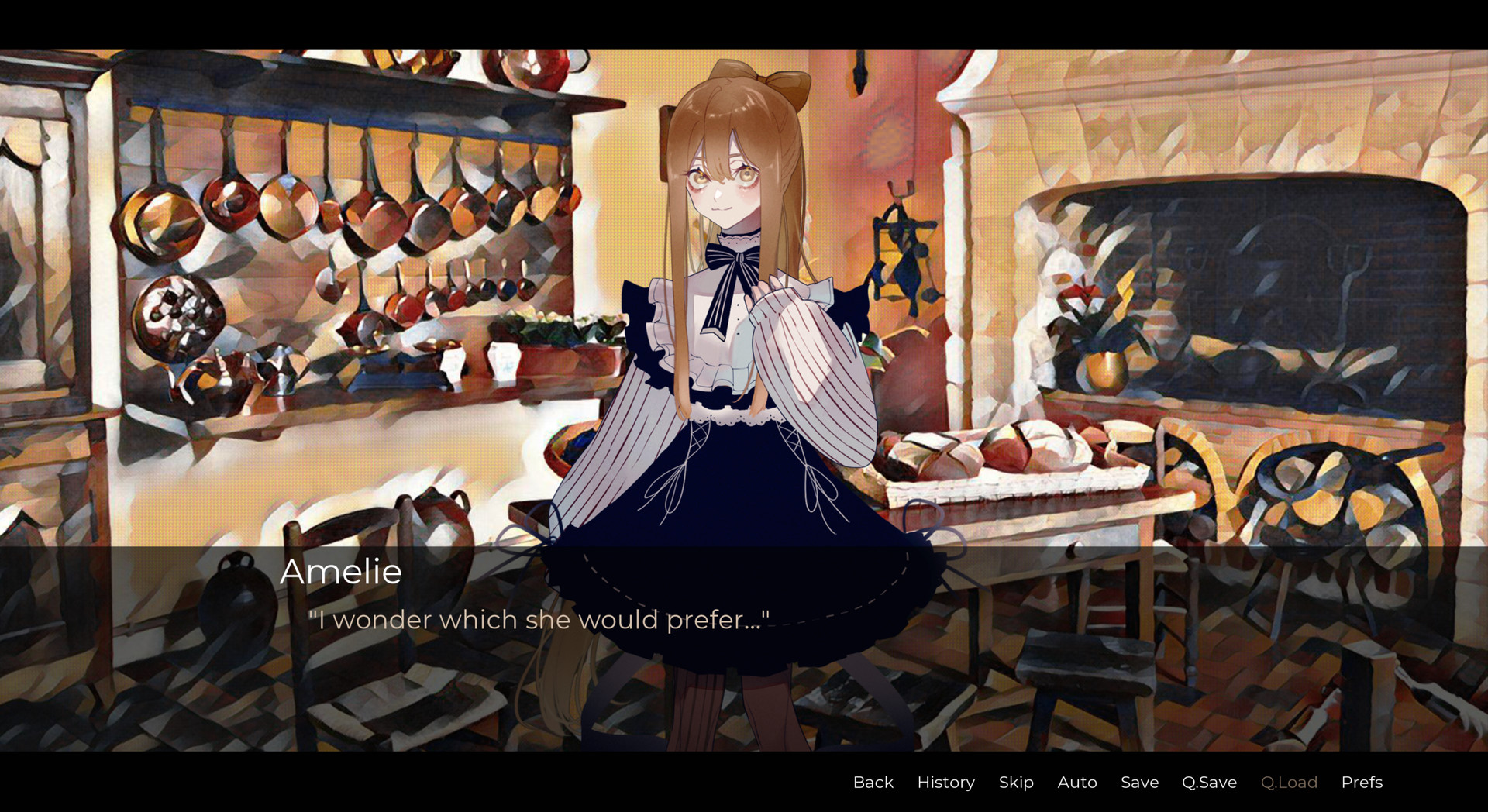
A psychological mystery yuri visual novel about a girl named Amelie. Forbidden from leaving the house, Amelie awaits the arrival of her long time penpal, Sofia, to her dear friend Lilika’s dismay. What secrets will Sofia unravel that were best kept buried?
Amelie is a female protagonist, lgbtq+ and visual novel game
developed and published by Two and a Half Studios.
Released on December 15th 2021 is available on Windows and MacOS.
It has received 390 reviews of which 357 were positive and 33 were negative resulting in a rating of 8.5 out of 10. 😎
The game is currently priced at 3.99€ on Steam.
The Steam community has classified Amelie into these genres:
Media & Screenshots
Get an in-depth look at Amelie through various videos and screenshots.


System requirements
These are the minimum specifications needed to play the game. For the best experience, we recommend that you verify them.
Windows
- OS *: Windows 7
- Processor: 1GHz
- Memory: 512 MB RAM
- Graphics: DirectX or OpenGL compatible card
- Storage: 1 GB available space
MacOS
- OS: Mac OS X 10.6+
- Processor: 1GHz
- Memory: 512 MB RAM
- Graphics: DirectX or OpenGL compatible card
- Storage: 1 GB available space
Steam Price & Best Deals
User reviews & Ratings
Explore reviews from Steam users sharing their experiences and what they love about the game.
I actually found myself so delighted with the twists an turns this round. No mystery left unaddressed or written in a way as to not leave you the pieces to piece the mysteries out yourselves but unpredictable enough to suprise anyway. Excellent stuff. I see why it was reccomended by fellow fans of the writer.
Amelie is a short psychological horror visual novel that uses isolation, romance, and conflicting perspectives to create an unsettling mystery without overstaying its welcome. Developed and published by Two and a Half Studios, the story takes place primarily within a lonely manor far from civilization. Amelie lives there with her close companion Lilika and has been forbidden from leaving the house. Her sheltered existence changes when Sofia, a longtime pen pal, finally comes to visit. Amelie welcomes the reunion, but Lilika clearly does not share her enthusiasm, immediately creating the suspicion that Sofia has entered somewhere she does not fully understand. The strongest feature is the way the story is divided among three playable protagonists. Players experience events through Amelie, Sofia, and Lilika, with each perspective revealing information the others either cannot see or deliberately conceal. Instead of simply repeating the same events, these viewpoints gradually reshape the player's interpretation of the manor and its inhabitants. Something that appears affectionate or innocent from one perspective can become disturbing once another character's knowledge is revealed. This makes uncovering the truth feel like assembling fragments of a larger psychological puzzle. Romance is closely connected to the horror rather than existing as a separate subplot. The story revolves around love, attachment, jealousy, grief, and obsession, allowing its yuri themes to contribute directly to the central mystery. Sofia's arrival disrupts the delicate relationship between Amelie and Lilika, while the history behind the characters slowly explains why the visit causes such intense reactions. The narrative is particularly effective when it leaves the player uncertain about which characters should be trusted. The isolated manor strengthens the atmosphere considerably. Being far from ordinary society gives the story a claustrophobic quality despite its countryside setting. Amelie cannot simply leave, Sofia is unfamiliar with what is happening around her, and Lilika appears to understand far more than she initially reveals. The possibility that Sofia might not survive the night adds immediate danger, but the more compelling question concerns what happened in the manor before she arrived. This is a deliberately compact experience at approximately 20,000 words, with a typical playthrough lasting around one to one and a half hours. That short duration works surprisingly well for the premise because the narrative has little need for filler. New information arrives regularly, perspectives change before the central mystery becomes stagnant, and the story can be completed comfortably in one sitting. Players seeking a lengthy visual novel with elaborate branching systems may find it too brief, but those who appreciate concise horror stories are more likely to see the limited runtime as an advantage. Presentation is another strength. Original illustrations give the characters and important scenes a distinctive appearance, while the artwork's attractive style creates an effective contrast with the darker material underneath. The music similarly moves between warmer emotional moments and increasingly threatening sequences. Since traditional gameplay is minimal, these audiovisual elements are essential for establishing mood, and they complement the writing without overwhelming it. Interaction largely follows familiar visual novel conventions, so this is primarily an experience built around reading and discovering information rather than mechanical challenges. There is no need to master complicated combat or exploration systems. The satisfaction comes from watching apparently disconnected details gain significance as additional viewpoints become available. This makes the game accessible but also means players looking for action, extensive puzzles, or deep mechanical systems should adjust their expectations. The cheerful artwork should not be mistaken for an indication that the subject matter is light. The story deals with themes including obsession, suicide, death, stalking, blood, bones, domestic abuse, and grief, alongside flashing imagery and a reference to a pandemic. Some of these elements can become uncomfortable because the horror is closely tied to personal relationships rather than being limited to supernatural scares. The contrast between affection and disturbing behavior is central to the experience. Steam Deck compatibility is officially rated Playable. The game runs successfully on SteamOS, its default graphical configuration performs well, and its functionality can be accessed with the standard controller configuration. The primary caveat is that some in-game text may appear small and therefore be harder to read on the handheld display. Given that reading is the core activity, this is worth considering, although the overall experience remains suitable for portable play. Amelie succeeds most when it allows one character's perspective to undermine assumptions established by another. Its limited runtime means some ideas and relationships could have benefited from additional development, but expanding the story too much might also have weakened its tightly controlled pacing. Instead, it provides a concentrated mixture of psychological horror, romantic tragedy, mystery, and character-driven storytelling that rewards players for seeing the same situation through different eyes. As a short visual novel, it delivers an intriguing mystery with attractive artwork, effective music, disturbing themes, and a clever multi-perspective structure. It is best approached as a compact narrative experience rather than a mechanically complex game. Players interested in psychological horror and dark relationship stories can find plenty to appreciate within its modest running time. Rating: 8/10
Really recommend if you want a quick get away, cool art, cute characters, and some weird twists! ⚠️ SPOILERS AHEAD! ⚠️ I honestly fell in love with Lilika. From the very beginning, I had a feeling something was wrong with her, and that is exactly the kind of thing I love in a story. I was so curious to figure out what was actually going on with her. And honestly, I predicted almost everything that happened, but I still really enjoyed the story. Sometimes knowing where the story is going doesn’t matter when the journey itself is this cute and enjoyable. I genuinely thought Sophia was going to be the villain, but she ended up being such a sweetheart 😭. I really loved that twist because it made her character so much more lovable than I expected. The romance was also really cute, and I loved how empowering the overall story felt (only if you get the right ending but you have plenty of chances) Also, HUGE appreciation for the skip feature! For anyone who’s new to visual novels or just wants to try something quick, just go for it. It’s such a good read, so you don’t have to worry about investing hours and hours into it.
Similar games
View all

Fatal Twelve
Shishimai Rinka was a high schooler who ran a small café named Lion House in place of her grandmother. She lived her life much like any other person her age, but one day, she was caught up in an explosion while returning home on the train alongside her friend, Hitsuji Naomi.
It gets so lonely here
A yandere yuri visual novel with a fairytale theme. Can you escape from your mysterious pursuer?

Black Lily's Tale
Perhaps it was the curse of a black lily that bloomed too early in the winter...Before graduation, a girl falls in love with another girl... But her pure feelings are torn apart by a "loop of tragedy."By [interrupting choices] and [typing in words], you will weave her feelings into the story.

Flowers -Le volume sur printemps-
Suoh Shirahane, a shy girl with a mysterious past, will begin her first year of high school at Saint Angraecum Academy, where she hopes to find a new beginning. She will navigate friendships and mysteries at her new school, and discovers that love can come in many forms.

Perfect Gold - Yuri Visual Novel
In this short, coming-of-age yuri visual novel, play as Marion LaRue and Audrey Clary as they explore the magical city of Castlecoast and get a second chance at love and friendship.

Flowers -Le volume sur ete-
Summer has arrived early to Saint Angraecum Academy, and with it comes change. Follow the story of Erika in the second game in the Flowers series.

Higurashi When They Cry Hou - Ch.3 Tatarigoroshi
Higurashi When They Cry is a sound novel. The music, backgrounds and characters work together to create a world that is the stage of a novel for the user to read. They laugh and cry and get angry. The user takes the point of view of the protagonist to experience the story.
Higurashi When They Cry Hou - Ch.2 Watanagashi
Higurashi When They Cry is a sound novel. The music, backgrounds and characters work together to create a world that is the stage of a novel for the user to read. They laugh and cry and get angry. The user takes the point of view of the protagonist to experience the story.

A Little Lily Princess
Newly arrived at a boarding school in Victorian England, Sara Crewe uses her love of books and storytelling to build new relationships. But what happens to a fairy-tale princess when she loses everything?

Flowers -Le volume sur automne-
As the summer heat fades, Suoh Shirahane is just one step away from unraveling the mystery of why her beloved Amitie partner left in the spring.

Martha Is Dead
Set in 1944 Italy, Martha Is Dead is an award-winning dark psychological thriller where the lines between truth, superstition, and tragedy blur. Explore a haunting countryside, uncover disturbing memories, and peel back layers of mystery. Every choice shapes the nightmare…are you ready to face it?
Frequently Asked Questions
Amelie is currently priced at 3.99€ on Steam.
No, Amelie is currently not on sale. You can purchase it for 3.99€ on Steam.
Yes, Amelie received 357 positive votes out of a total of 390 achieving a rating of 8.46.
😎
Amelie was developed and published by Two and a Half Studios.
Yes, Amelie is playable and fully supported on Windows.
Yes, Amelie is playable and fully supported on MacOS.
No, Amelie is not playable on Linux.
This information about Amelie is not available yet.
This information about Amelie is not available yet.
No, Amelie does not support VR.
Amelie is a single-player game.
No, Amelie does not currently offer any DLC.
No, Amelie does not support mods via Steam Workshop.
No, Amelie does not support Steam Remote Play.
Yes, Amelie is enabled for Steam Family Sharing. This means you can share the game with authorized users from your Steam Library, allowing them to play it on their own accounts. For more details on how the feature works, you can read the original Steam Family Sharing announcement or visit the Steam Family Sharing user guide and FAQ page.
You can find solutions or submit a support ticket by visiting the Steam Support page for Amelie.
Data sources
The information presented on this page is sourced from reliable APIs to ensure accuracy and relevance. We utilize the Steam API to gather data on game details, including titles, descriptions, prices, and user reviews. This allows us to provide you with the most up-to-date information directly from the Steam platform.
Additionally, we incorporate data from the SteamSpy API, which offers insights into game sales and player statistics. This helps us present a comprehensive view of each game's popularity and performance within the gaming community.
Last Updates| Steam data | 25 September 2026 10:09 UTC |
|---|---|
| SteamSpy data | 18 October 2026 00:07 UTC |
| Steam price | 26 October 2026 19:27 UTC |
| Steam reviews | 19 October 2026 05:51 UTC |
If you'd like to dive deeper into the details about Amelie, we invite you to check out a few dedicated websites that offer extensive information and insights. These platforms provide valuable data, analysis, and user-generated reports to enhance your understanding of the game and its performance.
- SteamDB - A comprehensive database of everything on Steam about Amelie
- SteamCharts - Analysis of Amelie concurrent players on Steam
- ProtonDB - Crowdsourced reports on Linux and Steam Deck Amelie compatibility

Game modes
Features
Online players
0
Developer
Two and a Half Studios
Publisher
Two and a Half Studios
Release
15 Dec 2021
Platforms