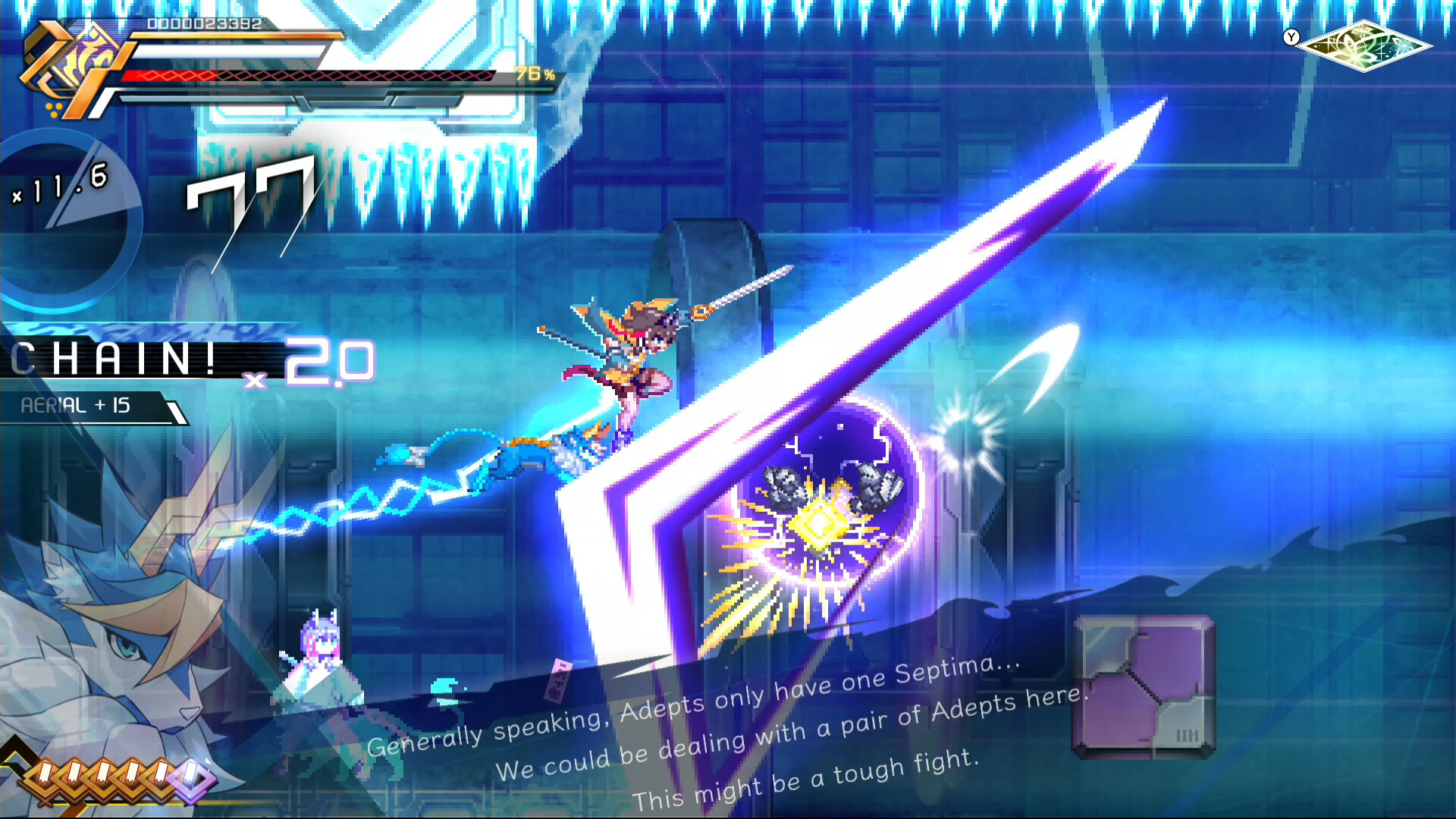
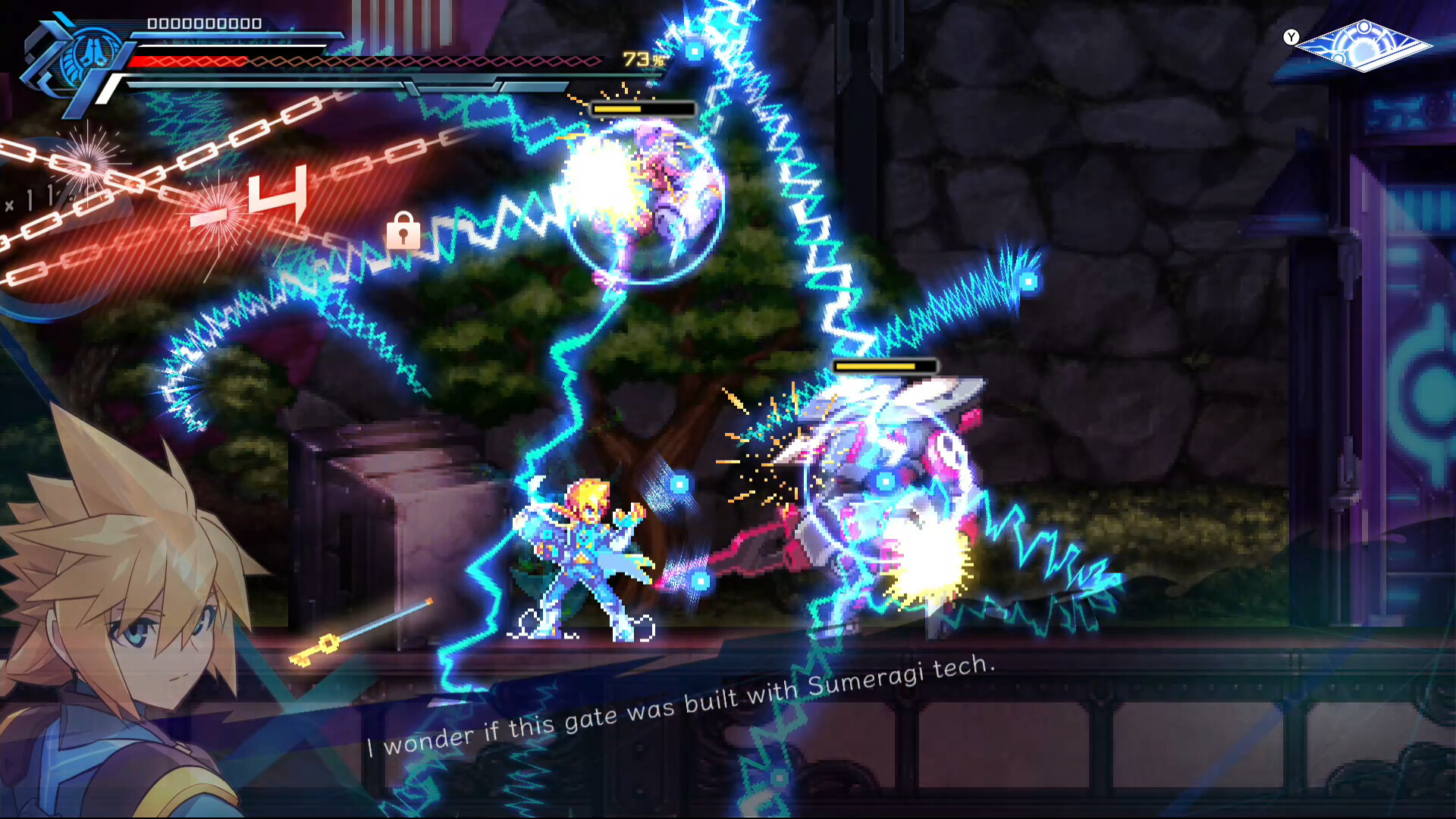
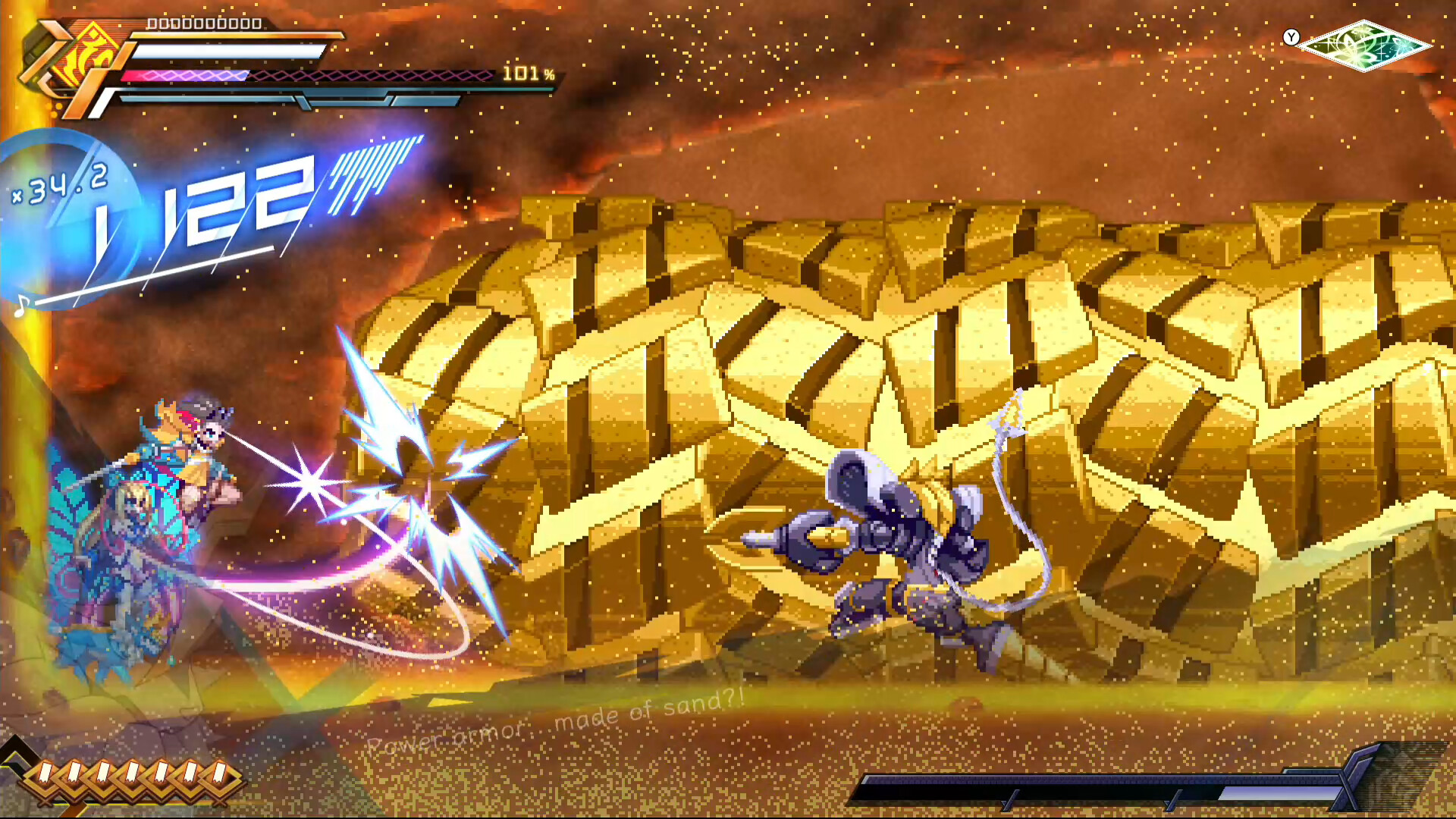
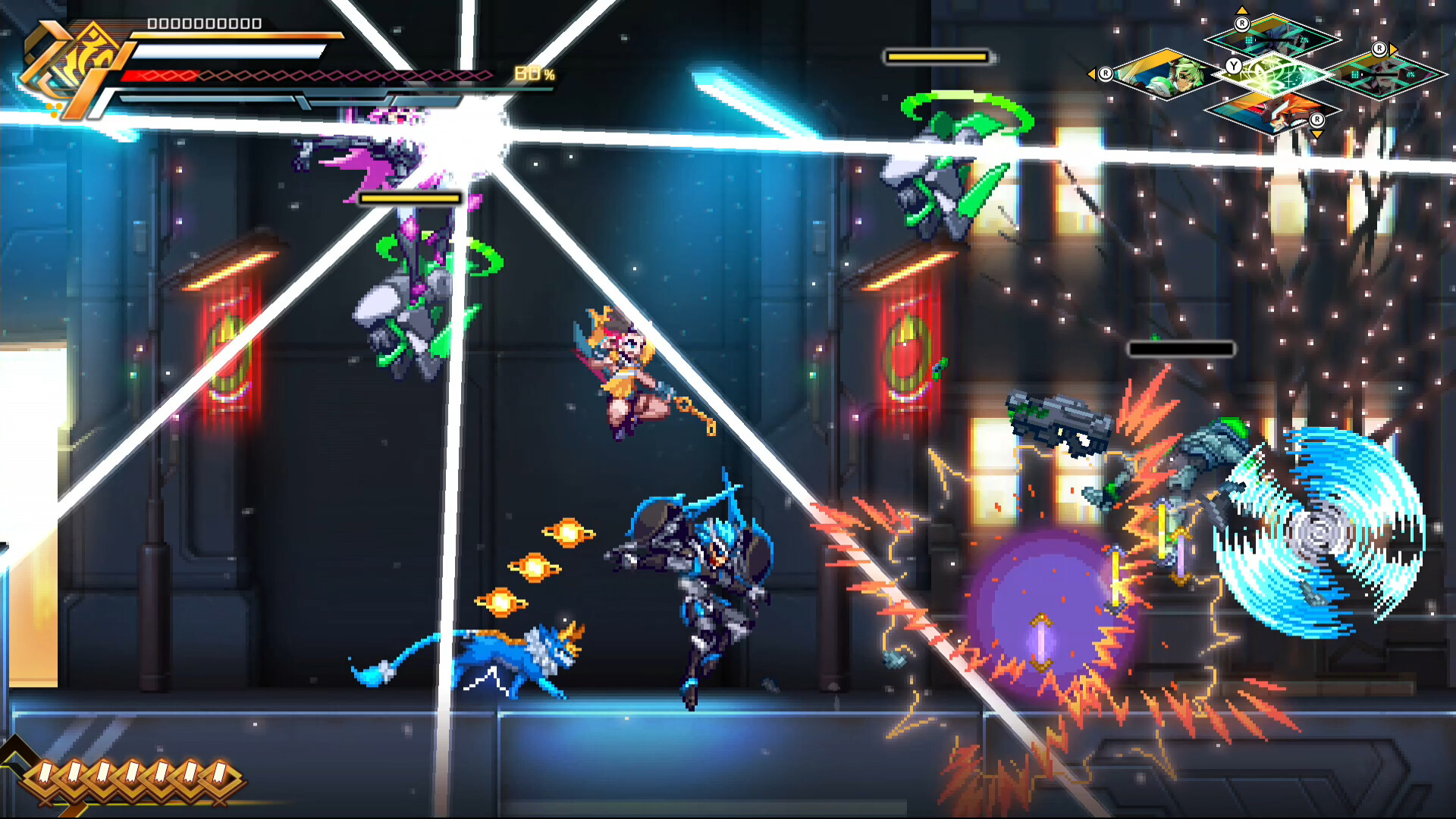
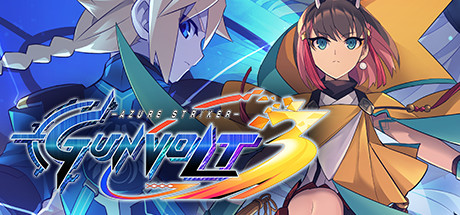
Azure Gunvolt 3 is the best of all three mainline Gunvolt games, hands down. While Gunvolt 2 was more of Gunvolt 1 with some polish, Gunvolt 3 is radically different. It offers a different playstyle on top of the usual Gunvolt Mega Man-esque formula. It is much faster, more akin to a Sonic game, and it inherits problems from that too. The music and visuals are also on par with other Gunvolt games. The story is practically non-existent, but thankfully, it does not need to be. There is no reason not to pick this up, even if you have not played prior Gunvolt games. You will not get some of the very few “grander” plot points, but that is entirely unimportant. If you like fast-paced, combat-oriented platformers, get it and do not think twice! Story It exists. It goes full-on anime, even more so than Gunvolt 2 did. Gunvolt has turned into a dragon, gets kissed by the protagonist, then turns into a dog (never explained). Then the story is you working to destroy X amount of dragons in the usual Mega Man style. You get a whole Scooby gang this time, versus prior games where you usually had one or two companions in the “side conversations” at base. They are all tropes dialed straight past 11. Side conversations were okay, some mildly funny, though they lacked the charm prior games did. This was most likely the case because the characters essentially have zero chemistry or relationships with one another. Kirin, the protagonist, also has the personality of a wet sock. Think “nice new office girl who works for HR” sort of person, with no personality outside a bit of sass here and there. The story introduces a new faction, another country of adepts. While this premise is quite interesting, it is not explored at all. They are just tossed into the story and cause carnage simply to be extra bosses for you to fight. Their motivations make zero sense. They are not antagonistic either. It is one of those “we are the bad, but good guys” sort of situations, where the conflict resolves itself if they just sit down and talk. In addition, you are working for Sumeragi now, the organisation that was touted as evil in both prior games. To which now Gunvolt has zero issue working for, and he just accepts?! Gunvolt’s character does seem off here, though to be fair, I was too deep into the story of prior games to take special note of it. Funnily enough, Sumeragi in the story is still “hiding god” in their basement, even while you work for them trying to “change it for the good from the inside”. The story concludes with you finding god in the basement, killing it, then Gunvolt being sacrificed. Ending as if basically nothing ever happened in the story, honestly. So the story really is not worth your time even paying attention to. It is all set dressing and an excuse for the game to exist. Gameplay In Gunvolt 2, the introduction of Copen gameplay was more fast-paced than Gunvolt’s. In Gunvolt 3, they have taken that to the next level. You can play as neither Gunvolt nor Copen, but as Kirin. Her gameplay follows a similar core mechanic of tagging enemies. Tagged enemies take increased damage from your next melee sword strike, or you can instantly attack them, teleporting behind or in front of them. You can tag many enemies and you will attack all of them. This teleportation is the key mechanic which makes the entire system so fast-paced. You are heavily rewarded for not landing on the ground, racking up “combos”, so talisman-hopping from enemy to enemy. After the teleportation, you float briefly and gain a jump, so there is some room to judge and line up your next hop. You gain other moves gradually throughout the game too, but they are never anything that deviates from this being the main formula. You get an upward strike, downward strike, charged shot, etc. They do add an extra layer of depth. The whole flow is immensely satisfying for several reasons. Visual and sound effects are punchy, the fact that you zoom across the map, the way that as Kudos racks up the songs start playing. It all contributes to a feeling of YOU JUST HAVE TO KEEP GOING FAST. These positives are double-edged swords, however. Visual clarity has always been an issue in these games, and that is no exception here. “What hit me?” is even more of a problem here because if you tag five enemies and go all zoomies and kill them all, it feels GREAT, but it is very easy to get lost on where Kirin ACTUALLY is or where she will end up. This happens for a minority of cases, but it is quite prevalent in some boss battles where there are hazards. Enemies are also designed around this teleportation. They will deploy projectiles in front of them, so you will teleport ON the projectile and take damage. This is a layer of depth you can learn around, as holding a certain direction makes Kirin appear either behind or in front of an enemy, so you have control over this. Though if you do not know where she is going to appear, you are out of luck. Beyond the teleportation being sometimes hard to predict, it is unclear for some bosses where the hitboxes are for their attacks. While the animations look nice, I frequently found issues where learning to dodge an attack was annoying, since I thought I was safe but got hit anyway. Where boss battles are more like puzzles than tests of reaction speed, it is quite annoying. Kudos are no longer completely lost in one to three hits. This is amazing because now you can actually listen to the Kudos songs. The trade-off is you get a negative Kudos penalty when you get hit, which you must recover from to build additional Kudos on top of what you already have. I really like this system. It fixes a core issue both Gunvolt games had. The problem is it is TOO easy to get 1000 Kudos now, so much so that you do not really get to listen to the stage’s music anymore. The OST just becomes the Lumen songs. While this is not so bad, it does overshadow a large part of the soundtrack. They do kind of try to address this by having level 2 Kudos songs, which you get at 4000, which is a fair bit harder to achieve. Perhaps 2000 would have been a nicer middle ground. Accessories have been shafted for “Image Pulses”. Essentially, these are sprites of past characters which give you abilities. There are active and passive ones. I never used much of the active ones, but they all seem to be unique attacks or health recovery. Passive ones can be impactful, from an extra 60 percent jump height, reduced Kudos penalty on hit, lower health plus more Kudos gain, etc. You can equip A LOT of these, at least five from memory, probably more like eight. It is a dramatically better system than the “crafting” they had in previous games. It is somewhat gacha-like, in that you must collect collectibles in the stages to get random drops. Certain Image Pulses are only dropped on certain stages, which encourages you to replay them. It is a little at odds with the “GOTTA GO FAST” mentality it drills into you with mechanics, as exploring is not something the game encourages. The ranking system in this game feels weird yet again. The highest rank is S++. Sometimes I was rushing through a level and got an S+ on accident when grinding Image Pulses. Times I tried to actively score higher, avoid getting hit, etc., I constantly get an A??? After learning Image Pulses can make getting Kudos dramatically easier, it feels like attempting to get a high score without them is a fool’s errand. It is quite disappointing. Conclusion Gunvolt 3 really stands out as an amazing action platformer coming from the first two games. A good chunk of content, bosses that allow high skill expression, a reworked Kudos system, a lot of character customisation through Image Pulses, on top of the great pixel art, voice acting, and music that comes with every one of these games. If you could only play one Gunvolt game, this is the game you should play!
Expand the review