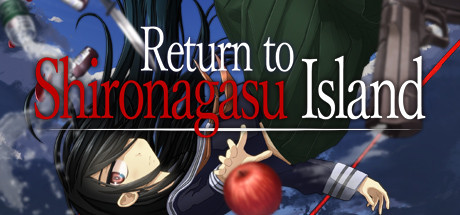
01. Intro I'm positive...ly disappointed. I like Shironagasu Island, but I'd have liked it much more, had it been better. I discovered this via artworks of Neneko, and respected the creator of RtSI from there. Having played the game, I respect him more, but even so, I am disappointed. There is a good story here, and it is told okay, but it's far from ideal. There's things that could've been cut out, one-dimensionalities that could've been ironed out. Crucially, the fit between characters & world, and with promotional material, could've been better. SPOILER-FREE 02. Audiovisuals Cover artwork is beautiful, with both the falling & the objects symbolizing progression and characters, though Neneko at the center is misleading. Character art is good, but the cutscenes vary from good to serviceable to flawed. At one point, Neneko's eyes appear as if painted on a flat surface; at another point, in a bathroom, a character's legs seem bendy and rubbery. Voice-acting is present, which is impressive relative to other visual novels. Music ranges from excellent to serviceable. 03. Input Advancing text can be done with four commonly-used keys, which is more than I can say for many visual novels, but all other functions are finnicky or unresponsive. There is no in-game list of inputs, so I wrote a [url=https://steamcommunity.com/sharedfiles/filedetails/?id=3585739586]guide . 04. GUI GUI is standard, and you can hide the dialog box, which is nice, but two bugs are annoying: - overwriting a save then viewing Steam's overlay causes a crash - a hidden dialog box stops Steam's overlay from showing 05. Big Two The story is disappointing for two big reasons — it: 1. sidelines own protagonists 2. errs while delivering a detective fantasy there are supporting reasons for both. I'll soon elaborate. 06. Characters Your character wakes up at an all-girls' school classroom, and in the window, we get to see they are actually detective Ikeda Sen, picking up Neneko at an airport. That's right, contrary to what the cover implies, you play as John Genericus. It's awfully close to plainly fraudulent marketing. Ikeda is a bland & ultracompetent stoic who is either mocking someone or interrogating them. Neneko is meant to be a co-protagonist, but there's very little of her, who is offscreen waiting, staying safe, or being harshly mocked by yours truly, Ikeda. Not only is Neneko underutilized, she's misutilized — relegated to a savant "Rain Woman"; a tropey, walking encyclopedia of factoids who speaks in non-conversational language, and a speaker of "your interaction here was pointless" lines. Except for one bad ending, she never truly demonstrates virtues relating to her willed action, instead of her in-born curse of memory. It is not cool. She could've been herself and cool at the same time. Moreover, her relevance in the story is circumstantial. Literally, she is in the story because she circumstantially appears, without any plausible explanation, method or motive, at the place Ikeda tells her not to be, then sticks around. I can't overstate how disappointing all this is. The story would've been better with more of Neneko, or without her entirely, and instead, with more of the doctoress character. Who, by the way, was a highly promising but underdeveloped character. Of the three underdeveloped characters, a major villain among them, hers is the most lamentable. 07. Dialogue Neneko says "pissing" and "ueh" too many times. The latter is never voiced convincingly, is never cute, but most of all, it happens too much from things that wouldn't plausibly cause this response, even from a scaredy-cat such as her. 08. Main Story We know Neneko is not the protagonist, and that Ikeda is instead. Except they're both sidelined in their own story. Little quality-time is spent on the duo's motives, worries; they don't retreat mentally to find themselves amidst all the horror. Most of the story is, in fact, the past of other characters, the past of the island. It's to the frank point where... neither of them should've been the protagonist, but one of three, perhaps four, characters, with minor modification, should have. Key points in the story rely on leapsome inferences that no detective would make, failing to convey Ikeda as a detective, and to immerse the player in that role. He's a detective as a way to interface player with world, but he could simply be telling someone else's story, it isn't at all required that he be embedded into everything as the nominal protagonist. The protagonist of the real-life history of the Munster Rebellion was not the witness, but those he observed. The story has other contrivances: Ikeda's bizarre being quick-to-trust one character; Ikeda's self as the solution to a specific animal problem; Neneko's finding of a special manual; A major event where Special Character is seen, uses a decoy, is still suspected, then is somehow considered dead despite being seen. 09. Extra Story An "Extra Scenario" is available. It's divided into two parts: the good part; and the jarring, inconsequent dogshit part. The good part is, well, good; it's happy, tense, and awkward. There is more Neneko, and this 'more" is good, but she still gets the least focus, out of all the other characters. There is also more of one specific character. This more is excellent, and left me wanting even more. Sadly, no more came, because the second part arrived. It's a sequence of events blending text with metatext, in jarringly contrived, undeserved, disvaluable ways. It isn't even canonical and feels pointless. You can get a bad end in the present from a decision made within a fucking flashback sequence. As soon as all that's over, the very brief final section begins, ending just as it starts. Neneko and Specific Character are great, and the character artworks were improved from the main story, but it's not enough to counteract the rest. I wanted it to be full-on slice-of-life respite from horror, but instead, that was tacked on, feeling like filler. Disappointing. 10. Closing My most liked chapters were 1, 2 (late), 3 and 5. Besides that Neneko matters so little, I disliked the sections where you are TOLD and FORCED to "Look around". There never is anything meaningful in these sections. It's always "Nothing", "Just a normal thing", "Yeah, that sure is a pointless thing to interact with, why did you do it, retarded player". I did it because I was fucking forced to. You know you've hit gold when the character goes from saying "That's unimportant and boring and dogshit" to "Wow, I just noticed something new here!" Even though it's the same dogshit. The noticing isn't because of a recently acquired new information, it's just because you exhausted the nothings. I'm not sure the people who translated this actually played it, or proofread it. Some of the translation is plain wrong, like a woman's noticing of Ikeda being translated as "Good Afternoon". In the "Main Scenario", a character was said to have broken TWO legs, but later we see it's a SINGULAR leg. In the "Extra Scenario", someone says "I'm not made of Pasta", clearly Pasta, and the translated text says "play dough". It's not major, but distracting. But what I most dislike about Shironagasu Island is the illusion of choice and non-inferential, trial-error decisionmaking. Once, if between ABC you choose C, the characters reject and act as if you chose A, but if you choose A, everything happens as if you chose C, except Sir Protagonoid has an "epiphany". That's the major failure in this detective fantasy. Bad choices leads into Bad Ends, which are rushed and distort the story's sense of time, and don't feel coherent even as bad ends. Were it not for the word count, I would go on. It was disappointing.
Expand the review